


Myth vs. Fact: “Hosting in a UAE Cloud Region Automatically Satisfies Data Sovereignty”
With massive data center infrastructure investments expanding across Abu Dhabi and Dubai, tech teams across the Emirates are rapidly migrating enterprise workloads locally.
However, engineering leads and cloud architects regularly conflate two fundamentally different concepts: Data Residency (physical bytes at rest) vs. Data Sovereignty (legal jurisdiction, telemetry, and access boundaries).
Here is what UAE regulatory frameworks actually require:
❌ The Myth:
“We deployed our databases, LLM inference endpoints, and microservices in a UAE cloud region (AWS UAE / Azure UAE / Core42), so our data is sovereign and compliant with UAE PDPL, DIFC, and ADGM requirements.”
✅ The Reality:
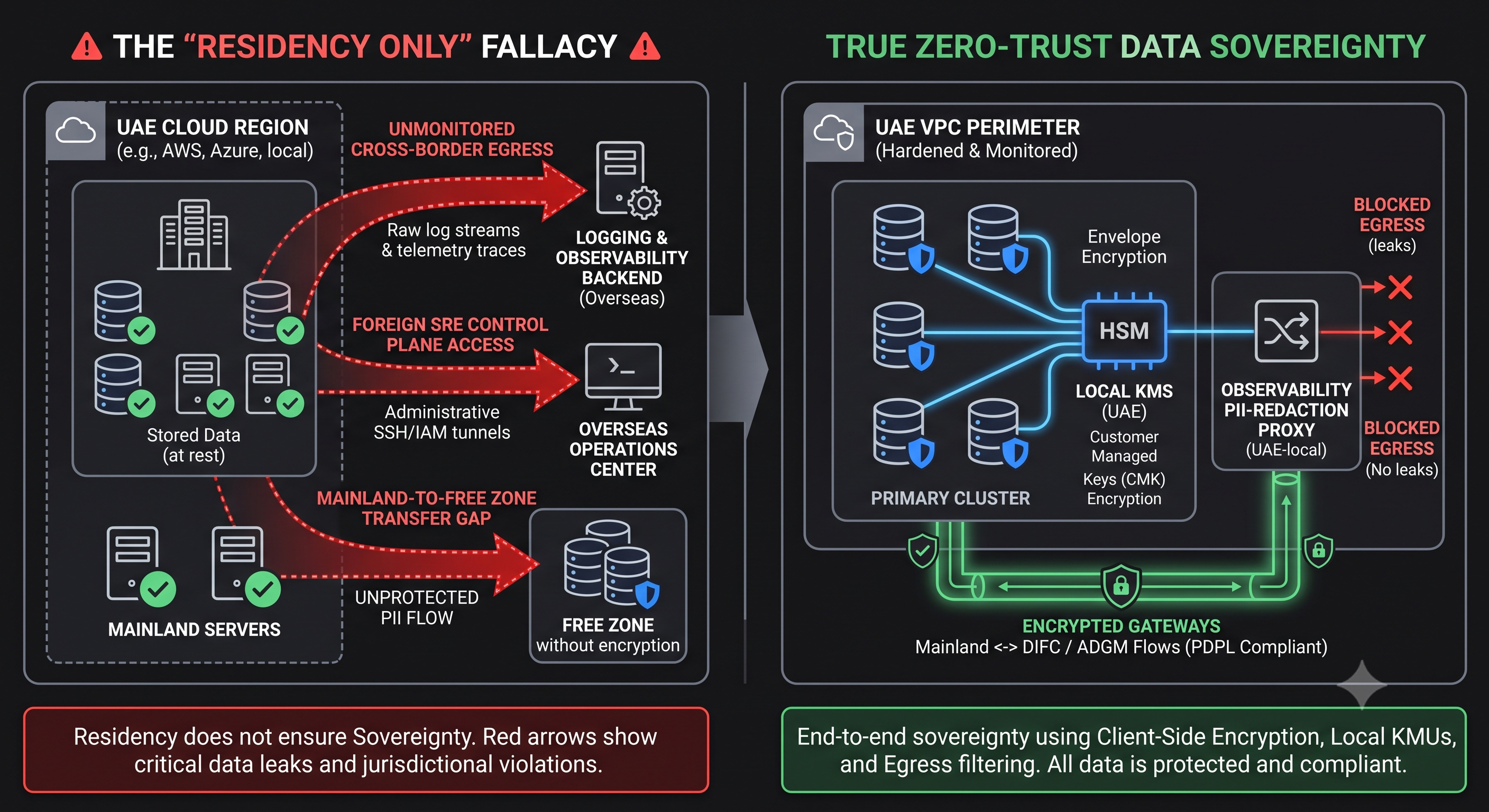
Physical data location is just the first tier. Under UAE Federal Decree-Law No. 45 of 2021 (PDPL), DIFC Law No. 5 of 2020 (plus Regulation 10 on AI systems), and ADGM Data Protection Regulations, a workload hosted in the UAE can still trigger cross-border compliance violations through several common architectural blind spots:
The Telemetry & Observability Leak
Your database might sit in Dubai, but where do your application performance logs, APM agent metrics (e.g., Datadog, Dynatrace), and Sentry exception stack traces get routed? If unredacted customer PII or raw user prompts leak into observability collectors outside the country without an approved adequacy mechanism or standard contractual clauses, you have triggered a cross-border transfer.
Cross-Jurisdictional Inter-UAE Transfers (Mainland vs. Free Zones)
Many engineering teams do not realize that the UAE is a multi-jurisdictional landscape. Moving personal data between a mainland UAE entity and a DIFC or ADGM financial entity is legally an independent cross-border data transfer between distinct legal regimes, each enforcing its own adequacy determinations and transfer safeguards.
Global Control Planes & Support Access
If a cloud provider’s remote global site reliability engineer (SRE) can access production payloads via IAM break-glass procedures from an overseas operations center, that access is legally treated as an extraterritorial export. Data residency without Customer Managed Keys (CMK) and Client-Side Field-Level Encryption (CSFLE) fails zero-trust data sovereignty standards.
Autonomous AI & Algorithmic Processing
If you are deploying LLMs or automated decision-making engines (particularly under DIFC's Regulation 10), data processing requires explicit algorithmic auditability, bias mitigation, and purpose limitation—hosting the weights on local compute does not bypass these governance requirements.
The Architectural Fix for UAE Tech Teams:
Implement strict egress-filtering policies (VPC endpoints) to prevent third-party SaaS SDKs from sending logs to foreign clusters.
Enforce envelope encryption using HSMs located within the UAE, ensuring your organization exclusively holds the root keys.
Map data flows between Mainland, DIFC, and ADGM nodes as distinct jurisdictional boundaries with explicit lawful transfer bases.
Discussion Question
When conducting cloud architectural reviews, how is your engineering team isolating third-party observability telemetry to prevent unintended cross-border data egress?
CTA (Join Techawks UAE)
Build robust, compliant enterprise architectures designed for the Middle East’s leading digital economy. Join Techawks UAE to connect with technical architects, engineering leads, and CTOs scaling production-grade infrastructure across Dubai, Abu Dhabi, and the wider region.
With massive data center infrastructure investments expanding across Abu Dhabi and Dubai, tech teams across the Emirates are rapidly migrating enterprise workloads locally.
However, engineering leads and cloud architects regularly conflate two fundamentally different concepts: Data Residency (physical bytes at rest) vs. Data Sovereignty (legal jurisdiction, telemetry, and access boundaries).
Here is what UAE regulatory frameworks actually require:
❌ The Myth:
“We deployed our databases, LLM inference endpoints, and microservices in a UAE cloud region (AWS UAE / Azure UAE / Core42), so our data is sovereign and compliant with UAE PDPL, DIFC, and ADGM requirements.”
✅ The Reality:
Physical data location is just the first tier. Under UAE Federal Decree-Law No. 45 of 2021 (PDPL), DIFC Law No. 5 of 2020 (plus Regulation 10 on AI systems), and ADGM Data Protection Regulations, a workload hosted in the UAE can still trigger cross-border compliance violations through several common architectural blind spots:
The Telemetry & Observability Leak
Your database might sit in Dubai, but where do your application performance logs, APM agent metrics (e.g., Datadog, Dynatrace), and Sentry exception stack traces get routed? If unredacted customer PII or raw user prompts leak into observability collectors outside the country without an approved adequacy mechanism or standard contractual clauses, you have triggered a cross-border transfer.
Cross-Jurisdictional Inter-UAE Transfers (Mainland vs. Free Zones)
Many engineering teams do not realize that the UAE is a multi-jurisdictional landscape. Moving personal data between a mainland UAE entity and a DIFC or ADGM financial entity is legally an independent cross-border data transfer between distinct legal regimes, each enforcing its own adequacy determinations and transfer safeguards.
Global Control Planes & Support Access
If a cloud provider’s remote global site reliability engineer (SRE) can access production payloads via IAM break-glass procedures from an overseas operations center, that access is legally treated as an extraterritorial export. Data residency without Customer Managed Keys (CMK) and Client-Side Field-Level Encryption (CSFLE) fails zero-trust data sovereignty standards.
Autonomous AI & Algorithmic Processing
If you are deploying LLMs or automated decision-making engines (particularly under DIFC's Regulation 10), data processing requires explicit algorithmic auditability, bias mitigation, and purpose limitation—hosting the weights on local compute does not bypass these governance requirements.
The Architectural Fix for UAE Tech Teams:
Implement strict egress-filtering policies (VPC endpoints) to prevent third-party SaaS SDKs from sending logs to foreign clusters.
Enforce envelope encryption using HSMs located within the UAE, ensuring your organization exclusively holds the root keys.
Map data flows between Mainland, DIFC, and ADGM nodes as distinct jurisdictional boundaries with explicit lawful transfer bases.
Discussion Question
When conducting cloud architectural reviews, how is your engineering team isolating third-party observability telemetry to prevent unintended cross-border data egress?
CTA (Join Techawks UAE)
Build robust, compliant enterprise architectures designed for the Middle East’s leading digital economy. Join Techawks UAE to connect with technical architects, engineering leads, and CTOs scaling production-grade infrastructure across Dubai, Abu Dhabi, and the wider region.
Myth vs. Fact: “Hosting in a UAE Cloud Region Automatically Satisfies Data Sovereignty”
With massive data center infrastructure investments expanding across Abu Dhabi and Dubai, tech teams across the Emirates are rapidly migrating enterprise workloads locally.
However, engineering leads and cloud architects regularly conflate two fundamentally different concepts: Data Residency (physical bytes at rest) vs. Data Sovereignty (legal jurisdiction, telemetry, and access boundaries).
Here is what UAE regulatory frameworks actually require:
❌ The Myth:
“We deployed our databases, LLM inference endpoints, and microservices in a UAE cloud region (AWS UAE / Azure UAE / Core42), so our data is sovereign and compliant with UAE PDPL, DIFC, and ADGM requirements.”
✅ The Reality:
Physical data location is just the first tier. Under UAE Federal Decree-Law No. 45 of 2021 (PDPL), DIFC Law No. 5 of 2020 (plus Regulation 10 on AI systems), and ADGM Data Protection Regulations, a workload hosted in the UAE can still trigger cross-border compliance violations through several common architectural blind spots:
The Telemetry & Observability Leak
Your database might sit in Dubai, but where do your application performance logs, APM agent metrics (e.g., Datadog, Dynatrace), and Sentry exception stack traces get routed? If unredacted customer PII or raw user prompts leak into observability collectors outside the country without an approved adequacy mechanism or standard contractual clauses, you have triggered a cross-border transfer.
Cross-Jurisdictional Inter-UAE Transfers (Mainland vs. Free Zones)
Many engineering teams do not realize that the UAE is a multi-jurisdictional landscape. Moving personal data between a mainland UAE entity and a DIFC or ADGM financial entity is legally an independent cross-border data transfer between distinct legal regimes, each enforcing its own adequacy determinations and transfer safeguards.
Global Control Planes & Support Access
If a cloud provider’s remote global site reliability engineer (SRE) can access production payloads via IAM break-glass procedures from an overseas operations center, that access is legally treated as an extraterritorial export. Data residency without Customer Managed Keys (CMK) and Client-Side Field-Level Encryption (CSFLE) fails zero-trust data sovereignty standards.
Autonomous AI & Algorithmic Processing
If you are deploying LLMs or automated decision-making engines (particularly under DIFC's Regulation 10), data processing requires explicit algorithmic auditability, bias mitigation, and purpose limitation—hosting the weights on local compute does not bypass these governance requirements.
The Architectural Fix for UAE Tech Teams:
Implement strict egress-filtering policies (VPC endpoints) to prevent third-party SaaS SDKs from sending logs to foreign clusters.
Enforce envelope encryption using HSMs located within the UAE, ensuring your organization exclusively holds the root keys.
Map data flows between Mainland, DIFC, and ADGM nodes as distinct jurisdictional boundaries with explicit lawful transfer bases.
Discussion Question
When conducting cloud architectural reviews, how is your engineering team isolating third-party observability telemetry to prevent unintended cross-border data egress?
CTA (Join Techawks UAE)
Build robust, compliant enterprise architectures designed for the Middle East’s leading digital economy. Join Techawks UAE to connect with technical architects, engineering leads, and CTOs scaling production-grade infrastructure across Dubai, Abu Dhabi, and the wider region.

 English
 Arabic
 French
 Spanish
 Portuguese
 Deutsch
 Turkish
 Dutch
Dutch
 Russian
 Romaian
 Portuguese (Brazil)
 Greek
Greek