


Myth vs. Fact: “Because Federal AI Legislation Stalled, Canadian AI Products Don’t Require Automated Decision Guardrails”
A common architectural fallacy inside Canadian tech hubs—from the Waterloo-Toronto corridor to Vancouver and Montreal—is that Canada remains a relaxed regulatory sandbox for automated systems while federal bills get debated.
Engineering leads keep confusing legislative delay on Parliament Hill with an absence of binding law.
Here is the production reality:
❌ The Myth:
“Since Bill C-27 and AIDA died on the order paper and federal privacy overhauls are still making their way through committee, we don't need automated decision-making (ADM) transparency or explainability hooks in production.”
✅ The Reality:
Canada already has an active, GDPR-grade enforcement regime with statutory teeth: Quebec’s Law 25. It has no minimum size threshold, applies extraterritorially across Canada if you process data from a single Quebec resident, and enforces strict algorithmic transparency.
If your microservices or predictive ML models make decisions that directly impact users (e.g., credit approvals, hiring screening, dynamic pricing, or risk tiering), relying on black-box inference triggers clear operational failures:
Mandatory Point-of-Decision Notice
Under Law 25, you cannot bury AI usage in a generic privacy policy. The moment an automated process makes a decision without human intervention, the system must explicitly inform the user no later than when the decision is communicated.
The "Right to Factor Explainability" Endpoint
Individuals have a statutory right to request:
The specific personal data points consumed by the model.
The primary parameters, weights, and factors that generated the decision.
A direct mechanism to rectify incorrect source data.
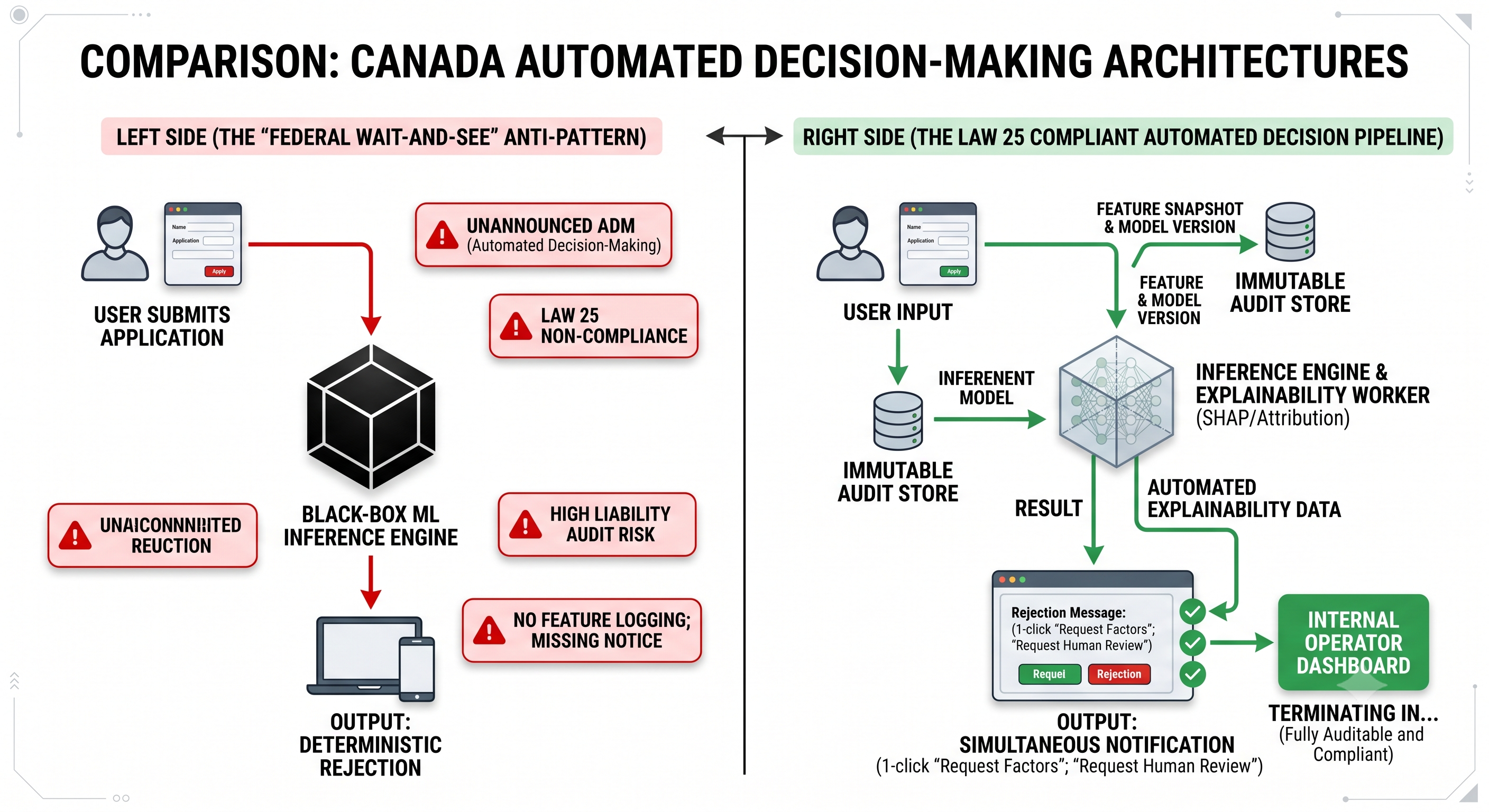
If your architecture treats inference as a one-way POST request without persisting the deterministic feature vector and SHAP/attribution weights, fulfilling this audit request within statutory timelines is nearly impossible.
Statutory Human-in-the-Loop Remediation
Compliance requires giving users the ability to submit observations and request a manual review by an authorized team member who can overturn the decision. With Commission d'accès à l'information (CAI) penalities scaling up to $25 million CAD or 4% of worldwide turnover, along with a statutory private right of action, algorithmic unaccountability carries immediate financial risk.
The Production Blueprint for Canadian Tech:
Decouple your feature extraction pipeline and log the exact input snapshot into an auditable telemetry store alongside the model version.
Build an asynchronous explainability worker that computes feature importance at inference time, ready to serve transparent plain-text rationales.
Provide an automated escalation queue routing contested decisions directly to internal human operators.
Discussion Question
How is your team handling automated decision logging: Are you instrumenting feature importance and explainability traces directly into your inference pipelines, or relying on ad-hoc post-mortems?
CTA (Join Techawks Canada)
Build robust, legally sound engineering systems that scale across provincial and international borders. Join Techawks Canada to connect with technical architects, software engineers, and engineering leaders building production-grade software across Canada.
A common architectural fallacy inside Canadian tech hubs—from the Waterloo-Toronto corridor to Vancouver and Montreal—is that Canada remains a relaxed regulatory sandbox for automated systems while federal bills get debated.
Engineering leads keep confusing legislative delay on Parliament Hill with an absence of binding law.
Here is the production reality:
❌ The Myth:
“Since Bill C-27 and AIDA died on the order paper and federal privacy overhauls are still making their way through committee, we don't need automated decision-making (ADM) transparency or explainability hooks in production.”
✅ The Reality:
Canada already has an active, GDPR-grade enforcement regime with statutory teeth: Quebec’s Law 25. It has no minimum size threshold, applies extraterritorially across Canada if you process data from a single Quebec resident, and enforces strict algorithmic transparency.
If your microservices or predictive ML models make decisions that directly impact users (e.g., credit approvals, hiring screening, dynamic pricing, or risk tiering), relying on black-box inference triggers clear operational failures:
Mandatory Point-of-Decision Notice
Under Law 25, you cannot bury AI usage in a generic privacy policy. The moment an automated process makes a decision without human intervention, the system must explicitly inform the user no later than when the decision is communicated.
The "Right to Factor Explainability" Endpoint
Individuals have a statutory right to request:
The specific personal data points consumed by the model.
The primary parameters, weights, and factors that generated the decision.
A direct mechanism to rectify incorrect source data.
If your architecture treats inference as a one-way POST request without persisting the deterministic feature vector and SHAP/attribution weights, fulfilling this audit request within statutory timelines is nearly impossible.
Statutory Human-in-the-Loop Remediation
Compliance requires giving users the ability to submit observations and request a manual review by an authorized team member who can overturn the decision. With Commission d'accès à l'information (CAI) penalities scaling up to $25 million CAD or 4% of worldwide turnover, along with a statutory private right of action, algorithmic unaccountability carries immediate financial risk.
The Production Blueprint for Canadian Tech:
Decouple your feature extraction pipeline and log the exact input snapshot into an auditable telemetry store alongside the model version.
Build an asynchronous explainability worker that computes feature importance at inference time, ready to serve transparent plain-text rationales.
Provide an automated escalation queue routing contested decisions directly to internal human operators.
Discussion Question
How is your team handling automated decision logging: Are you instrumenting feature importance and explainability traces directly into your inference pipelines, or relying on ad-hoc post-mortems?
CTA (Join Techawks Canada)
Build robust, legally sound engineering systems that scale across provincial and international borders. Join Techawks Canada to connect with technical architects, software engineers, and engineering leaders building production-grade software across Canada.
Myth vs. Fact: “Because Federal AI Legislation Stalled, Canadian AI Products Don’t Require Automated Decision Guardrails”
A common architectural fallacy inside Canadian tech hubs—from the Waterloo-Toronto corridor to Vancouver and Montreal—is that Canada remains a relaxed regulatory sandbox for automated systems while federal bills get debated.
Engineering leads keep confusing legislative delay on Parliament Hill with an absence of binding law.
Here is the production reality:
❌ The Myth:
“Since Bill C-27 and AIDA died on the order paper and federal privacy overhauls are still making their way through committee, we don't need automated decision-making (ADM) transparency or explainability hooks in production.”
✅ The Reality:
Canada already has an active, GDPR-grade enforcement regime with statutory teeth: Quebec’s Law 25. It has no minimum size threshold, applies extraterritorially across Canada if you process data from a single Quebec resident, and enforces strict algorithmic transparency.
If your microservices or predictive ML models make decisions that directly impact users (e.g., credit approvals, hiring screening, dynamic pricing, or risk tiering), relying on black-box inference triggers clear operational failures:
Mandatory Point-of-Decision Notice
Under Law 25, you cannot bury AI usage in a generic privacy policy. The moment an automated process makes a decision without human intervention, the system must explicitly inform the user no later than when the decision is communicated.
The "Right to Factor Explainability" Endpoint
Individuals have a statutory right to request:
The specific personal data points consumed by the model.
The primary parameters, weights, and factors that generated the decision.
A direct mechanism to rectify incorrect source data.
If your architecture treats inference as a one-way POST request without persisting the deterministic feature vector and SHAP/attribution weights, fulfilling this audit request within statutory timelines is nearly impossible.
Statutory Human-in-the-Loop Remediation
Compliance requires giving users the ability to submit observations and request a manual review by an authorized team member who can overturn the decision. With Commission d'accès à l'information (CAI) penalities scaling up to $25 million CAD or 4% of worldwide turnover, along with a statutory private right of action, algorithmic unaccountability carries immediate financial risk.
The Production Blueprint for Canadian Tech:
Decouple your feature extraction pipeline and log the exact input snapshot into an auditable telemetry store alongside the model version.
Build an asynchronous explainability worker that computes feature importance at inference time, ready to serve transparent plain-text rationales.
Provide an automated escalation queue routing contested decisions directly to internal human operators.
Discussion Question
How is your team handling automated decision logging: Are you instrumenting feature importance and explainability traces directly into your inference pipelines, or relying on ad-hoc post-mortems?
CTA (Join Techawks Canada)
Build robust, legally sound engineering systems that scale across provincial and international borders. Join Techawks Canada to connect with technical architects, software engineers, and engineering leaders building production-grade software across Canada.

 English
 Arabic
 French
 Spanish
 Portuguese
 Deutsch
 Turkish
 Dutch
Dutch
 Italiano
 Russian
 Portuguese (Brazil)
 Greek
Greek