


Myth vs Fact: Is Platform Engineering Just Kubernetes with a Nicer Developer Portal?
The shift from traditional DevOps to Platform Engineering is often derailed by treating internal platforms as a software bundle rather than an internal product:
❌ Myth 1: "Installing Backstage or an IDP tool immediately solves developer cognitive load."
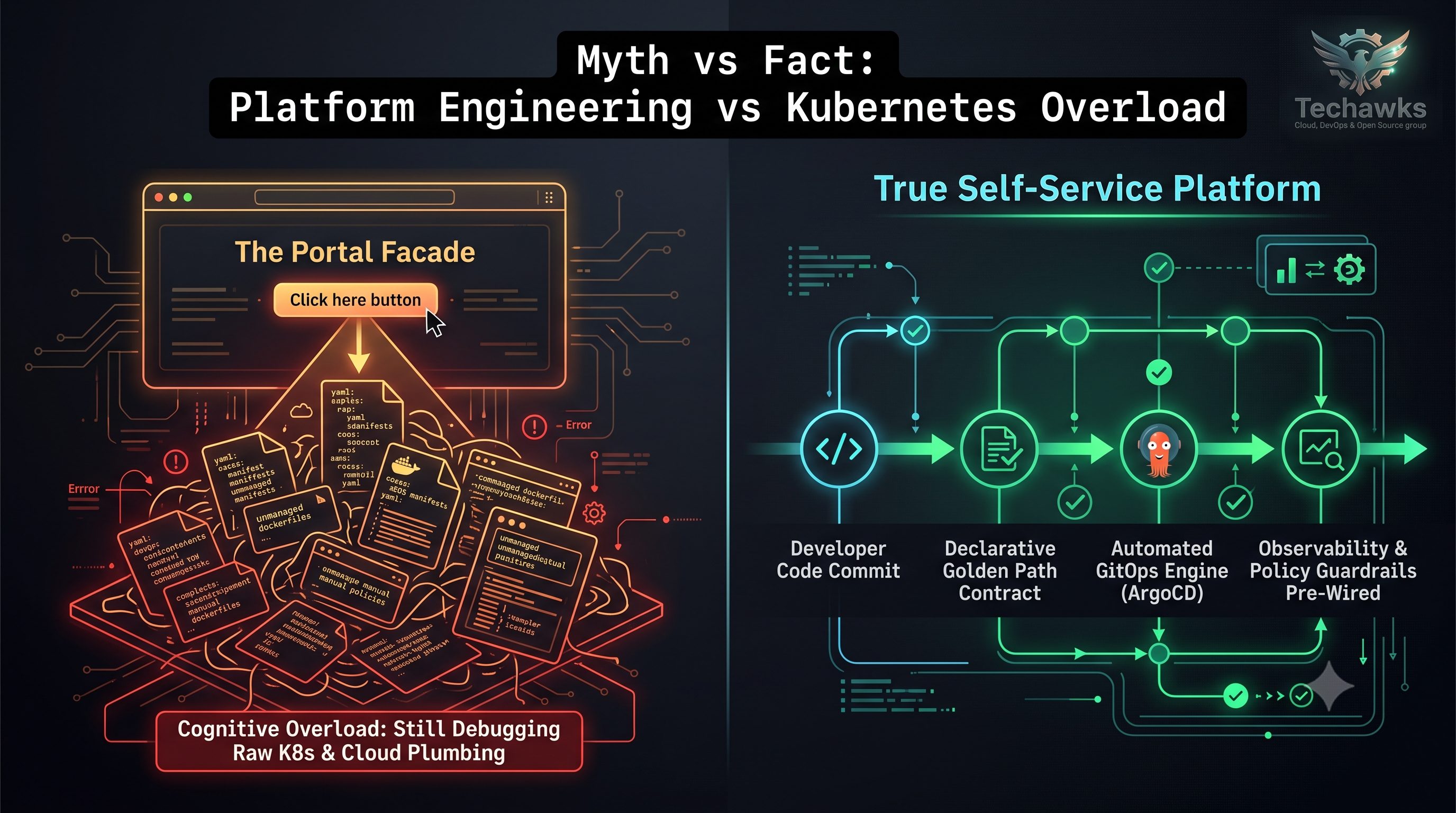
The Reality: A portal is just a UI layer; it is not the platform. If clicking "Create New Service" in a developer portal simply generates an uncurated Git repository dumping Helm templates, raw Terraform/OpenTofu files, and complex Ingress controllers into a developer's lap, you haven't eliminated cognitive load—you've merely automated boilerplate delivery. Real platform engineering builds Golden Paths: opinionated, end-to-end paved roads where security defaults, zero-trust RBAC, telemetry probes, and CI/CD pipelines are pre-wired by contract, not configured manually.
❌ Myth 2: "Platform engineering replaces DevOps."
The Reality: Platform engineering doesn't kill DevOps; it operationalizes DevOps principles at scale. In early-stage or small teams, having developers directly manage cloud infrastructure works fine. But as organizations scale beyond 50+ engineers, forcing every product developer to master VPC subnetting, Kubernetes cluster scheduling, and container networking creates catastrophic context switching. Platform engineers operate as an internal SaaS product team—treating application developers as their customers and delivering infrastructure via declarative APIs.
❌ Myth 3: "Every software team needs a dedicated Internal Developer Platform."
The Reality: Over-engineering an IDP for a small team with 5 services is pure architectural vanity. When you have a lean engineering team, lightweight container runtimes (like AWS ECS or serverless containers), standard GitHub Actions workflows, and managed infrastructure-as-code (OpenTofu) deliver 10x more velocity than managing custom Kubernetes control planes, Crossplane compositions, and portal plugins. Platforms only justify their operational overhead when recurring multi-team friction and duplicated infrastructure patterns slow release cycles.
What Actually Delivers Velocity
Self-Service Infrastructure as APIs: Use Kubernetes as a control plane (paired with tools like Crossplane) to expose simplified high-level resource definitions (e.g., kind: DatabaseInstance) rather than forcing devs to touch low-level cloud primitives.
Paved Roads Over Paved Walls: Golden paths should make the secure, compliant, observable way the easiest path to production—while still providing clear escape hatches when specialized workloads require custom tuning.
Product Mindset & Developer Experience (DevEx): Platform teams must measure success through internal developer NPS, lead time to production (from hours to under 30 minutes), and reduction in unplanned toil, not the number of internal portal plugins deployed.
Discussion Question
For the DevOps and cloud engineers in our community: Has your team built or adopted an Internal Developer Platform (IDP)? Are your developers actually self-serving through clear golden paths, or has the platform become another layer of infrastructure that your team has to constantly troubleshoot?
CTA
Share your deployment setups and architectures! Drop your stack in the comments below—whether you're orchestrating via full-blown Kubernetes GitOps (ArgoCD/Flux), lightweight container services, or custom OpenTofu pipelines. Let’s compare platform designs! 🦅☁️
The shift from traditional DevOps to Platform Engineering is often derailed by treating internal platforms as a software bundle rather than an internal product:
❌ Myth 1: "Installing Backstage or an IDP tool immediately solves developer cognitive load."
The Reality: A portal is just a UI layer; it is not the platform. If clicking "Create New Service" in a developer portal simply generates an uncurated Git repository dumping Helm templates, raw Terraform/OpenTofu files, and complex Ingress controllers into a developer's lap, you haven't eliminated cognitive load—you've merely automated boilerplate delivery. Real platform engineering builds Golden Paths: opinionated, end-to-end paved roads where security defaults, zero-trust RBAC, telemetry probes, and CI/CD pipelines are pre-wired by contract, not configured manually.
❌ Myth 2: "Platform engineering replaces DevOps."
The Reality: Platform engineering doesn't kill DevOps; it operationalizes DevOps principles at scale. In early-stage or small teams, having developers directly manage cloud infrastructure works fine. But as organizations scale beyond 50+ engineers, forcing every product developer to master VPC subnetting, Kubernetes cluster scheduling, and container networking creates catastrophic context switching. Platform engineers operate as an internal SaaS product team—treating application developers as their customers and delivering infrastructure via declarative APIs.
❌ Myth 3: "Every software team needs a dedicated Internal Developer Platform."
The Reality: Over-engineering an IDP for a small team with 5 services is pure architectural vanity. When you have a lean engineering team, lightweight container runtimes (like AWS ECS or serverless containers), standard GitHub Actions workflows, and managed infrastructure-as-code (OpenTofu) deliver 10x more velocity than managing custom Kubernetes control planes, Crossplane compositions, and portal plugins. Platforms only justify their operational overhead when recurring multi-team friction and duplicated infrastructure patterns slow release cycles.
What Actually Delivers Velocity
Self-Service Infrastructure as APIs: Use Kubernetes as a control plane (paired with tools like Crossplane) to expose simplified high-level resource definitions (e.g., kind: DatabaseInstance) rather than forcing devs to touch low-level cloud primitives.
Paved Roads Over Paved Walls: Golden paths should make the secure, compliant, observable way the easiest path to production—while still providing clear escape hatches when specialized workloads require custom tuning.
Product Mindset & Developer Experience (DevEx): Platform teams must measure success through internal developer NPS, lead time to production (from hours to under 30 minutes), and reduction in unplanned toil, not the number of internal portal plugins deployed.
Discussion Question
For the DevOps and cloud engineers in our community: Has your team built or adopted an Internal Developer Platform (IDP)? Are your developers actually self-serving through clear golden paths, or has the platform become another layer of infrastructure that your team has to constantly troubleshoot?
CTA
Share your deployment setups and architectures! Drop your stack in the comments below—whether you're orchestrating via full-blown Kubernetes GitOps (ArgoCD/Flux), lightweight container services, or custom OpenTofu pipelines. Let’s compare platform designs! 🦅☁️
Myth vs Fact: Is Platform Engineering Just Kubernetes with a Nicer Developer Portal?
The shift from traditional DevOps to Platform Engineering is often derailed by treating internal platforms as a software bundle rather than an internal product:
❌ Myth 1: "Installing Backstage or an IDP tool immediately solves developer cognitive load."
The Reality: A portal is just a UI layer; it is not the platform. If clicking "Create New Service" in a developer portal simply generates an uncurated Git repository dumping Helm templates, raw Terraform/OpenTofu files, and complex Ingress controllers into a developer's lap, you haven't eliminated cognitive load—you've merely automated boilerplate delivery. Real platform engineering builds Golden Paths: opinionated, end-to-end paved roads where security defaults, zero-trust RBAC, telemetry probes, and CI/CD pipelines are pre-wired by contract, not configured manually.
❌ Myth 2: "Platform engineering replaces DevOps."
The Reality: Platform engineering doesn't kill DevOps; it operationalizes DevOps principles at scale. In early-stage or small teams, having developers directly manage cloud infrastructure works fine. But as organizations scale beyond 50+ engineers, forcing every product developer to master VPC subnetting, Kubernetes cluster scheduling, and container networking creates catastrophic context switching. Platform engineers operate as an internal SaaS product team—treating application developers as their customers and delivering infrastructure via declarative APIs.
❌ Myth 3: "Every software team needs a dedicated Internal Developer Platform."
The Reality: Over-engineering an IDP for a small team with 5 services is pure architectural vanity. When you have a lean engineering team, lightweight container runtimes (like AWS ECS or serverless containers), standard GitHub Actions workflows, and managed infrastructure-as-code (OpenTofu) deliver 10x more velocity than managing custom Kubernetes control planes, Crossplane compositions, and portal plugins. Platforms only justify their operational overhead when recurring multi-team friction and duplicated infrastructure patterns slow release cycles.
What Actually Delivers Velocity
Self-Service Infrastructure as APIs: Use Kubernetes as a control plane (paired with tools like Crossplane) to expose simplified high-level resource definitions (e.g., kind: DatabaseInstance) rather than forcing devs to touch low-level cloud primitives.
Paved Roads Over Paved Walls: Golden paths should make the secure, compliant, observable way the easiest path to production—while still providing clear escape hatches when specialized workloads require custom tuning.
Product Mindset & Developer Experience (DevEx): Platform teams must measure success through internal developer NPS, lead time to production (from hours to under 30 minutes), and reduction in unplanned toil, not the number of internal portal plugins deployed.
Discussion Question
For the DevOps and cloud engineers in our community: Has your team built or adopted an Internal Developer Platform (IDP)? Are your developers actually self-serving through clear golden paths, or has the platform become another layer of infrastructure that your team has to constantly troubleshoot?
CTA
Share your deployment setups and architectures! Drop your stack in the comments below—whether you're orchestrating via full-blown Kubernetes GitOps (ArgoCD/Flux), lightweight container services, or custom OpenTofu pipelines. Let’s compare platform designs! 🦅☁️

 English
 French
 Spanish
 Portuguese
 Deutsch
 Turkish
 Dutch
Dutch
 Italiano
 Russian
 Romaian
 Portuguese (Brazil)
 Greek
Greek