


The GitOps Drift Challenge: What Happens When You Bypass Your CI/CD Pipeline During a P1 Outage?
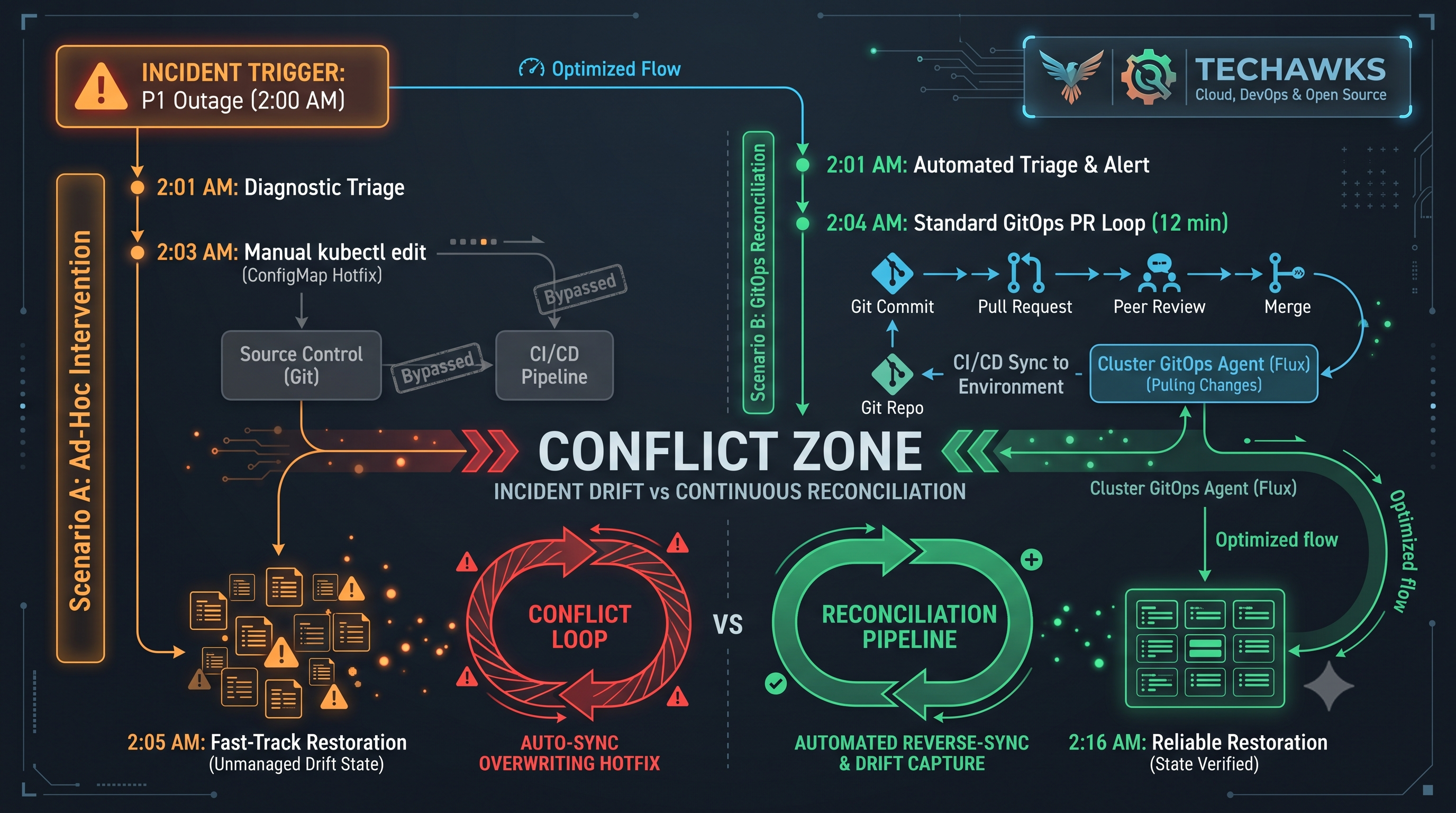
GitOps creates an immaculate single source of truth—until production reality clashes with theoretical purity. When an incident strikes, engineering teams typically fall into one of two traps:
1. The Reconciliation Overwrite Trap
A developer manually scales up a replica set or tweaks environment variables directly in the cluster to mitigate an outage. Three minutes later, Argo CD or Flux runs its reconciliation cycle, detects that live state does not match the Git repository, and silently rolls the hotfix back to the broken state, re-triggering the outage.
2. The Unrecorded Drift Debt
To prevent the auto-revert, the on-call engineer disables automated sync or suspends the application. The incident is resolved, everyone goes back to sleep, and the cluster remains untracked. Three weeks later, an unrelated routine merge re-enables sync, clobbering the live patch and causing an unexplained regression.
The 3-Step Architectural Challenge for Your Stack
Instead of pretending manual hotfixes never happen, resilient platforms design for emergency drift by default:
Automated Reverse-Syncing: If an emergency mutation occurs in the cluster, does your tooling alert on drift and automatically open a reverse pull request to capture the live state into Git?
Break-Glass Ephemeral Access: Do your engineers hold permanent write access to production namespaces, or do you enforce time-boxed, auto-expiring elevated roles with mandatory post-incident audit webhooks?
Graceful Suspension Safeguards: When an application sync is manually paused during an outage, is there an automated ticket or Slack alert tied to your observability stack that blocks future pipeline merges until Git and live state achieve parity?
Key Takeaways
Purity is not resilience: An infrastructure workflow that breaks under incident pressure will inevitably be bypassed by engineers under stress.
Reconciliation can be an adversary: Automated controllers must have clear, incident-aware operational modes to prevent clobbering life-saving emergency hotfixes.
Design for the reconciliation back-channel: High-maturity cloud teams do not ban manual triage; they build automated pipelines that capture emergency drift back into code before the on-call shift ends.
CTA
Be honest: how does your team handle emergency production changes? Do you strictly enforce "Git-only" commits even during active downtime, or do you have a battle-tested break-glass workflow that reconciles manual patches afterward? Share your setup and incident lessons below! 🦅☁️
GitOps creates an immaculate single source of truth—until production reality clashes with theoretical purity. When an incident strikes, engineering teams typically fall into one of two traps:
1. The Reconciliation Overwrite Trap
A developer manually scales up a replica set or tweaks environment variables directly in the cluster to mitigate an outage. Three minutes later, Argo CD or Flux runs its reconciliation cycle, detects that live state does not match the Git repository, and silently rolls the hotfix back to the broken state, re-triggering the outage.
2. The Unrecorded Drift Debt
To prevent the auto-revert, the on-call engineer disables automated sync or suspends the application. The incident is resolved, everyone goes back to sleep, and the cluster remains untracked. Three weeks later, an unrelated routine merge re-enables sync, clobbering the live patch and causing an unexplained regression.
The 3-Step Architectural Challenge for Your Stack
Instead of pretending manual hotfixes never happen, resilient platforms design for emergency drift by default:
Automated Reverse-Syncing: If an emergency mutation occurs in the cluster, does your tooling alert on drift and automatically open a reverse pull request to capture the live state into Git?
Break-Glass Ephemeral Access: Do your engineers hold permanent write access to production namespaces, or do you enforce time-boxed, auto-expiring elevated roles with mandatory post-incident audit webhooks?
Graceful Suspension Safeguards: When an application sync is manually paused during an outage, is there an automated ticket or Slack alert tied to your observability stack that blocks future pipeline merges until Git and live state achieve parity?
Key Takeaways
Purity is not resilience: An infrastructure workflow that breaks under incident pressure will inevitably be bypassed by engineers under stress.
Reconciliation can be an adversary: Automated controllers must have clear, incident-aware operational modes to prevent clobbering life-saving emergency hotfixes.
Design for the reconciliation back-channel: High-maturity cloud teams do not ban manual triage; they build automated pipelines that capture emergency drift back into code before the on-call shift ends.
CTA
Be honest: how does your team handle emergency production changes? Do you strictly enforce "Git-only" commits even during active downtime, or do you have a battle-tested break-glass workflow that reconciles manual patches afterward? Share your setup and incident lessons below! 🦅☁️
The GitOps Drift Challenge: What Happens When You Bypass Your CI/CD Pipeline During a P1 Outage?
GitOps creates an immaculate single source of truth—until production reality clashes with theoretical purity. When an incident strikes, engineering teams typically fall into one of two traps:
1. The Reconciliation Overwrite Trap
A developer manually scales up a replica set or tweaks environment variables directly in the cluster to mitigate an outage. Three minutes later, Argo CD or Flux runs its reconciliation cycle, detects that live state does not match the Git repository, and silently rolls the hotfix back to the broken state, re-triggering the outage.
2. The Unrecorded Drift Debt
To prevent the auto-revert, the on-call engineer disables automated sync or suspends the application. The incident is resolved, everyone goes back to sleep, and the cluster remains untracked. Three weeks later, an unrelated routine merge re-enables sync, clobbering the live patch and causing an unexplained regression.
The 3-Step Architectural Challenge for Your Stack
Instead of pretending manual hotfixes never happen, resilient platforms design for emergency drift by default:
Automated Reverse-Syncing: If an emergency mutation occurs in the cluster, does your tooling alert on drift and automatically open a reverse pull request to capture the live state into Git?
Break-Glass Ephemeral Access: Do your engineers hold permanent write access to production namespaces, or do you enforce time-boxed, auto-expiring elevated roles with mandatory post-incident audit webhooks?
Graceful Suspension Safeguards: When an application sync is manually paused during an outage, is there an automated ticket or Slack alert tied to your observability stack that blocks future pipeline merges until Git and live state achieve parity?
Key Takeaways
Purity is not resilience: An infrastructure workflow that breaks under incident pressure will inevitably be bypassed by engineers under stress.
Reconciliation can be an adversary: Automated controllers must have clear, incident-aware operational modes to prevent clobbering life-saving emergency hotfixes.
Design for the reconciliation back-channel: High-maturity cloud teams do not ban manual triage; they build automated pipelines that capture emergency drift back into code before the on-call shift ends.
CTA
Be honest: how does your team handle emergency production changes? Do you strictly enforce "Git-only" commits even during active downtime, or do you have a battle-tested break-glass workflow that reconciles manual patches afterward? Share your setup and incident lessons below! 🦅☁️

 Arabic
 French
 Spanish
 Portuguese
 Deutsch
 Turkish
 Dutch
Dutch
 Italiano
 Russian
 Romaian
 Portuguese (Brazil)
 Greek
Greek