


The 100M-Row Indian Scale Challenge: Is Your Backend Designed for UPI-Level Concurrent Spikes?
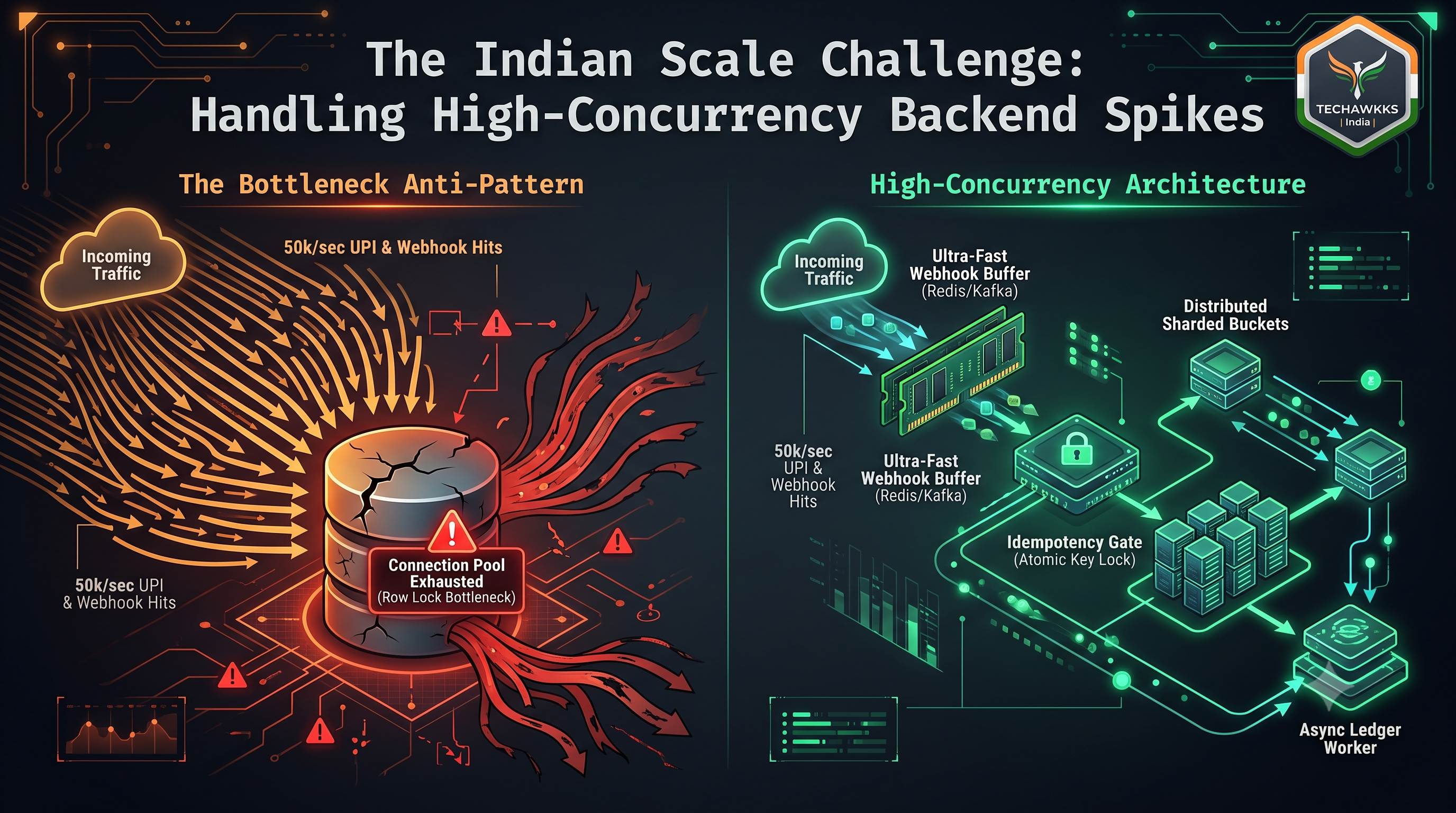
Most backend applications built for startup demos work flawlessly up to 5,000 requests per minute. But when exposed to high-concurrency Indian payment and commerce rails, traditional relational models buckle under connection exhaustion and database row contention.1. The Hot-Row Lock Contention Trap When thousands of concurrent transactions try to deduct inventory or decrement a single seller's ledger balance simultaneously, running:
SQLUPDATE inventory SET stock = stock - 1 WHERE item_id = 42;
forces the database engine into aggressive row-level locking. Incoming queries queue up, worker connection pools saturate within seconds, and downstream cascading timeouts bring down the entire API gateway.2. Synchronous Web hook Dependency If your payment confirmation flow waits synchronously on third-party banking APIs or SMS gateways inside the user’s HTTP request cycle, network latency jitter (even 400ms per call) will exhaust your web server thread pool during peak traffic windows.
The 3-Step Indian Engineering Scale Challenge Decouple Ingestion from Processing (Event Sinks): Never execute complex business logic directly on the payment callback endpoint. Immediately acknowledge incoming gateway web hooks with an HTTP 200 after dumping the raw payload into a partitioned Kafka topic or distributed Redis stream. Let decoupled worker pools process transactions idempotently.
Shard Hot Ledger Rows (Reservation Buckets): Stop locking a single database row. Split high-velocity items or balances across $N$ virtual buckets (e.g., 10 parallel rows of 100 items each). Route concurrent write requests randomly across buckets to slash lock contention by an order of magnitude. Idempotency Keys with Redis TTL Locks: Distributed network retries are guaranteed during peak loads. Enforce strict distributed locking via atomic Redis SET NX EX on unique transaction reference IDs before acquiring database locks to eliminate double-spend and double-credit bugs.
Key Takeaways
Protect the database core: Never let unpredictable external web hooks or concurrent user checkouts run unbuffered writes directly against relational primary nodes.
Embrace asynchronous eventual consistency: Heavy operations (loyalty point calculations, notification dispatches, analytics logging) belong in async event workers, not the critical path.
Design for inevitable network retries: In distributed payments, idempotency is not an optimization—it is your primary defense against balance reconciliation nightmares.
CTA
Are you building for India-scale infrastructure? Join Techawks India to collaborate with top backend architects, DevOps practitioners, and engineers building resilient, distributed systems for hundreds of millions of users across the subcontinent. Let’s engineer the future together! 🦅🇮🇳
Most backend applications built for startup demos work flawlessly up to 5,000 requests per minute. But when exposed to high-concurrency Indian payment and commerce rails, traditional relational models buckle under connection exhaustion and database row contention.1. The Hot-Row Lock Contention Trap When thousands of concurrent transactions try to deduct inventory or decrement a single seller's ledger balance simultaneously, running:
SQLUPDATE inventory SET stock = stock - 1 WHERE item_id = 42;
forces the database engine into aggressive row-level locking. Incoming queries queue up, worker connection pools saturate within seconds, and downstream cascading timeouts bring down the entire API gateway.2. Synchronous Web hook Dependency If your payment confirmation flow waits synchronously on third-party banking APIs or SMS gateways inside the user’s HTTP request cycle, network latency jitter (even 400ms per call) will exhaust your web server thread pool during peak traffic windows.
The 3-Step Indian Engineering Scale Challenge Decouple Ingestion from Processing (Event Sinks): Never execute complex business logic directly on the payment callback endpoint. Immediately acknowledge incoming gateway web hooks with an HTTP 200 after dumping the raw payload into a partitioned Kafka topic or distributed Redis stream. Let decoupled worker pools process transactions idempotently.
Shard Hot Ledger Rows (Reservation Buckets): Stop locking a single database row. Split high-velocity items or balances across $N$ virtual buckets (e.g., 10 parallel rows of 100 items each). Route concurrent write requests randomly across buckets to slash lock contention by an order of magnitude. Idempotency Keys with Redis TTL Locks: Distributed network retries are guaranteed during peak loads. Enforce strict distributed locking via atomic Redis SET NX EX on unique transaction reference IDs before acquiring database locks to eliminate double-spend and double-credit bugs.
Key Takeaways
Protect the database core: Never let unpredictable external web hooks or concurrent user checkouts run unbuffered writes directly against relational primary nodes.
Embrace asynchronous eventual consistency: Heavy operations (loyalty point calculations, notification dispatches, analytics logging) belong in async event workers, not the critical path.
Design for inevitable network retries: In distributed payments, idempotency is not an optimization—it is your primary defense against balance reconciliation nightmares.
CTA
Are you building for India-scale infrastructure? Join Techawks India to collaborate with top backend architects, DevOps practitioners, and engineers building resilient, distributed systems for hundreds of millions of users across the subcontinent. Let’s engineer the future together! 🦅🇮🇳
The 100M-Row Indian Scale Challenge: Is Your Backend Designed for UPI-Level Concurrent Spikes?
Most backend applications built for startup demos work flawlessly up to 5,000 requests per minute. But when exposed to high-concurrency Indian payment and commerce rails, traditional relational models buckle under connection exhaustion and database row contention.1. The Hot-Row Lock Contention Trap When thousands of concurrent transactions try to deduct inventory or decrement a single seller's ledger balance simultaneously, running:
SQLUPDATE inventory SET stock = stock - 1 WHERE item_id = 42;
forces the database engine into aggressive row-level locking. Incoming queries queue up, worker connection pools saturate within seconds, and downstream cascading timeouts bring down the entire API gateway.2. Synchronous Web hook Dependency If your payment confirmation flow waits synchronously on third-party banking APIs or SMS gateways inside the user’s HTTP request cycle, network latency jitter (even 400ms per call) will exhaust your web server thread pool during peak traffic windows.
The 3-Step Indian Engineering Scale Challenge Decouple Ingestion from Processing (Event Sinks): Never execute complex business logic directly on the payment callback endpoint. Immediately acknowledge incoming gateway web hooks with an HTTP 200 after dumping the raw payload into a partitioned Kafka topic or distributed Redis stream. Let decoupled worker pools process transactions idempotently.
Shard Hot Ledger Rows (Reservation Buckets): Stop locking a single database row. Split high-velocity items or balances across $N$ virtual buckets (e.g., 10 parallel rows of 100 items each). Route concurrent write requests randomly across buckets to slash lock contention by an order of magnitude. Idempotency Keys with Redis TTL Locks: Distributed network retries are guaranteed during peak loads. Enforce strict distributed locking via atomic Redis SET NX EX on unique transaction reference IDs before acquiring database locks to eliminate double-spend and double-credit bugs.
Key Takeaways
Protect the database core: Never let unpredictable external web hooks or concurrent user checkouts run unbuffered writes directly against relational primary nodes.
Embrace asynchronous eventual consistency: Heavy operations (loyalty point calculations, notification dispatches, analytics logging) belong in async event workers, not the critical path.
Design for inevitable network retries: In distributed payments, idempotency is not an optimization—it is your primary defense against balance reconciliation nightmares.
CTA
Are you building for India-scale infrastructure? Join Techawks India to collaborate with top backend architects, DevOps practitioners, and engineers building resilient, distributed systems for hundreds of millions of users across the subcontinent. Let’s engineer the future together! 🦅🇮🇳

 English
 Arabic
 French
 Spanish
 Portuguese
 Deutsch
 Turkish
 Dutch
Dutch
 Russian
 Romaian
 Portuguese (Brazil)
 Greek
Greek