


Can Your Architecture Survive a Cross-AZ Blackout? The 48-Hour Multi-AZ Reality Check.
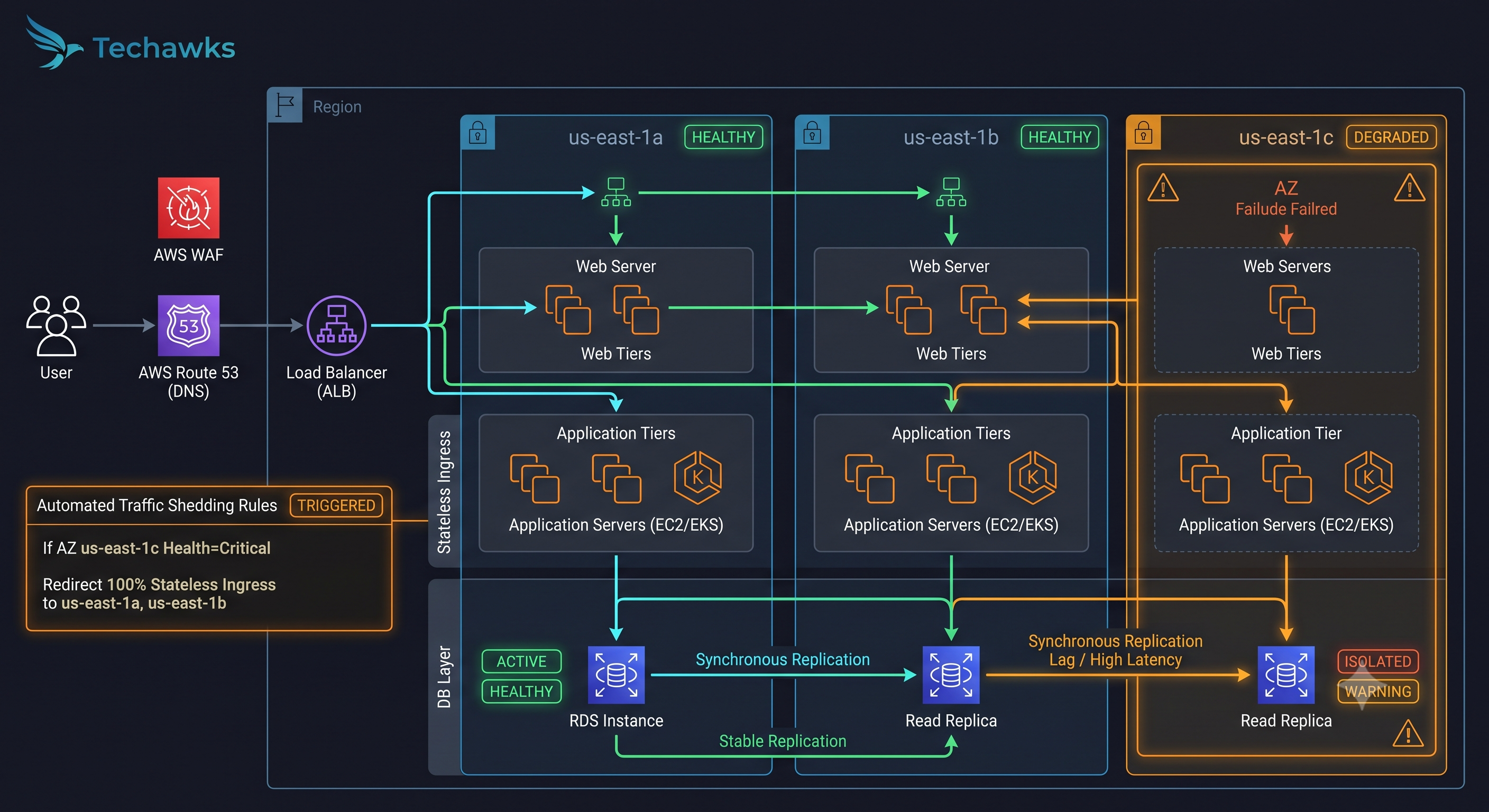
If you run production workloads in us-east-1, us-west-2, or central regional hubs, regional resilience is your primary operational benchmark. But deployment across three subnets does not guarantee survival.
Take the Techawks 48-Hour Resilience Challenge to test whether your setup is truly fault-tolerant or just expensive:
Audit Your Cross-AZ Latency Tax
The Problem: Chatty microservices distributed indiscriminately across zones run into a 1–2 ms cross-zone penalty per network hop. During peak traffic, this compounds into cascading timeouts.
The Fix: Implement AZ-affinity routing using service mesh topologies or client-side load balancing. Keep read/write request-reply loops within the same AZ, routing across boundaries only for consensus and data replication.
Test Your Read-Replica Promotion Under Load
The Problem: Managed databases promise automated failover. However, if your primary zone fails under heavy I/O, replica lag can spike, causing automated promotion to hang or drop uncommitted transactions.
The Fix: Simulate a forced failover during staging peak hours. Track your Mean Time to Recovery (MTTR) and confirm your application connection pools handle DNS cache purges without requiring manual pod restarts.
Validate Stateless Ingress Failover
The Problem: Load balancers often continue directing traffic to degraded compute targets until health checks register multiple consecutive failures—saturating retry queues.
The Fix: Tighten interval thresholds: drop health-check intervals to 5 seconds with a 2-strike unhealthy threshold. Pair this with client-side exponential backoff and jitter to prevent thundering herd problems on healthy zones.
Key Takeaways
Network Topology Over Proximity: Ensure traffic stays localized within an AZ to reduce latency and eliminate avoidable cross-AZ data egress charges.
Failover Requires Muscle Memory: If failover is not verified under sustained load, your failover automation is merely a theory.
Decouple DNS from Health: Ensure application client pools flush stale IP addresses immediately upon ingress health transitions.
CTA
Tackling resilience, cloud architecture, and high-scale systems design across the US tech landscape? Connect with lead architects and senior engineers building reliable infrastructure.
If you run production workloads in us-east-1, us-west-2, or central regional hubs, regional resilience is your primary operational benchmark. But deployment across three subnets does not guarantee survival.
Take the Techawks 48-Hour Resilience Challenge to test whether your setup is truly fault-tolerant or just expensive:
Audit Your Cross-AZ Latency Tax
The Problem: Chatty microservices distributed indiscriminately across zones run into a 1–2 ms cross-zone penalty per network hop. During peak traffic, this compounds into cascading timeouts.
The Fix: Implement AZ-affinity routing using service mesh topologies or client-side load balancing. Keep read/write request-reply loops within the same AZ, routing across boundaries only for consensus and data replication.
Test Your Read-Replica Promotion Under Load
The Problem: Managed databases promise automated failover. However, if your primary zone fails under heavy I/O, replica lag can spike, causing automated promotion to hang or drop uncommitted transactions.
The Fix: Simulate a forced failover during staging peak hours. Track your Mean Time to Recovery (MTTR) and confirm your application connection pools handle DNS cache purges without requiring manual pod restarts.
Validate Stateless Ingress Failover
The Problem: Load balancers often continue directing traffic to degraded compute targets until health checks register multiple consecutive failures—saturating retry queues.
The Fix: Tighten interval thresholds: drop health-check intervals to 5 seconds with a 2-strike unhealthy threshold. Pair this with client-side exponential backoff and jitter to prevent thundering herd problems on healthy zones.
Key Takeaways
Network Topology Over Proximity: Ensure traffic stays localized within an AZ to reduce latency and eliminate avoidable cross-AZ data egress charges.
Failover Requires Muscle Memory: If failover is not verified under sustained load, your failover automation is merely a theory.
Decouple DNS from Health: Ensure application client pools flush stale IP addresses immediately upon ingress health transitions.
CTA
Tackling resilience, cloud architecture, and high-scale systems design across the US tech landscape? Connect with lead architects and senior engineers building reliable infrastructure.
Can Your Architecture Survive a Cross-AZ Blackout? The 48-Hour Multi-AZ Reality Check.
If you run production workloads in us-east-1, us-west-2, or central regional hubs, regional resilience is your primary operational benchmark. But deployment across three subnets does not guarantee survival.
Take the Techawks 48-Hour Resilience Challenge to test whether your setup is truly fault-tolerant or just expensive:
Audit Your Cross-AZ Latency Tax
The Problem: Chatty microservices distributed indiscriminately across zones run into a 1–2 ms cross-zone penalty per network hop. During peak traffic, this compounds into cascading timeouts.
The Fix: Implement AZ-affinity routing using service mesh topologies or client-side load balancing. Keep read/write request-reply loops within the same AZ, routing across boundaries only for consensus and data replication.
Test Your Read-Replica Promotion Under Load
The Problem: Managed databases promise automated failover. However, if your primary zone fails under heavy I/O, replica lag can spike, causing automated promotion to hang or drop uncommitted transactions.
The Fix: Simulate a forced failover during staging peak hours. Track your Mean Time to Recovery (MTTR) and confirm your application connection pools handle DNS cache purges without requiring manual pod restarts.
Validate Stateless Ingress Failover
The Problem: Load balancers often continue directing traffic to degraded compute targets until health checks register multiple consecutive failures—saturating retry queues.
The Fix: Tighten interval thresholds: drop health-check intervals to 5 seconds with a 2-strike unhealthy threshold. Pair this with client-side exponential backoff and jitter to prevent thundering herd problems on healthy zones.
Key Takeaways
Network Topology Over Proximity: Ensure traffic stays localized within an AZ to reduce latency and eliminate avoidable cross-AZ data egress charges.
Failover Requires Muscle Memory: If failover is not verified under sustained load, your failover automation is merely a theory.
Decouple DNS from Health: Ensure application client pools flush stale IP addresses immediately upon ingress health transitions.
CTA
Tackling resilience, cloud architecture, and high-scale systems design across the US tech landscape? Connect with lead architects and senior engineers building reliable infrastructure.

 English
 Arabic
 French
 Spanish
 Portuguese
 Deutsch
 Turkish
 Dutch
Dutch
 Italiano
 Russian
 Portuguese (Brazil)
 Greek
Greek