


Can Your Distributed Stack Survive a Middle East Subsea Cable Outage? The 48-Hour In-Country Resilience Challenge.
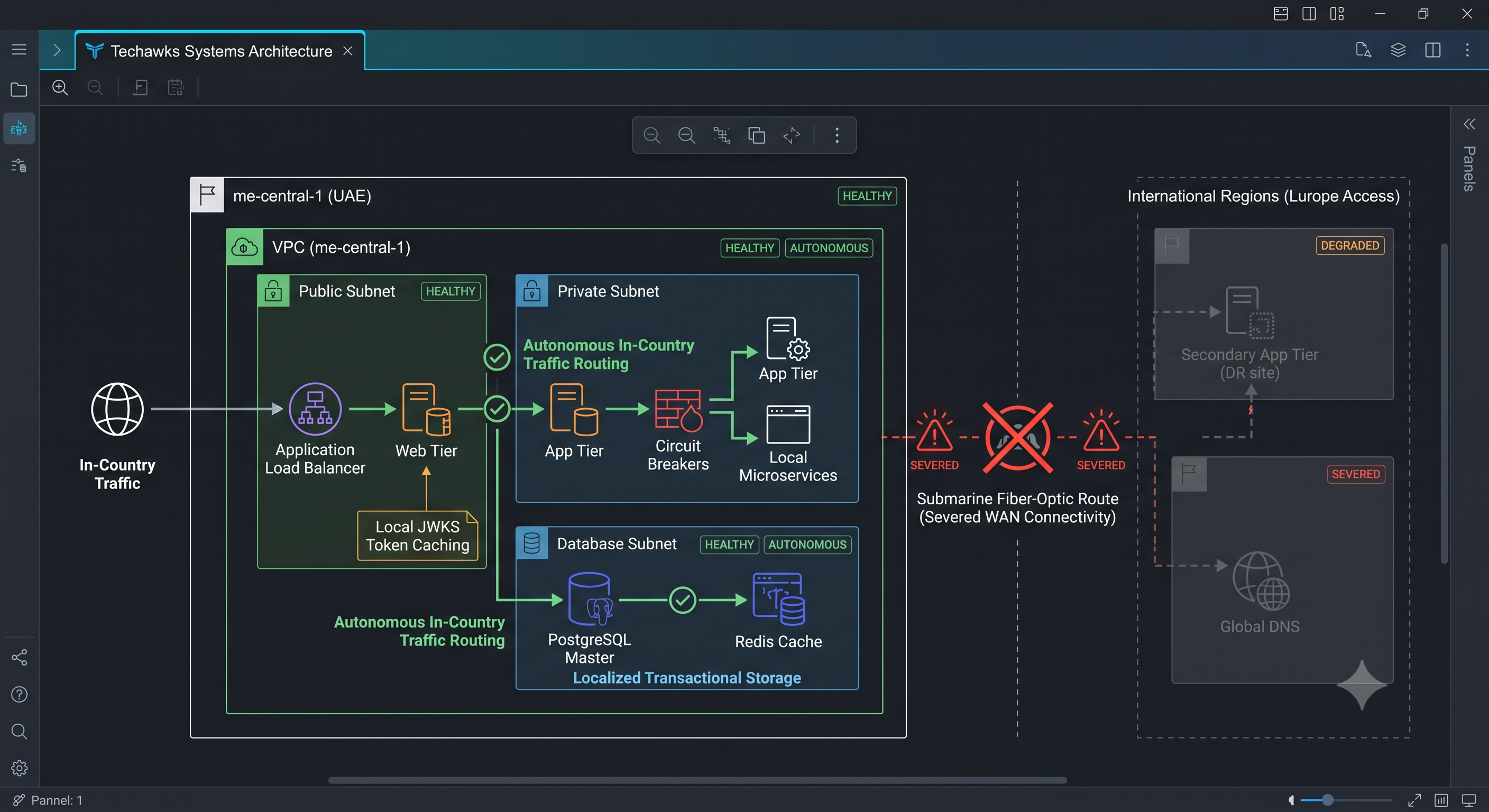
Building production-grade architecture in me-central-1 (UAE) requires engineering for self-contained survivability. When cross-border transit degrades, your domestic user experience should not collapse with it.
Take the Techawks 48-Hour In-Country Resilience Challenge to verify whether your UAE workloads can operate autonomously when international WAN connectivity chokes:
Decouple Regional Third-Party Auth & CDN Dependencies
The Problem: Relying on global identity providers (IdPs), authorization webhooks, or CDN edge workers terminating outside the GCC causes local sessions to fail if cross-region round-trip time spikes.
The Fix: Terminate and cache session tokens locally within UAE VPCs. Implement local fallbacks for token verification using cached public keys (JWKS) rather than forcing synchronous, out-of-region validation on every API handshake.
Stress-Test Cross-Border Asynchronous Data Sync
The Problem: Distributed event brokers (Kafka, RabbitMQ) streaming data between the UAE and overseas secondary regions choke under severe packet loss, buffering messages locally until broker memory limits trigger out-of-memory (OOM) crashes.
The Fix: Configure isolated, circuit-breaker-backed replication queues. When egress latency exceeds your 80 ms threshold, automatically trip the circuit: spool events to local persistent disk volumes and preserve 100% of in-country transactional operations without backpressure.
Verify Sovereign Data Residency Containment
The Problem: Fallback routes configured during failover simulations can inadvertently reroute protected local user records or payment telemetry to foreign data centers, violating local UAE data protection and sector-specific residency mandates.
The Fix: Define explicit egress security groups and VPC route tables that restrict sensitive transactional tables to local UAE subnets, ensuring failover paths never route regulated data out-of-territory under any failure scenario.
Key Takeaways
Prioritize Domestic Autonomy: Treat external international regions as untrusted, volatile links rather than reliable synchronous dependencies.
Isolate Egress Buffering: Protect local application pods from crashing by utilizing backpressure-safe local storage queues when international pipelines stall.
Keep Boundaries Immutable: Resilience mechanisms must enforce sovereign data boundaries by default, even during catastrophic network partitioning.
CTA
Architecting high-availability, low-latency, and compliant systems across the UAE and GCC? Connect with the systems engineers, cloud leads, and solutions architects shaping local tech infrastructure.
👉 Join the Techawks UAE community today: [link]
Building production-grade architecture in me-central-1 (UAE) requires engineering for self-contained survivability. When cross-border transit degrades, your domestic user experience should not collapse with it.
Take the Techawks 48-Hour In-Country Resilience Challenge to verify whether your UAE workloads can operate autonomously when international WAN connectivity chokes:
Decouple Regional Third-Party Auth & CDN Dependencies
The Problem: Relying on global identity providers (IdPs), authorization webhooks, or CDN edge workers terminating outside the GCC causes local sessions to fail if cross-region round-trip time spikes.
The Fix: Terminate and cache session tokens locally within UAE VPCs. Implement local fallbacks for token verification using cached public keys (JWKS) rather than forcing synchronous, out-of-region validation on every API handshake.
Stress-Test Cross-Border Asynchronous Data Sync
The Problem: Distributed event brokers (Kafka, RabbitMQ) streaming data between the UAE and overseas secondary regions choke under severe packet loss, buffering messages locally until broker memory limits trigger out-of-memory (OOM) crashes.
The Fix: Configure isolated, circuit-breaker-backed replication queues. When egress latency exceeds your 80 ms threshold, automatically trip the circuit: spool events to local persistent disk volumes and preserve 100% of in-country transactional operations without backpressure.
Verify Sovereign Data Residency Containment
The Problem: Fallback routes configured during failover simulations can inadvertently reroute protected local user records or payment telemetry to foreign data centers, violating local UAE data protection and sector-specific residency mandates.
The Fix: Define explicit egress security groups and VPC route tables that restrict sensitive transactional tables to local UAE subnets, ensuring failover paths never route regulated data out-of-territory under any failure scenario.
Key Takeaways
Prioritize Domestic Autonomy: Treat external international regions as untrusted, volatile links rather than reliable synchronous dependencies.
Isolate Egress Buffering: Protect local application pods from crashing by utilizing backpressure-safe local storage queues when international pipelines stall.
Keep Boundaries Immutable: Resilience mechanisms must enforce sovereign data boundaries by default, even during catastrophic network partitioning.
CTA
Architecting high-availability, low-latency, and compliant systems across the UAE and GCC? Connect with the systems engineers, cloud leads, and solutions architects shaping local tech infrastructure.
👉 Join the Techawks UAE community today: [link]
Can Your Distributed Stack Survive a Middle East Subsea Cable Outage? The 48-Hour In-Country Resilience Challenge.
Building production-grade architecture in me-central-1 (UAE) requires engineering for self-contained survivability. When cross-border transit degrades, your domestic user experience should not collapse with it.
Take the Techawks 48-Hour In-Country Resilience Challenge to verify whether your UAE workloads can operate autonomously when international WAN connectivity chokes:
Decouple Regional Third-Party Auth & CDN Dependencies
The Problem: Relying on global identity providers (IdPs), authorization webhooks, or CDN edge workers terminating outside the GCC causes local sessions to fail if cross-region round-trip time spikes.
The Fix: Terminate and cache session tokens locally within UAE VPCs. Implement local fallbacks for token verification using cached public keys (JWKS) rather than forcing synchronous, out-of-region validation on every API handshake.
Stress-Test Cross-Border Asynchronous Data Sync
The Problem: Distributed event brokers (Kafka, RabbitMQ) streaming data between the UAE and overseas secondary regions choke under severe packet loss, buffering messages locally until broker memory limits trigger out-of-memory (OOM) crashes.
The Fix: Configure isolated, circuit-breaker-backed replication queues. When egress latency exceeds your 80 ms threshold, automatically trip the circuit: spool events to local persistent disk volumes and preserve 100% of in-country transactional operations without backpressure.
Verify Sovereign Data Residency Containment
The Problem: Fallback routes configured during failover simulations can inadvertently reroute protected local user records or payment telemetry to foreign data centers, violating local UAE data protection and sector-specific residency mandates.
The Fix: Define explicit egress security groups and VPC route tables that restrict sensitive transactional tables to local UAE subnets, ensuring failover paths never route regulated data out-of-territory under any failure scenario.
Key Takeaways
Prioritize Domestic Autonomy: Treat external international regions as untrusted, volatile links rather than reliable synchronous dependencies.
Isolate Egress Buffering: Protect local application pods from crashing by utilizing backpressure-safe local storage queues when international pipelines stall.
Keep Boundaries Immutable: Resilience mechanisms must enforce sovereign data boundaries by default, even during catastrophic network partitioning.
CTA
Architecting high-availability, low-latency, and compliant systems across the UAE and GCC? Connect with the systems engineers, cloud leads, and solutions architects shaping local tech infrastructure.
👉 Join the Techawks UAE community today: [link]

 Arabic
 French
 Spanish
 Portuguese
 Deutsch
 Turkish
 Dutch
Dutch
 Italiano
 Russian
 Romaian
 Portuguese (Brazil)
 Greek
Greek