


The System Design Challenge: Can Your App Handle 100K Concurrent Requests During a Peak Flash Sale?
Surging traffic spikes—common during festival sales, match-day streaming, or viral product launches—test the limits of software architecture. Here is your challenge: evaluate your application stack against this 4-tier stress test to see where your infrastructure breaks first.
The Challenge Scenario
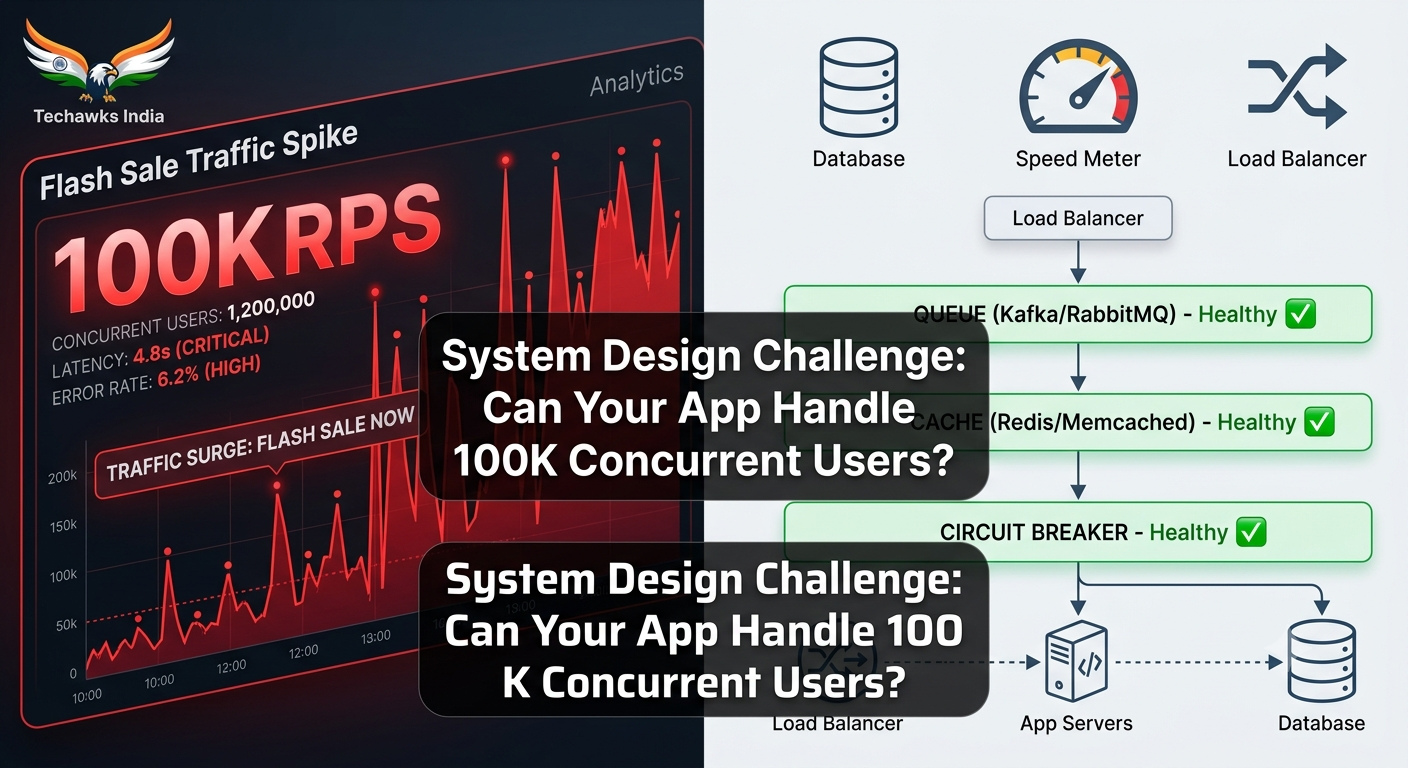
Traffic Spike: Normal load is 1,000 requests/sec. Within 10 seconds, traffic surges 100x to 100,000 requests/sec, with 80% of users attempting write operations (e.g., checkout or ticket reservation) simultaneously.
Evaluate Your Architecture:
Level 1: The Database Bottleneck
The Test: Does every incoming request hit your primary relational database directly?
🛑 Fail: Direct DB writes cause lock contention, connection pool exhaustion, and cascading 504 gateway timeouts.
🛠️ The Fix: Implement an asynchronous message queue (e.g., Apache Kafka or RabbitMQ) to buffer incoming orders, and use Redis for read-heavy caching.
Level 2: API Gateway & Rate Limiting
The Test: What happens when bots or malicious scripts spam your checkout endpoint?
🛑 Fail: All traffic reaches your application logic, consuming compute resources and starving legitimate users.
🛠️ The Fix: Enforce token-bucket or leaky-bucket rate limiting at your API Gateway (or CDN edge) based on user ID and IP address.
Level 3: Session & Cache Management
The Test: How does your caching layer handle sudden cache invalidation (the "Thundering Herd" problem)?
🛑 Fail: Expired cache keys cause thousands of concurrent worker threads to query the database simultaneously for the exact same data.
🛠️ The Fix: Implement mutex locking (like Redis Distributed Locks) or probabilistic early expiration to recompute cached data safely.
Level 4: Graceful Degradation
The Test: When downstream microservices fail, does the whole application go down?
🛑 Fail: Non-critical service outages (e.g., recommendation engine, analytics) crash the main payment flow.
🛠️ The Fix: Use Circuit Breakers (e.g., Resilience4j) to automatically bypass secondary services and serve fallback UI states.
Key Takeaways
Decouple writes from processing: Never force a database to process synchronous spikes; queue incoming workloads to smooth out load curves.
Protect the core path: Gateways and circuit breakers exist to shield core checkout/booking functionality from secondary system failures.
Design for failure: System resilience isn't avoiding traffic spikes—it's controlling how your application degrades when overloaded.
CTA
🇮🇳 How did your architecture score on the scale test? Drop your system design fixes and strategies in the comments! For more hands-on engineering challenges, tech breakdowns, and developer discussions, join Techawks India.
👉 [Join Techawks India]
Surging traffic spikes—common during festival sales, match-day streaming, or viral product launches—test the limits of software architecture. Here is your challenge: evaluate your application stack against this 4-tier stress test to see where your infrastructure breaks first.
The Challenge Scenario
Traffic Spike: Normal load is 1,000 requests/sec. Within 10 seconds, traffic surges 100x to 100,000 requests/sec, with 80% of users attempting write operations (e.g., checkout or ticket reservation) simultaneously.
Evaluate Your Architecture:
Level 1: The Database Bottleneck
The Test: Does every incoming request hit your primary relational database directly?
🛑 Fail: Direct DB writes cause lock contention, connection pool exhaustion, and cascading 504 gateway timeouts.
🛠️ The Fix: Implement an asynchronous message queue (e.g., Apache Kafka or RabbitMQ) to buffer incoming orders, and use Redis for read-heavy caching.
Level 2: API Gateway & Rate Limiting
The Test: What happens when bots or malicious scripts spam your checkout endpoint?
🛑 Fail: All traffic reaches your application logic, consuming compute resources and starving legitimate users.
🛠️ The Fix: Enforce token-bucket or leaky-bucket rate limiting at your API Gateway (or CDN edge) based on user ID and IP address.
Level 3: Session & Cache Management
The Test: How does your caching layer handle sudden cache invalidation (the "Thundering Herd" problem)?
🛑 Fail: Expired cache keys cause thousands of concurrent worker threads to query the database simultaneously for the exact same data.
🛠️ The Fix: Implement mutex locking (like Redis Distributed Locks) or probabilistic early expiration to recompute cached data safely.
Level 4: Graceful Degradation
The Test: When downstream microservices fail, does the whole application go down?
🛑 Fail: Non-critical service outages (e.g., recommendation engine, analytics) crash the main payment flow.
🛠️ The Fix: Use Circuit Breakers (e.g., Resilience4j) to automatically bypass secondary services and serve fallback UI states.
Key Takeaways
Decouple writes from processing: Never force a database to process synchronous spikes; queue incoming workloads to smooth out load curves.
Protect the core path: Gateways and circuit breakers exist to shield core checkout/booking functionality from secondary system failures.
Design for failure: System resilience isn't avoiding traffic spikes—it's controlling how your application degrades when overloaded.
CTA
🇮🇳 How did your architecture score on the scale test? Drop your system design fixes and strategies in the comments! For more hands-on engineering challenges, tech breakdowns, and developer discussions, join Techawks India.
👉 [Join Techawks India]
The System Design Challenge: Can Your App Handle 100K Concurrent Requests During a Peak Flash Sale?
Surging traffic spikes—common during festival sales, match-day streaming, or viral product launches—test the limits of software architecture. Here is your challenge: evaluate your application stack against this 4-tier stress test to see where your infrastructure breaks first.
The Challenge Scenario
Traffic Spike: Normal load is 1,000 requests/sec. Within 10 seconds, traffic surges 100x to 100,000 requests/sec, with 80% of users attempting write operations (e.g., checkout or ticket reservation) simultaneously.
Evaluate Your Architecture:
Level 1: The Database Bottleneck
The Test: Does every incoming request hit your primary relational database directly?
🛑 Fail: Direct DB writes cause lock contention, connection pool exhaustion, and cascading 504 gateway timeouts.
🛠️ The Fix: Implement an asynchronous message queue (e.g., Apache Kafka or RabbitMQ) to buffer incoming orders, and use Redis for read-heavy caching.
Level 2: API Gateway & Rate Limiting
The Test: What happens when bots or malicious scripts spam your checkout endpoint?
🛑 Fail: All traffic reaches your application logic, consuming compute resources and starving legitimate users.
🛠️ The Fix: Enforce token-bucket or leaky-bucket rate limiting at your API Gateway (or CDN edge) based on user ID and IP address.
Level 3: Session & Cache Management
The Test: How does your caching layer handle sudden cache invalidation (the "Thundering Herd" problem)?
🛑 Fail: Expired cache keys cause thousands of concurrent worker threads to query the database simultaneously for the exact same data.
🛠️ The Fix: Implement mutex locking (like Redis Distributed Locks) or probabilistic early expiration to recompute cached data safely.
Level 4: Graceful Degradation
The Test: When downstream microservices fail, does the whole application go down?
🛑 Fail: Non-critical service outages (e.g., recommendation engine, analytics) crash the main payment flow.
🛠️ The Fix: Use Circuit Breakers (e.g., Resilience4j) to automatically bypass secondary services and serve fallback UI states.
Key Takeaways
Decouple writes from processing: Never force a database to process synchronous spikes; queue incoming workloads to smooth out load curves.
Protect the core path: Gateways and circuit breakers exist to shield core checkout/booking functionality from secondary system failures.
Design for failure: System resilience isn't avoiding traffic spikes—it's controlling how your application degrades when overloaded.
CTA
🇮🇳 How did your architecture score on the scale test? Drop your system design fixes and strategies in the comments! For more hands-on engineering challenges, tech breakdowns, and developer discussions, join Techawks India.
👉 [Join Techawks India]

 English
 French
 Spanish
 Portuguese
 Deutsch
 Turkish
 Dutch
Dutch
 Italiano
 Russian
 Romaian
 Portuguese (Brazil)
 Greek
Greek