


Can Your Trans-Canada Architecture Survive a Cross-Country Partition? The 72-Hour PIPEDA & Latency Challenge.
Designing for Canada’s unique geographic footprint requires balancing strict data residency (PIPEDA, provincial public-sector mandates, and Quebec’s Law 25) with ~3,000 km of physical transit distance. When domestic pipelines falter, resilience shouldn't come at the cost of legal compliance.
Take the Techawks 72-Hour Canadian Resilience Challenge to verify whether your distributed stack can handle trans-continental latency spikes without breaking:
Audit BGP Routing and US-Transit Border Bleed
The Problem: When domestic cross-country leased lines or direct connects experience route flap, dynamic routing protocols frequently reroute East-West traffic via lower-cost, high-capacity US transit hubs (e.g., through Chicago or Seattle)—inadvertently crossing sovereign borders unencrypted.
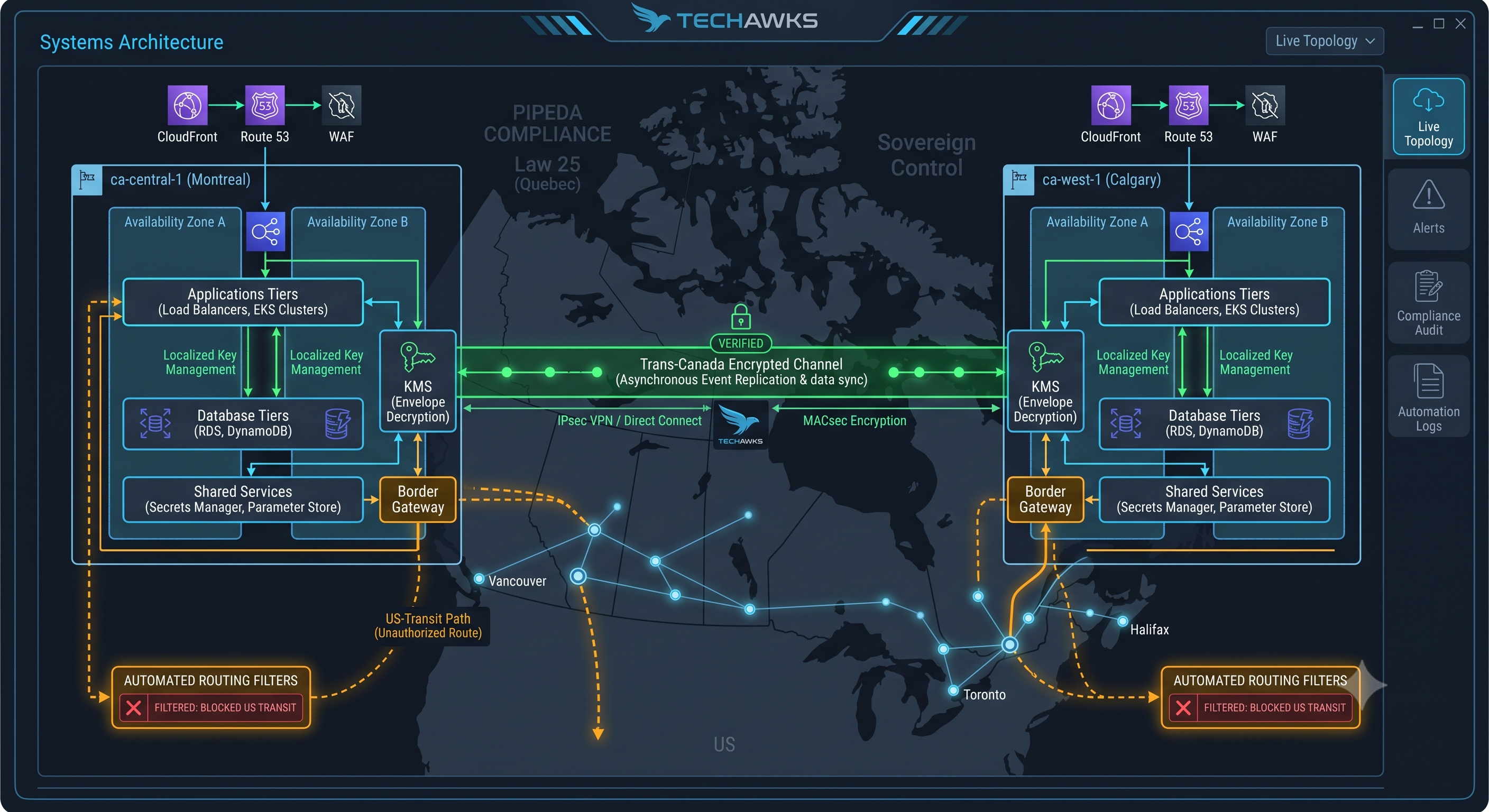
The Fix: Enforce deterministic IP routing and apply strict AWS Direct Connect / Azure ExpressRoute traffic pathing. Mandate MACsec or IPsec overlay encryption across all inter-region peering, and configure BGP route policies to drop rather than spill over into foreign ASNs during trans-Canada transit blips.
Decouple Synchronous Writes Across the Montreal-Calgary Divide
The Problem: Forcing synchronous cross-region replication over a ~50–65 ms round-trip time (RTT) chokes transaction throughput under peak load, leading application servers to exhaust their worker pools while waiting on database ACKs.
The Fix: Adopt localized read/write boundaries with asynchronous replication. Use conflict-free replicated data types (CRDTs) or strict event sourcing with Kafka mirrors, pinning user writes to their geographically nearest region and resolving replication state asynchronously.
Validate In-Country Secret & Identity Independence
The Problem: Multi-region stacks often retain centralized dependency on an IAM control plane, vault, or single-region KMS cluster hosted exclusively in Montreal, rendering the Calgary disaster recovery site unable to decrypt configuration secrets if central connectivity drops.
The Fix: Implement multi-region localized key replication using primary and replica KMS keys anchored strictly within ca-central-1 and ca-west-1. Test an explicit partition drill where external IAM calls fail, ensuring local service accounts authenticate via cached runtime tokens.
Key Takeaways
Geography Dictates Architecture: At 50+ ms cross-region RTT, synchronous ACID transactions across Canadian hubs degrade throughput; embrace asynchronous consensus by design.
Inspect the Network Route, Not Just the Endpoint: Ensure domestic failover routes never bleed across US transit corridors without active cryptographic isolation.
Decouple Secret Enclaves: Make each Canadian region independently capable of bootstrapping without depending on an East-Coast identity master.
CTA
Building fault-tolerant, compliant, and low-latency infrastructure across the Canadian tech landscape? Connect with senior architects, platform engineers, and DevOps leads building resilient systems coast to coast.
👉 Join the Techawks Canada community today: [link]
Designing for Canada’s unique geographic footprint requires balancing strict data residency (PIPEDA, provincial public-sector mandates, and Quebec’s Law 25) with ~3,000 km of physical transit distance. When domestic pipelines falter, resilience shouldn't come at the cost of legal compliance.
Take the Techawks 72-Hour Canadian Resilience Challenge to verify whether your distributed stack can handle trans-continental latency spikes without breaking:
Audit BGP Routing and US-Transit Border Bleed
The Problem: When domestic cross-country leased lines or direct connects experience route flap, dynamic routing protocols frequently reroute East-West traffic via lower-cost, high-capacity US transit hubs (e.g., through Chicago or Seattle)—inadvertently crossing sovereign borders unencrypted.
The Fix: Enforce deterministic IP routing and apply strict AWS Direct Connect / Azure ExpressRoute traffic pathing. Mandate MACsec or IPsec overlay encryption across all inter-region peering, and configure BGP route policies to drop rather than spill over into foreign ASNs during trans-Canada transit blips.
Decouple Synchronous Writes Across the Montreal-Calgary Divide
The Problem: Forcing synchronous cross-region replication over a ~50–65 ms round-trip time (RTT) chokes transaction throughput under peak load, leading application servers to exhaust their worker pools while waiting on database ACKs.
The Fix: Adopt localized read/write boundaries with asynchronous replication. Use conflict-free replicated data types (CRDTs) or strict event sourcing with Kafka mirrors, pinning user writes to their geographically nearest region and resolving replication state asynchronously.
Validate In-Country Secret & Identity Independence
The Problem: Multi-region stacks often retain centralized dependency on an IAM control plane, vault, or single-region KMS cluster hosted exclusively in Montreal, rendering the Calgary disaster recovery site unable to decrypt configuration secrets if central connectivity drops.
The Fix: Implement multi-region localized key replication using primary and replica KMS keys anchored strictly within ca-central-1 and ca-west-1. Test an explicit partition drill where external IAM calls fail, ensuring local service accounts authenticate via cached runtime tokens.
Key Takeaways
Geography Dictates Architecture: At 50+ ms cross-region RTT, synchronous ACID transactions across Canadian hubs degrade throughput; embrace asynchronous consensus by design.
Inspect the Network Route, Not Just the Endpoint: Ensure domestic failover routes never bleed across US transit corridors without active cryptographic isolation.
Decouple Secret Enclaves: Make each Canadian region independently capable of bootstrapping without depending on an East-Coast identity master.
CTA
Building fault-tolerant, compliant, and low-latency infrastructure across the Canadian tech landscape? Connect with senior architects, platform engineers, and DevOps leads building resilient systems coast to coast.
👉 Join the Techawks Canada community today: [link]
Can Your Trans-Canada Architecture Survive a Cross-Country Partition? The 72-Hour PIPEDA & Latency Challenge.
Designing for Canada’s unique geographic footprint requires balancing strict data residency (PIPEDA, provincial public-sector mandates, and Quebec’s Law 25) with ~3,000 km of physical transit distance. When domestic pipelines falter, resilience shouldn't come at the cost of legal compliance.
Take the Techawks 72-Hour Canadian Resilience Challenge to verify whether your distributed stack can handle trans-continental latency spikes without breaking:
Audit BGP Routing and US-Transit Border Bleed
The Problem: When domestic cross-country leased lines or direct connects experience route flap, dynamic routing protocols frequently reroute East-West traffic via lower-cost, high-capacity US transit hubs (e.g., through Chicago or Seattle)—inadvertently crossing sovereign borders unencrypted.
The Fix: Enforce deterministic IP routing and apply strict AWS Direct Connect / Azure ExpressRoute traffic pathing. Mandate MACsec or IPsec overlay encryption across all inter-region peering, and configure BGP route policies to drop rather than spill over into foreign ASNs during trans-Canada transit blips.
Decouple Synchronous Writes Across the Montreal-Calgary Divide
The Problem: Forcing synchronous cross-region replication over a ~50–65 ms round-trip time (RTT) chokes transaction throughput under peak load, leading application servers to exhaust their worker pools while waiting on database ACKs.
The Fix: Adopt localized read/write boundaries with asynchronous replication. Use conflict-free replicated data types (CRDTs) or strict event sourcing with Kafka mirrors, pinning user writes to their geographically nearest region and resolving replication state asynchronously.
Validate In-Country Secret & Identity Independence
The Problem: Multi-region stacks often retain centralized dependency on an IAM control plane, vault, or single-region KMS cluster hosted exclusively in Montreal, rendering the Calgary disaster recovery site unable to decrypt configuration secrets if central connectivity drops.
The Fix: Implement multi-region localized key replication using primary and replica KMS keys anchored strictly within ca-central-1 and ca-west-1. Test an explicit partition drill where external IAM calls fail, ensuring local service accounts authenticate via cached runtime tokens.
Key Takeaways
Geography Dictates Architecture: At 50+ ms cross-region RTT, synchronous ACID transactions across Canadian hubs degrade throughput; embrace asynchronous consensus by design.
Inspect the Network Route, Not Just the Endpoint: Ensure domestic failover routes never bleed across US transit corridors without active cryptographic isolation.
Decouple Secret Enclaves: Make each Canadian region independently capable of bootstrapping without depending on an East-Coast identity master.
CTA
Building fault-tolerant, compliant, and low-latency infrastructure across the Canadian tech landscape? Connect with senior architects, platform engineers, and DevOps leads building resilient systems coast to coast.
👉 Join the Techawks Canada community today: [link]

 English
 Arabic
 French
 Spanish
 Portuguese
 Deutsch
 Turkish
 Dutch
Dutch
 Russian
 Romaian
 Portuguese (Brazil)
 Greek
Greek