


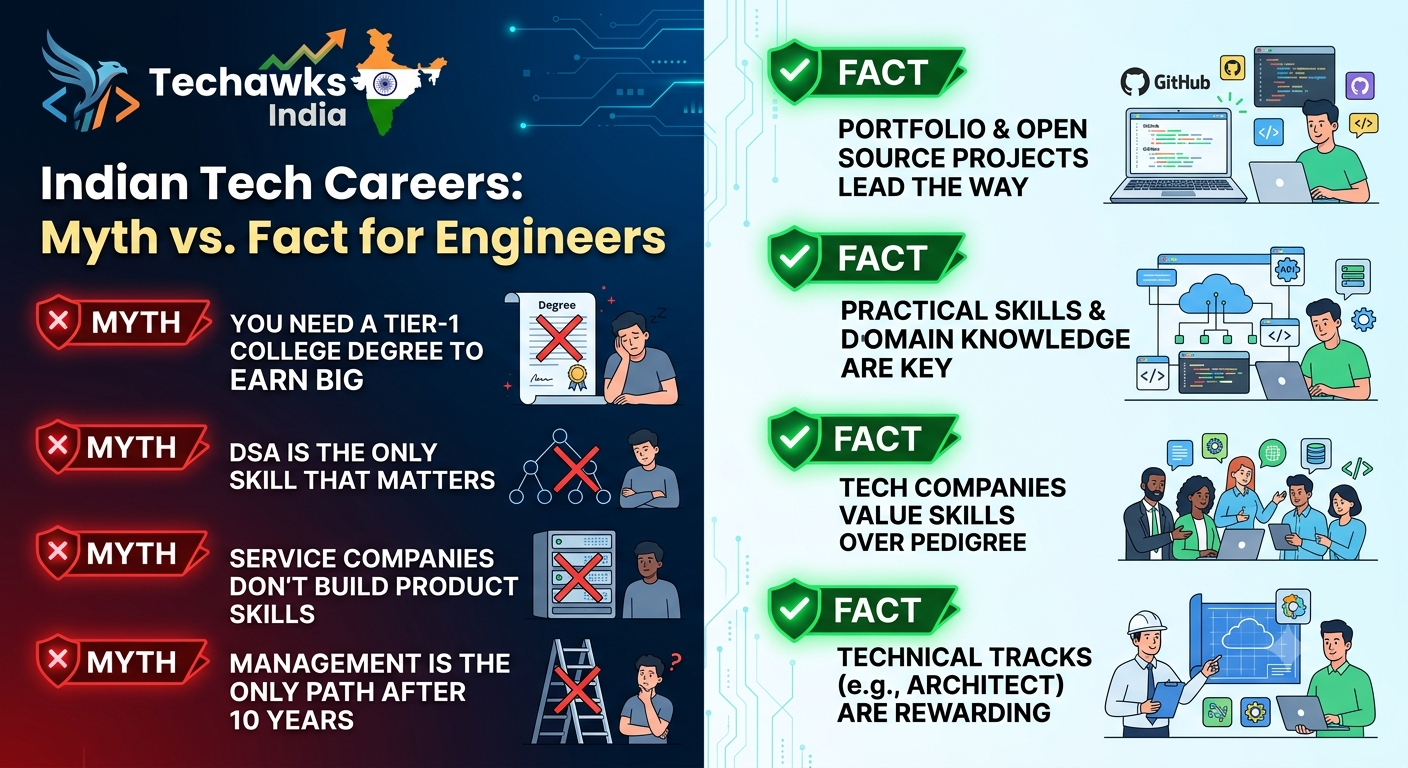
Myth vs. Fact: 4 Tech Career Myths Holding Indian Developers Back
Navigating the Indian tech industry can feel overwhelming with all the conflicting advice on LinkedIn and YouTube. To build a sustainable, high-growth engineering career, you need to separate outdated norms from real-world hiring standards.
Here are four common myths that hold talented Indian engineers back:
Myth 1: Competitive Programming (DSA) is All That Matters for Product Companies
❌ Myth: Grinding 1,000+ LeetCode problems is the only way to get hired by top product firms and startups in India.
✅ Fact: While Data Structures & Algorithms get you through the initial screening, practical system design, clean coding standards, and real-world project execution determine whether you clear system design rounds or land senior roles.
Actionable Advice: Balance your preparation—spend 40% of your time on problem-solving fundamentals and 60% building production-ready projects with proper logging, testing, and containerization.
Myth 2: Service-to-Product Company Switching is Impossible
❌ Myth: If you start your career in an IT services firm, product-based companies and high-growth startups will automatically reject your resume.
✅ Fact: Product companies care about individual capability, system ownership, and domain depth—not your previous employer's business model.
Actionable Advice: Highlight core engineering outcomes on your resume. Document open-source contributions, build high-concurrency side projects, and showcase public proof of work on GitHub or tech blogs.
Myth 3: Moving to Management is the Only Way to Scale Salary in India
❌ Myth: You must transition into Engineering Manager or Project Manager roles by age 30 to earn a top-tier compensation package.
✅ Fact: The Indian tech ecosystem has matured. Individual Contributor (IC) tracks—such as Staff Engineer, Principal Architect, and Specialist—offer equal or higher compensation without requiring people management.
Actionable Advice: Focus on deepening your domain expertise (e.g., Cloud Architecture, Distributed Systems, AI Infrastructure) if you prefer technical depth over administrative management.
Myth 4: Notice Periods of 90 Days Render You Unhireable
❌ Myth: Having a standard 90-day notice period in India means product startups will never consider your application.
✅ Fact: While startups prefer fast joiners, strong candidate evaluations frequently lead companies to buy out notice periods or wait for exceptional talent.
Actionable Advice: Be upfront during HR screens, keep your technical skills sharp to negotiate buyout terms, and use the last 30 days of your notice period to aggressively interview once your availability is immediate.
Key Takeaways
Proof over prestige: Practical project execution and system design skills matter far more than college pedigree or previous company brand.
Technical depth pays: You don't have to abandon hands-on coding to achieve senior-level compensation in India.
Control your narrative: Build a public tech presence (GitHub, technical writing) to stand out regardless of your notice period or current company background.
CTA
🇮🇳 Ready to cut through the noise and elevate your engineering career? Join the Techawks India community to connect with fellow developers, access system design guides, and attend local tech discussions!
👉 [Join Techawks India]
Navigating the Indian tech industry can feel overwhelming with all the conflicting advice on LinkedIn and YouTube. To build a sustainable, high-growth engineering career, you need to separate outdated norms from real-world hiring standards.
Here are four common myths that hold talented Indian engineers back:
Myth 1: Competitive Programming (DSA) is All That Matters for Product Companies
❌ Myth: Grinding 1,000+ LeetCode problems is the only way to get hired by top product firms and startups in India.
✅ Fact: While Data Structures & Algorithms get you through the initial screening, practical system design, clean coding standards, and real-world project execution determine whether you clear system design rounds or land senior roles.
Actionable Advice: Balance your preparation—spend 40% of your time on problem-solving fundamentals and 60% building production-ready projects with proper logging, testing, and containerization.
Myth 2: Service-to-Product Company Switching is Impossible
❌ Myth: If you start your career in an IT services firm, product-based companies and high-growth startups will automatically reject your resume.
✅ Fact: Product companies care about individual capability, system ownership, and domain depth—not your previous employer's business model.
Actionable Advice: Highlight core engineering outcomes on your resume. Document open-source contributions, build high-concurrency side projects, and showcase public proof of work on GitHub or tech blogs.
Myth 3: Moving to Management is the Only Way to Scale Salary in India
❌ Myth: You must transition into Engineering Manager or Project Manager roles by age 30 to earn a top-tier compensation package.
✅ Fact: The Indian tech ecosystem has matured. Individual Contributor (IC) tracks—such as Staff Engineer, Principal Architect, and Specialist—offer equal or higher compensation without requiring people management.
Actionable Advice: Focus on deepening your domain expertise (e.g., Cloud Architecture, Distributed Systems, AI Infrastructure) if you prefer technical depth over administrative management.
Myth 4: Notice Periods of 90 Days Render You Unhireable
❌ Myth: Having a standard 90-day notice period in India means product startups will never consider your application.
✅ Fact: While startups prefer fast joiners, strong candidate evaluations frequently lead companies to buy out notice periods or wait for exceptional talent.
Actionable Advice: Be upfront during HR screens, keep your technical skills sharp to negotiate buyout terms, and use the last 30 days of your notice period to aggressively interview once your availability is immediate.
Key Takeaways
Proof over prestige: Practical project execution and system design skills matter far more than college pedigree or previous company brand.
Technical depth pays: You don't have to abandon hands-on coding to achieve senior-level compensation in India.
Control your narrative: Build a public tech presence (GitHub, technical writing) to stand out regardless of your notice period or current company background.
CTA
🇮🇳 Ready to cut through the noise and elevate your engineering career? Join the Techawks India community to connect with fellow developers, access system design guides, and attend local tech discussions!
👉 [Join Techawks India]
Myth vs. Fact: 4 Tech Career Myths Holding Indian Developers Back
Navigating the Indian tech industry can feel overwhelming with all the conflicting advice on LinkedIn and YouTube. To build a sustainable, high-growth engineering career, you need to separate outdated norms from real-world hiring standards.
Here are four common myths that hold talented Indian engineers back:
Myth 1: Competitive Programming (DSA) is All That Matters for Product Companies
❌ Myth: Grinding 1,000+ LeetCode problems is the only way to get hired by top product firms and startups in India.
✅ Fact: While Data Structures & Algorithms get you through the initial screening, practical system design, clean coding standards, and real-world project execution determine whether you clear system design rounds or land senior roles.
Actionable Advice: Balance your preparation—spend 40% of your time on problem-solving fundamentals and 60% building production-ready projects with proper logging, testing, and containerization.
Myth 2: Service-to-Product Company Switching is Impossible
❌ Myth: If you start your career in an IT services firm, product-based companies and high-growth startups will automatically reject your resume.
✅ Fact: Product companies care about individual capability, system ownership, and domain depth—not your previous employer's business model.
Actionable Advice: Highlight core engineering outcomes on your resume. Document open-source contributions, build high-concurrency side projects, and showcase public proof of work on GitHub or tech blogs.
Myth 3: Moving to Management is the Only Way to Scale Salary in India
❌ Myth: You must transition into Engineering Manager or Project Manager roles by age 30 to earn a top-tier compensation package.
✅ Fact: The Indian tech ecosystem has matured. Individual Contributor (IC) tracks—such as Staff Engineer, Principal Architect, and Specialist—offer equal or higher compensation without requiring people management.
Actionable Advice: Focus on deepening your domain expertise (e.g., Cloud Architecture, Distributed Systems, AI Infrastructure) if you prefer technical depth over administrative management.
Myth 4: Notice Periods of 90 Days Render You Unhireable
❌ Myth: Having a standard 90-day notice period in India means product startups will never consider your application.
✅ Fact: While startups prefer fast joiners, strong candidate evaluations frequently lead companies to buy out notice periods or wait for exceptional talent.
Actionable Advice: Be upfront during HR screens, keep your technical skills sharp to negotiate buyout terms, and use the last 30 days of your notice period to aggressively interview once your availability is immediate.
Key Takeaways
Proof over prestige: Practical project execution and system design skills matter far more than college pedigree or previous company brand.
Technical depth pays: You don't have to abandon hands-on coding to achieve senior-level compensation in India.
Control your narrative: Build a public tech presence (GitHub, technical writing) to stand out regardless of your notice period or current company background.
CTA
🇮🇳 Ready to cut through the noise and elevate your engineering career? Join the Techawks India community to connect with fellow developers, access system design guides, and attend local tech discussions!
👉 [Join Techawks India]

 English
 Arabic
 French
 Spanish
 Portuguese
 Deutsch
 Dutch
Dutch
 Italiano
 Russian
 Romaian
 Portuguese (Brazil)
 Greek
Greek