


From Blank Canvas to Connected Flows: Why Product-Aware AI Prototyping is Replacing Static Wireframes
Modern product management and UX design are moving past generic, blank-canvas AI generators toward context-aware prototyping tools. Platforms like UXMagic, Figr, and advanced design system integrations are shifting how teams transition from problem statements to interactive test environments.
Why it matters:
Early-stage AI tools used to output isolated, disconnected screens that didn't respect existing design systems or product architecture, creating more technical and design debt than they solved. Today's product-aware prototyping agents ingest existing token libraries, user flows, and product data to generate multi-screen, connected journeys. This compresses the discovery loop, letting PMs and designers focus on usability logic and edge cases rather than manual layout construction.
What you can learn (The Product Playbook):
When integrating AI prototyping into your discovery and validation workflows, apply these three rules:
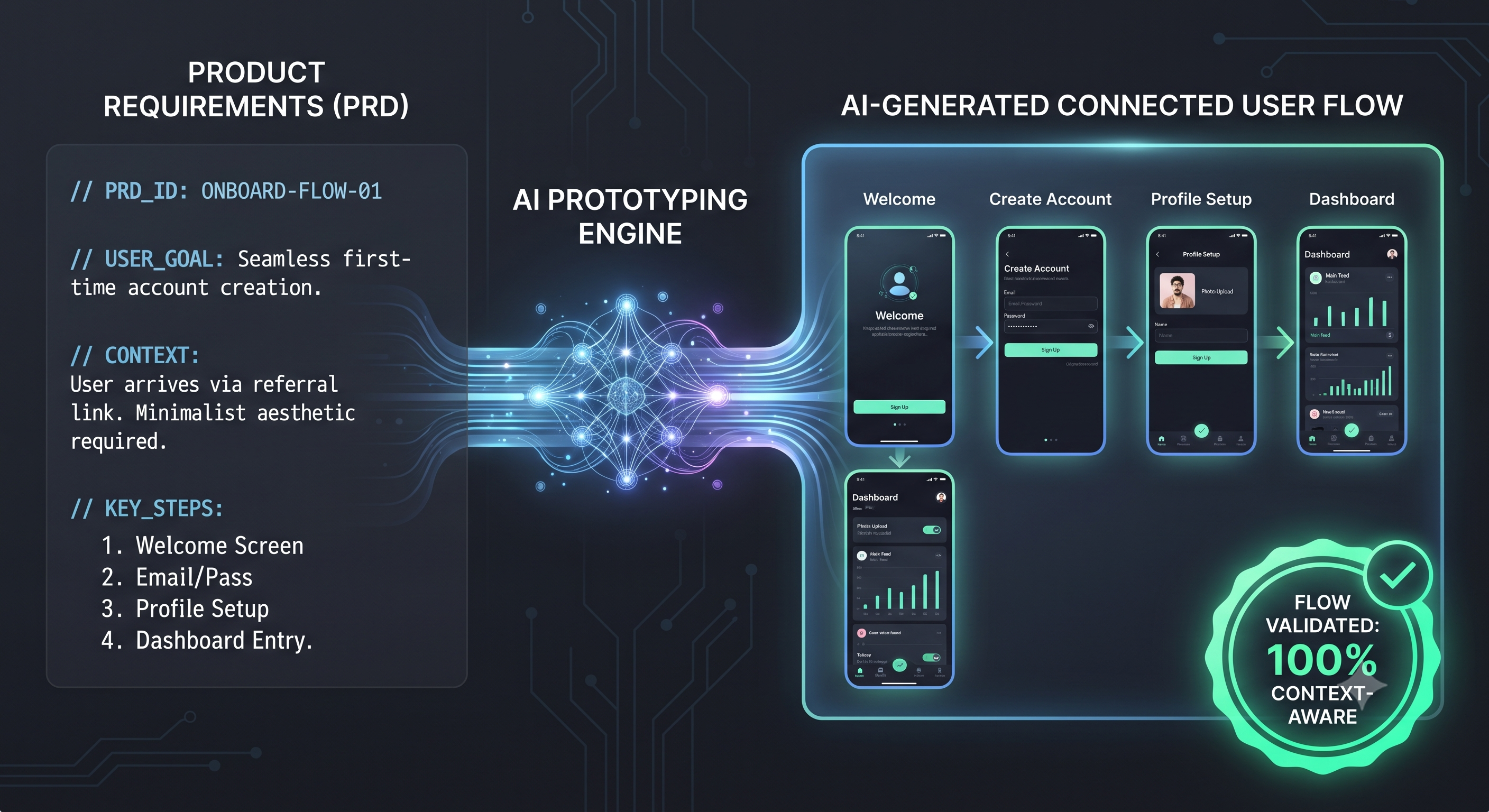
Context First, Prompts Second: Feed your AI tools real product artifacts—like PRD segments, user research themes, or existing design tokens—instead of starting from a blind prompt.
Prioritize Connected Flows over Single Screens: Test complete end-to-end user journeys (e.g., onboarding to first core action) rather than evaluating isolated UI components out of context.
Keep Humans in the Loop for Usability: Use AI to accelerate layout generation and rapid iteration, but rely on human product judgment to validate information hierarchy, emotional states, and actual user friction.
Discussion Question
Are you using AI prototyping tools to accelerate your discovery phase, or are you still relying on traditional wireframing workflows? What has been your biggest challenge with AI-generated UI?
CTA (Join Product, UX & Design)
Ready to master modern product discovery, design systems, and cutting-edge UX workflows? Join the Techawks Product, UX & Design community today to connect with product leaders and designers shaping the future
Modern product management and UX design are moving past generic, blank-canvas AI generators toward context-aware prototyping tools. Platforms like UXMagic, Figr, and advanced design system integrations are shifting how teams transition from problem statements to interactive test environments.
Why it matters:
Early-stage AI tools used to output isolated, disconnected screens that didn't respect existing design systems or product architecture, creating more technical and design debt than they solved. Today's product-aware prototyping agents ingest existing token libraries, user flows, and product data to generate multi-screen, connected journeys. This compresses the discovery loop, letting PMs and designers focus on usability logic and edge cases rather than manual layout construction.
What you can learn (The Product Playbook):
When integrating AI prototyping into your discovery and validation workflows, apply these three rules:
Context First, Prompts Second: Feed your AI tools real product artifacts—like PRD segments, user research themes, or existing design tokens—instead of starting from a blind prompt.
Prioritize Connected Flows over Single Screens: Test complete end-to-end user journeys (e.g., onboarding to first core action) rather than evaluating isolated UI components out of context.
Keep Humans in the Loop for Usability: Use AI to accelerate layout generation and rapid iteration, but rely on human product judgment to validate information hierarchy, emotional states, and actual user friction.
Discussion Question
Are you using AI prototyping tools to accelerate your discovery phase, or are you still relying on traditional wireframing workflows? What has been your biggest challenge with AI-generated UI?
CTA (Join Product, UX & Design)
Ready to master modern product discovery, design systems, and cutting-edge UX workflows? Join the Techawks Product, UX & Design community today to connect with product leaders and designers shaping the future
From Blank Canvas to Connected Flows: Why Product-Aware AI Prototyping is Replacing Static Wireframes
Modern product management and UX design are moving past generic, blank-canvas AI generators toward context-aware prototyping tools. Platforms like UXMagic, Figr, and advanced design system integrations are shifting how teams transition from problem statements to interactive test environments.
Why it matters:
Early-stage AI tools used to output isolated, disconnected screens that didn't respect existing design systems or product architecture, creating more technical and design debt than they solved. Today's product-aware prototyping agents ingest existing token libraries, user flows, and product data to generate multi-screen, connected journeys. This compresses the discovery loop, letting PMs and designers focus on usability logic and edge cases rather than manual layout construction.
What you can learn (The Product Playbook):
When integrating AI prototyping into your discovery and validation workflows, apply these three rules:
Context First, Prompts Second: Feed your AI tools real product artifacts—like PRD segments, user research themes, or existing design tokens—instead of starting from a blind prompt.
Prioritize Connected Flows over Single Screens: Test complete end-to-end user journeys (e.g., onboarding to first core action) rather than evaluating isolated UI components out of context.
Keep Humans in the Loop for Usability: Use AI to accelerate layout generation and rapid iteration, but rely on human product judgment to validate information hierarchy, emotional states, and actual user friction.
Discussion Question
Are you using AI prototyping tools to accelerate your discovery phase, or are you still relying on traditional wireframing workflows? What has been your biggest challenge with AI-generated UI?
CTA (Join Product, UX & Design)
Ready to master modern product discovery, design systems, and cutting-edge UX workflows? Join the Techawks Product, UX & Design community today to connect with product leaders and designers shaping the future

 English
 Arabic
 French
 Spanish
 Portuguese
 Deutsch
 Turkish
 Dutch
Dutch
 Russian
 Romaian
 Portuguese (Brazil)
 Greek
Greek