


NPCI’s Unified Agentic Protocol: The 5-Point Engineering Checklist for AI Payments
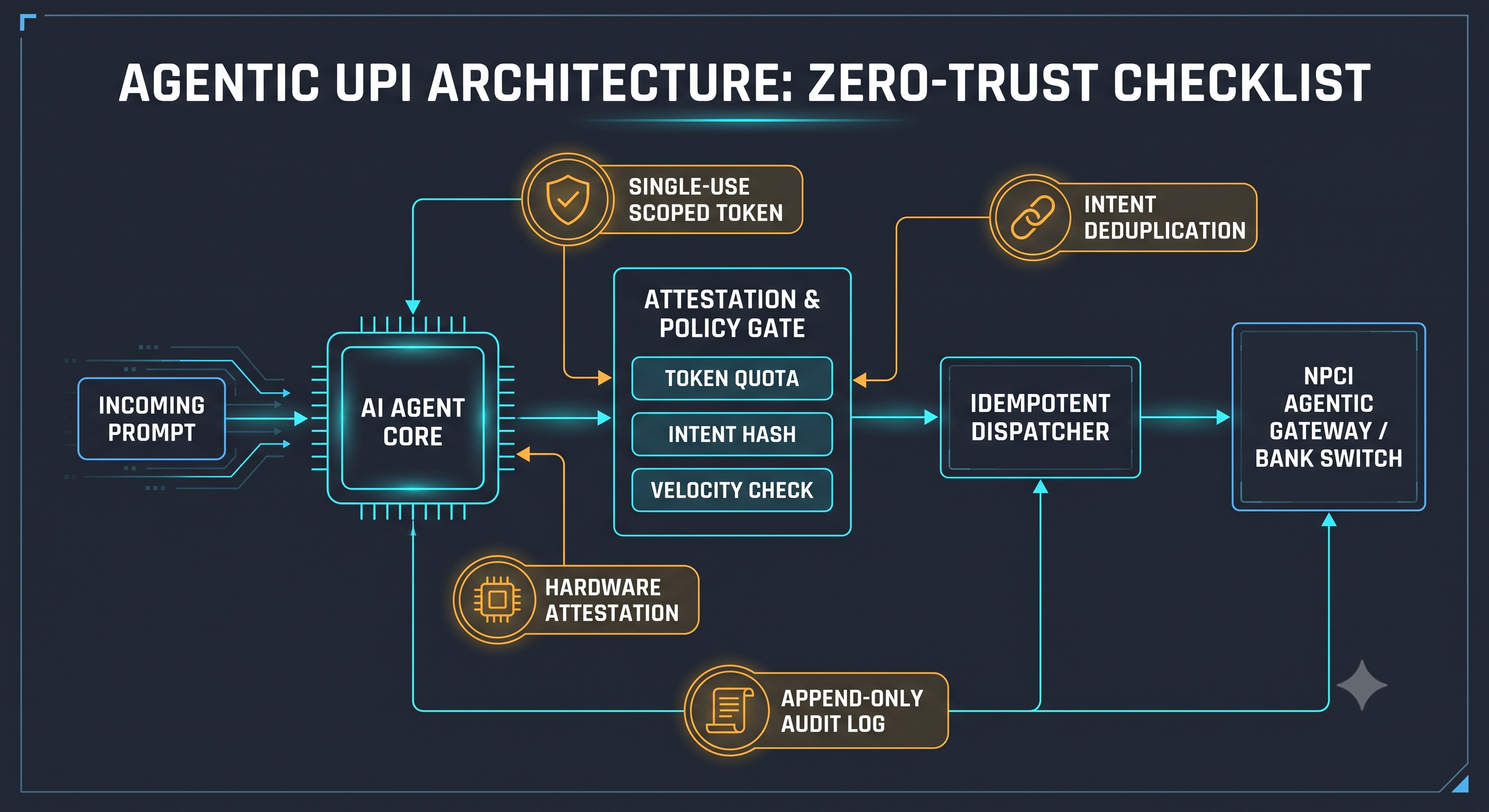
NPCI is actively establishing a verified registry for AI agents under the Unified Agentic Protocol (UAP) to govern autonomous UPI workflows. Autonomous checkout shifts your backend architecture from human-in-the-loop (interactive UI/OTP) to machine-to-machine delegation. If your microservices interact with financial rails, consumer commerce, or agentic automation, run through this production readiness checklist:
1. Scope and Cap Token Privileges (Strict Authorization)Never grant an autonomous runtime unbounded payment scope.
Implement deterministic, single-use delegated tokens that enforce strict per-transaction and cumulative session caps (e.g., maximum ₹2,000 per autonomous session).Anchor revocable permissions to the user's UPI mandate lifecycle rather than static API keys.
2. Enforce Mutual TLS & Agent Attestation AI agents should authenticate using cryptographic device/runtime attestation (hardware-backed enclave or signed cryptographic identity) registered against the upcoming registry.
Validate signed execution payloads end-to-end to prevent prompt-injection attacks from hijacking downstream settlement calls.
3. Idempotency at the Agent Orchestration Layer LLMs and autonomous loops frequently retry stalled tasks upon latency spikes.
Design robust idempotency keys tied directly to the high-level user intent rather than the agent’s generated prompt variations.
Ensure your payment gateway adapter deduplicates retries within a 15-minute sliding TTL window.
4. Asymmetric Circuit Breakers & Anomaly Monitoring Autonomous systems generate abnormal transaction velocities compared to humans.
Deploy localized circuit breakers that trip on velocity spikes (e.g., >3 automated transactions within 60 seconds) and automatically demote the workflow back to human step-up authentication.5. Audit Logging for Non-Deterministic Workflows Traditional logs only track request headers and SQL mutations.
Persist the agent's intent vector, tool-call payload, temperature, model version, and exact authorization chain in an append-only audit store for DPDP Act compliance and chargeback resolution.
Discussion Question
As autonomous agents begin handling micro-payments directly via UPI, where is the biggest security vulnerability in your current architecture: tool invocation validation, timeout handling, or token lifecycle?CTA (Join Techawks India)
Building for scale on India’s Digital Public Infrastructure? Join Techawks India to discuss production architectures, system design patterns, and engineering deep dives with peers building the future of Indian tech.
NPCI is actively establishing a verified registry for AI agents under the Unified Agentic Protocol (UAP) to govern autonomous UPI workflows. Autonomous checkout shifts your backend architecture from human-in-the-loop (interactive UI/OTP) to machine-to-machine delegation. If your microservices interact with financial rails, consumer commerce, or agentic automation, run through this production readiness checklist:
1. Scope and Cap Token Privileges (Strict Authorization)Never grant an autonomous runtime unbounded payment scope.
Implement deterministic, single-use delegated tokens that enforce strict per-transaction and cumulative session caps (e.g., maximum ₹2,000 per autonomous session).Anchor revocable permissions to the user's UPI mandate lifecycle rather than static API keys.
2. Enforce Mutual TLS & Agent Attestation AI agents should authenticate using cryptographic device/runtime attestation (hardware-backed enclave or signed cryptographic identity) registered against the upcoming registry.
Validate signed execution payloads end-to-end to prevent prompt-injection attacks from hijacking downstream settlement calls.
3. Idempotency at the Agent Orchestration Layer LLMs and autonomous loops frequently retry stalled tasks upon latency spikes.
Design robust idempotency keys tied directly to the high-level user intent rather than the agent’s generated prompt variations.
Ensure your payment gateway adapter deduplicates retries within a 15-minute sliding TTL window.
4. Asymmetric Circuit Breakers & Anomaly Monitoring Autonomous systems generate abnormal transaction velocities compared to humans.
Deploy localized circuit breakers that trip on velocity spikes (e.g., >3 automated transactions within 60 seconds) and automatically demote the workflow back to human step-up authentication.5. Audit Logging for Non-Deterministic Workflows Traditional logs only track request headers and SQL mutations.
Persist the agent's intent vector, tool-call payload, temperature, model version, and exact authorization chain in an append-only audit store for DPDP Act compliance and chargeback resolution.
Discussion Question
As autonomous agents begin handling micro-payments directly via UPI, where is the biggest security vulnerability in your current architecture: tool invocation validation, timeout handling, or token lifecycle?CTA (Join Techawks India)
Building for scale on India’s Digital Public Infrastructure? Join Techawks India to discuss production architectures, system design patterns, and engineering deep dives with peers building the future of Indian tech.
NPCI’s Unified Agentic Protocol: The 5-Point Engineering Checklist for AI Payments
NPCI is actively establishing a verified registry for AI agents under the Unified Agentic Protocol (UAP) to govern autonomous UPI workflows. Autonomous checkout shifts your backend architecture from human-in-the-loop (interactive UI/OTP) to machine-to-machine delegation. If your microservices interact with financial rails, consumer commerce, or agentic automation, run through this production readiness checklist:
1. Scope and Cap Token Privileges (Strict Authorization)Never grant an autonomous runtime unbounded payment scope.
Implement deterministic, single-use delegated tokens that enforce strict per-transaction and cumulative session caps (e.g., maximum ₹2,000 per autonomous session).Anchor revocable permissions to the user's UPI mandate lifecycle rather than static API keys.
2. Enforce Mutual TLS & Agent Attestation AI agents should authenticate using cryptographic device/runtime attestation (hardware-backed enclave or signed cryptographic identity) registered against the upcoming registry.
Validate signed execution payloads end-to-end to prevent prompt-injection attacks from hijacking downstream settlement calls.
3. Idempotency at the Agent Orchestration Layer LLMs and autonomous loops frequently retry stalled tasks upon latency spikes.
Design robust idempotency keys tied directly to the high-level user intent rather than the agent’s generated prompt variations.
Ensure your payment gateway adapter deduplicates retries within a 15-minute sliding TTL window.
4. Asymmetric Circuit Breakers & Anomaly Monitoring Autonomous systems generate abnormal transaction velocities compared to humans.
Deploy localized circuit breakers that trip on velocity spikes (e.g., >3 automated transactions within 60 seconds) and automatically demote the workflow back to human step-up authentication.5. Audit Logging for Non-Deterministic Workflows Traditional logs only track request headers and SQL mutations.
Persist the agent's intent vector, tool-call payload, temperature, model version, and exact authorization chain in an append-only audit store for DPDP Act compliance and chargeback resolution.
Discussion Question
As autonomous agents begin handling micro-payments directly via UPI, where is the biggest security vulnerability in your current architecture: tool invocation validation, timeout handling, or token lifecycle?CTA (Join Techawks India)
Building for scale on India’s Digital Public Infrastructure? Join Techawks India to discuss production architectures, system design patterns, and engineering deep dives with peers building the future of Indian tech.

 Arabic
 French
 Spanish
 Portuguese
 Deutsch
 Turkish
 Dutch
Dutch
 Italiano
 Russian
 Romaian
 Portuguese (Brazil)
 Greek
Greek