


The System Architecture Challenge: Can Your Infrastructure Handle a Region-Wide Outage?
True high availability requires active multi-region or automated cross-region failover design. Take this non-destructive architectural audit to see where your infrastructure breaks when a primary cloud region goes dark.
The Challenge Scenario
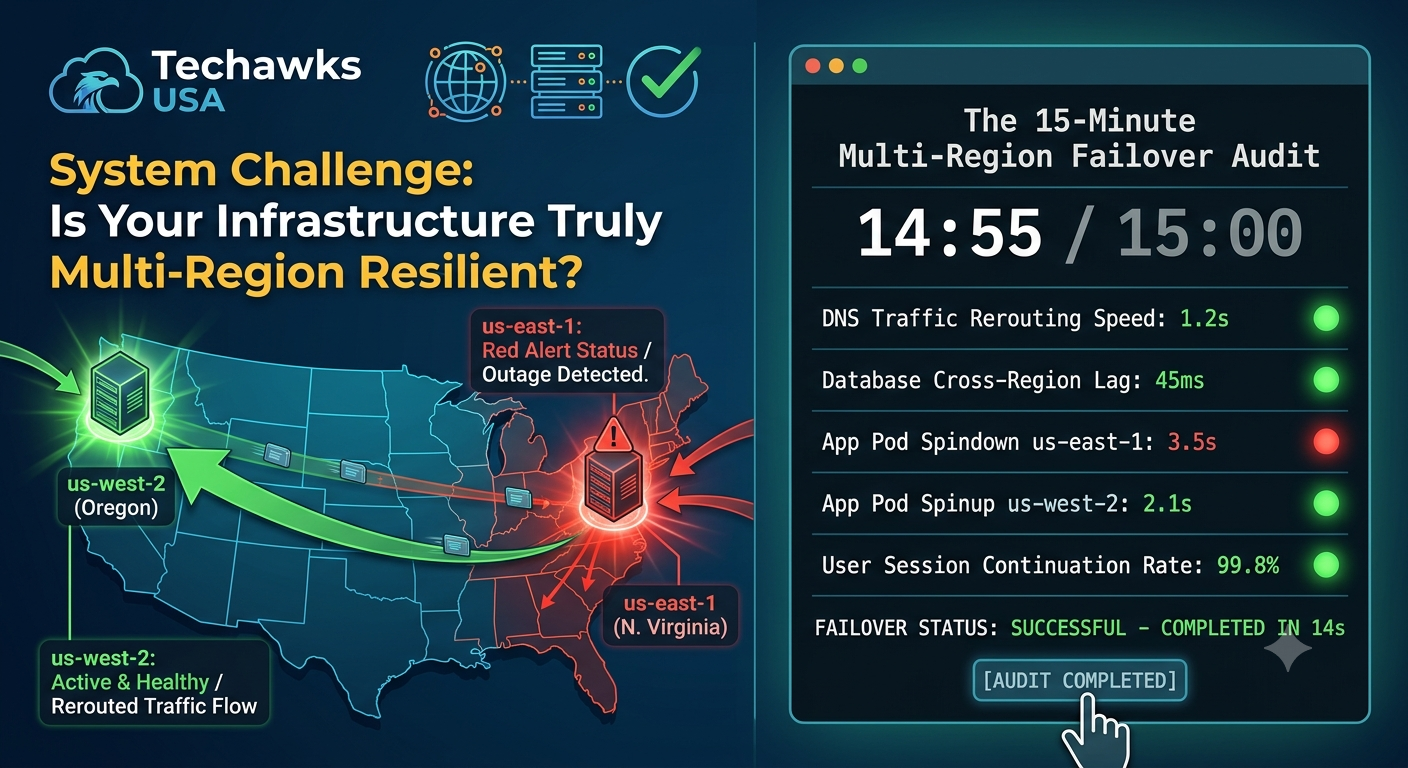
Condition: Your primary US region (us-east-1) experiences a complete networking black hole. Global DNS routes all traffic to your secondary region (us-west-2).
Score Your Multi-Region Readiness:
Level 1: Data Replication & Consistency
The Test: How are your primary databases configured across regions?
🛑 Fail: You rely on manual snapshot restores or single-region primary databases, causing hours of downtime and data loss.
🛠️ The Fix: Implement cross-region asynchronous read replicas with automated failover promotion (e.g., AWS Aurora Global Database or CockroachDB multi-region clusters).
Level 2: Global Traffic Management
The Test: How quickly does your DNS/routing layer detect region failure and reroute live traffic?
🛑 Fail: High DNS Time-To-Live (TTL) values force client devices to cache stale, unreachable IP addresses for 15+ minutes.
🛠️ The Fix: Use health-checked Anycast DNS or Global Accelerator endpoints with low TTLs (<60 seconds) for automatic traffic steering.
Level 3: State & Cache Synchronization
The Test: What happens to active user sessions and cached tokens during failover?
🛑 Fail: User sessions drop completely, forcing every active user to log in again and overloading downstream authentication services.
🛠️ The Fix: Use globally distributed session stores (like Redis Enterprise with Active-Active replication) or stateless JWT-based authentication.
Level 4: Cross-Region Secrets & Config Sync
The Test: Are environment secrets and feature flags identical and instantly readable in the secondary region?
🛑 Fail: Secondary app pods crash on boot because secrets or API keys are missing or out of sync.
🛠️ The Fix: Enforce Infrastructure-as-Code (Terraform/Pulumi) to deploy identical configurations and replicate secrets cross-region via secret management tools.
Key Takeaways
Failover must be automated: Manual DNS switches or manual DB promotions during an outage add unnecessary recovery time.
Watch out for data replication lag: Always design write paths to handle temporary async replication delays between US coasts.
Treat infrastructure as code: Identical deployment templates across regions are the only way to prevent silent configuration drift.
CTA
🇺🇸 How did your system architecture score on the multi-region resilience test? Drop your failover strategies and toolstacks in the comments below! For more hands-on system design challenges, cloud architecture guides, and tech leadership insights, join Techawks USA.
👉 [Join Techawks USA]
True high availability requires active multi-region or automated cross-region failover design. Take this non-destructive architectural audit to see where your infrastructure breaks when a primary cloud region goes dark.
The Challenge Scenario
Condition: Your primary US region (us-east-1) experiences a complete networking black hole. Global DNS routes all traffic to your secondary region (us-west-2).
Score Your Multi-Region Readiness:
Level 1: Data Replication & Consistency
The Test: How are your primary databases configured across regions?
🛑 Fail: You rely on manual snapshot restores or single-region primary databases, causing hours of downtime and data loss.
🛠️ The Fix: Implement cross-region asynchronous read replicas with automated failover promotion (e.g., AWS Aurora Global Database or CockroachDB multi-region clusters).
Level 2: Global Traffic Management
The Test: How quickly does your DNS/routing layer detect region failure and reroute live traffic?
🛑 Fail: High DNS Time-To-Live (TTL) values force client devices to cache stale, unreachable IP addresses for 15+ minutes.
🛠️ The Fix: Use health-checked Anycast DNS or Global Accelerator endpoints with low TTLs (<60 seconds) for automatic traffic steering.
Level 3: State & Cache Synchronization
The Test: What happens to active user sessions and cached tokens during failover?
🛑 Fail: User sessions drop completely, forcing every active user to log in again and overloading downstream authentication services.
🛠️ The Fix: Use globally distributed session stores (like Redis Enterprise with Active-Active replication) or stateless JWT-based authentication.
Level 4: Cross-Region Secrets & Config Sync
The Test: Are environment secrets and feature flags identical and instantly readable in the secondary region?
🛑 Fail: Secondary app pods crash on boot because secrets or API keys are missing or out of sync.
🛠️ The Fix: Enforce Infrastructure-as-Code (Terraform/Pulumi) to deploy identical configurations and replicate secrets cross-region via secret management tools.
Key Takeaways
Failover must be automated: Manual DNS switches or manual DB promotions during an outage add unnecessary recovery time.
Watch out for data replication lag: Always design write paths to handle temporary async replication delays between US coasts.
Treat infrastructure as code: Identical deployment templates across regions are the only way to prevent silent configuration drift.
CTA
🇺🇸 How did your system architecture score on the multi-region resilience test? Drop your failover strategies and toolstacks in the comments below! For more hands-on system design challenges, cloud architecture guides, and tech leadership insights, join Techawks USA.
👉 [Join Techawks USA]
The System Architecture Challenge: Can Your Infrastructure Handle a Region-Wide Outage?
True high availability requires active multi-region or automated cross-region failover design. Take this non-destructive architectural audit to see where your infrastructure breaks when a primary cloud region goes dark.
The Challenge Scenario
Condition: Your primary US region (us-east-1) experiences a complete networking black hole. Global DNS routes all traffic to your secondary region (us-west-2).
Score Your Multi-Region Readiness:
Level 1: Data Replication & Consistency
The Test: How are your primary databases configured across regions?
🛑 Fail: You rely on manual snapshot restores or single-region primary databases, causing hours of downtime and data loss.
🛠️ The Fix: Implement cross-region asynchronous read replicas with automated failover promotion (e.g., AWS Aurora Global Database or CockroachDB multi-region clusters).
Level 2: Global Traffic Management
The Test: How quickly does your DNS/routing layer detect region failure and reroute live traffic?
🛑 Fail: High DNS Time-To-Live (TTL) values force client devices to cache stale, unreachable IP addresses for 15+ minutes.
🛠️ The Fix: Use health-checked Anycast DNS or Global Accelerator endpoints with low TTLs (<60 seconds) for automatic traffic steering.
Level 3: State & Cache Synchronization
The Test: What happens to active user sessions and cached tokens during failover?
🛑 Fail: User sessions drop completely, forcing every active user to log in again and overloading downstream authentication services.
🛠️ The Fix: Use globally distributed session stores (like Redis Enterprise with Active-Active replication) or stateless JWT-based authentication.
Level 4: Cross-Region Secrets & Config Sync
The Test: Are environment secrets and feature flags identical and instantly readable in the secondary region?
🛑 Fail: Secondary app pods crash on boot because secrets or API keys are missing or out of sync.
🛠️ The Fix: Enforce Infrastructure-as-Code (Terraform/Pulumi) to deploy identical configurations and replicate secrets cross-region via secret management tools.
Key Takeaways
Failover must be automated: Manual DNS switches or manual DB promotions during an outage add unnecessary recovery time.
Watch out for data replication lag: Always design write paths to handle temporary async replication delays between US coasts.
Treat infrastructure as code: Identical deployment templates across regions are the only way to prevent silent configuration drift.
CTA
🇺🇸 How did your system architecture score on the multi-region resilience test? Drop your failover strategies and toolstacks in the comments below! For more hands-on system design challenges, cloud architecture guides, and tech leadership insights, join Techawks USA.
👉 [Join Techawks USA]

 English
 Arabic
 French
 Spanish
 Portuguese
 Deutsch
 Turkish
 Dutch
Dutch
 Italiano
 Russian
 Romaian
 Greek
Greek