


UAE Sovereign Cloud & AI Mandates: The 5-Point Engineering Checklist for In-Country Data Residency
As the UAE doubles down on sovereign AI initiatives—spanning localized LLMs like Jais and Falcon to DESC-certified cloud environments—engineering teams face strict enforcement around cross-border data sovereignty.
In production, digital sovereignty is not just where your primary database sits; it governs where your prompt vectors are embedded, where automated error logs route, and who controls cryptographic keys. Relying on generic public cloud configurations frequently leaks data offshore during automated backups, support ticket dumps, or third-party inference calls.
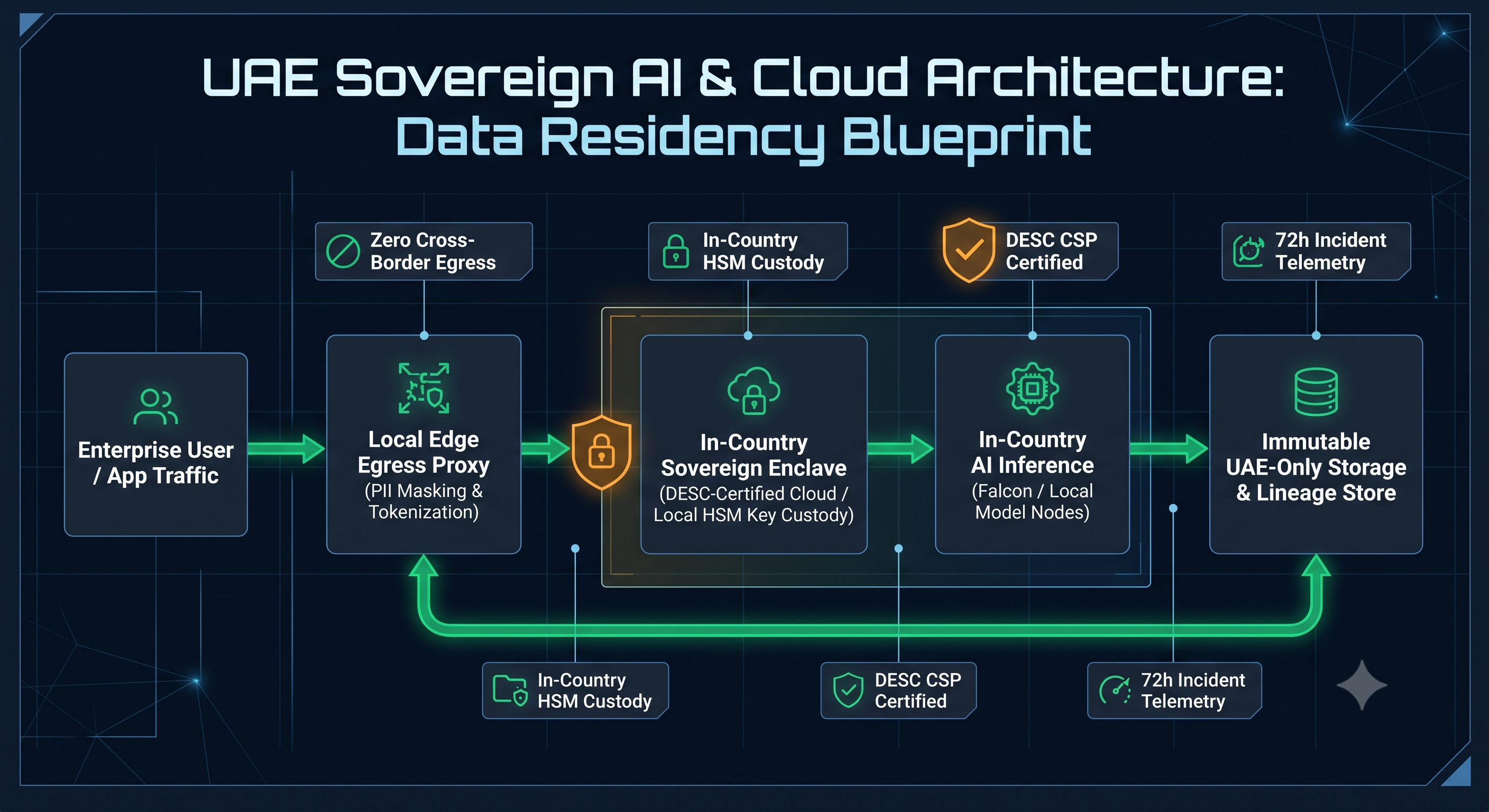
Here is the 5-point production checklist UAE engineering leads and platform architects must implement:
1. In-Country Inference Routing for Sensitive Datasets
If your application handles Level 3/Level 4 enterprise or regulated consumer data, queries must not egress to offshore inference endpoints.
Deploy local model runtimes or integrate with verified in-country sovereign AI platforms (such as Core42 or UAE-domiciled sovereign enclaves) to guarantee data never crosses geographic boundaries for model evaluation or batch processing.
2. BYOK with In-Country Hardware Security Modules (HSM)
Retain explicit key custody within UAE borders.
Enforce "Bring Your Own Key" (BYOK) architecture where root encryption keys are managed in dedicated, local FIPS 140-2 Level 3 HSMs. Foreign-managed root keys or cloud providers subject to extraterritorial discovery laws (like the US CLOUD Act) fail sovereign data ring-fencing audits.
3. Egress Sanitization & Real-Time PII Masking Proxies
Deploy an inline proxy layer upstream of any external tool invocation or third-party microservice.
Automatically detect and strip Emirates ID numbers, phone numbers, and sensitive personal identifiers using local NLP tokenizers before payloads hit asynchronous queues or external SaaS processors.
4. Audit Pipeline Telemetry, Backups & Subprocessors
Hyperscaler disaster recovery and logging defaults often replicate snapshots to secondary regions outside the Middle East.
Explicitly configure regional lock policies: ensure secondary backup targets, CloudWatch/Datadog log streams, and container registry mirrors remain restricted strictly to UAE physical availability zones.
5. Automated 72-Hour Breach Notification & Lineage Telemetry
Under UAE PDPL, personal data incidents require statutory notification within 72 hours to the UAE Data Office.
Implement immutable data lineage tracing at the storage layer so you can pinpoint the exact scope of affected records within minutes of an anomalous query event, rather than relying on manual log reconstruction.
Discussion Question
When deploying generative AI models and RAG pipelines in the UAE, how is your team handling prompt telemetry—are you hosting models fully in-country, using client-side masking proxies, or running hybrid sovereign enclaves?
CTA (Join Techawks UAE)
Building high-scale, resilient architectures and AI systems in the Emirates? Join Techawks UAE to exchange blueprints, sovereign cloud best practices, and engineering insights with the region’s top tech leaders.
As the UAE doubles down on sovereign AI initiatives—spanning localized LLMs like Jais and Falcon to DESC-certified cloud environments—engineering teams face strict enforcement around cross-border data sovereignty.
In production, digital sovereignty is not just where your primary database sits; it governs where your prompt vectors are embedded, where automated error logs route, and who controls cryptographic keys. Relying on generic public cloud configurations frequently leaks data offshore during automated backups, support ticket dumps, or third-party inference calls.
Here is the 5-point production checklist UAE engineering leads and platform architects must implement:
1. In-Country Inference Routing for Sensitive Datasets
If your application handles Level 3/Level 4 enterprise or regulated consumer data, queries must not egress to offshore inference endpoints.
Deploy local model runtimes or integrate with verified in-country sovereign AI platforms (such as Core42 or UAE-domiciled sovereign enclaves) to guarantee data never crosses geographic boundaries for model evaluation or batch processing.
2. BYOK with In-Country Hardware Security Modules (HSM)
Retain explicit key custody within UAE borders.
Enforce "Bring Your Own Key" (BYOK) architecture where root encryption keys are managed in dedicated, local FIPS 140-2 Level 3 HSMs. Foreign-managed root keys or cloud providers subject to extraterritorial discovery laws (like the US CLOUD Act) fail sovereign data ring-fencing audits.
3. Egress Sanitization & Real-Time PII Masking Proxies
Deploy an inline proxy layer upstream of any external tool invocation or third-party microservice.
Automatically detect and strip Emirates ID numbers, phone numbers, and sensitive personal identifiers using local NLP tokenizers before payloads hit asynchronous queues or external SaaS processors.
4. Audit Pipeline Telemetry, Backups & Subprocessors
Hyperscaler disaster recovery and logging defaults often replicate snapshots to secondary regions outside the Middle East.
Explicitly configure regional lock policies: ensure secondary backup targets, CloudWatch/Datadog log streams, and container registry mirrors remain restricted strictly to UAE physical availability zones.
5. Automated 72-Hour Breach Notification & Lineage Telemetry
Under UAE PDPL, personal data incidents require statutory notification within 72 hours to the UAE Data Office.
Implement immutable data lineage tracing at the storage layer so you can pinpoint the exact scope of affected records within minutes of an anomalous query event, rather than relying on manual log reconstruction.
Discussion Question
When deploying generative AI models and RAG pipelines in the UAE, how is your team handling prompt telemetry—are you hosting models fully in-country, using client-side masking proxies, or running hybrid sovereign enclaves?
CTA (Join Techawks UAE)
Building high-scale, resilient architectures and AI systems in the Emirates? Join Techawks UAE to exchange blueprints, sovereign cloud best practices, and engineering insights with the region’s top tech leaders.
UAE Sovereign Cloud & AI Mandates: The 5-Point Engineering Checklist for In-Country Data Residency
As the UAE doubles down on sovereign AI initiatives—spanning localized LLMs like Jais and Falcon to DESC-certified cloud environments—engineering teams face strict enforcement around cross-border data sovereignty.
In production, digital sovereignty is not just where your primary database sits; it governs where your prompt vectors are embedded, where automated error logs route, and who controls cryptographic keys. Relying on generic public cloud configurations frequently leaks data offshore during automated backups, support ticket dumps, or third-party inference calls.
Here is the 5-point production checklist UAE engineering leads and platform architects must implement:
1. In-Country Inference Routing for Sensitive Datasets
If your application handles Level 3/Level 4 enterprise or regulated consumer data, queries must not egress to offshore inference endpoints.
Deploy local model runtimes or integrate with verified in-country sovereign AI platforms (such as Core42 or UAE-domiciled sovereign enclaves) to guarantee data never crosses geographic boundaries for model evaluation or batch processing.
2. BYOK with In-Country Hardware Security Modules (HSM)
Retain explicit key custody within UAE borders.
Enforce "Bring Your Own Key" (BYOK) architecture where root encryption keys are managed in dedicated, local FIPS 140-2 Level 3 HSMs. Foreign-managed root keys or cloud providers subject to extraterritorial discovery laws (like the US CLOUD Act) fail sovereign data ring-fencing audits.
3. Egress Sanitization & Real-Time PII Masking Proxies
Deploy an inline proxy layer upstream of any external tool invocation or third-party microservice.
Automatically detect and strip Emirates ID numbers, phone numbers, and sensitive personal identifiers using local NLP tokenizers before payloads hit asynchronous queues or external SaaS processors.
4. Audit Pipeline Telemetry, Backups & Subprocessors
Hyperscaler disaster recovery and logging defaults often replicate snapshots to secondary regions outside the Middle East.
Explicitly configure regional lock policies: ensure secondary backup targets, CloudWatch/Datadog log streams, and container registry mirrors remain restricted strictly to UAE physical availability zones.
5. Automated 72-Hour Breach Notification & Lineage Telemetry
Under UAE PDPL, personal data incidents require statutory notification within 72 hours to the UAE Data Office.
Implement immutable data lineage tracing at the storage layer so you can pinpoint the exact scope of affected records within minutes of an anomalous query event, rather than relying on manual log reconstruction.
Discussion Question
When deploying generative AI models and RAG pipelines in the UAE, how is your team handling prompt telemetry—are you hosting models fully in-country, using client-side masking proxies, or running hybrid sovereign enclaves?
CTA (Join Techawks UAE)
Building high-scale, resilient architectures and AI systems in the Emirates? Join Techawks UAE to exchange blueprints, sovereign cloud best practices, and engineering insights with the region’s top tech leaders.

 English
 Arabic
 French
 Spanish
 Portuguese
 Deutsch
 Turkish
 Dutch
Dutch
 Russian
 Romaian
 Portuguese (Brazil)
 Greek
Greek