


Engineering Beyond PIPEDA: The 5-Point Canadian Privacy & AI Pipeline Checklist
Across Canada's tech corridor—from Toronto-Waterloo to Montreal and Vancouver—engineering teams are aggressively scaling LLMs, RAG pipelines, and automated decision engines. However, the regulatory ground has fundamentally shifted.
Between Quebec’s Law 25 carrying enforcement penalties up to C$25M or 4% of global turnover and Ottawa’s push toward modernized private-sector privacy regimes, Canadian engineering teams can no longer rely on legacy PIPEDA "check-the-box" consent forms.
When your data pipeline feeds automated decision systems or customer embeddings, architecture is compliance. Here is your 5-point production checklist to audit your pipelines:
1. Architect for the Statutory Anonymization vs. De-Identification Boundary
De-identified data (hashed user IDs, masked emails) remains personal data under Canadian standards and cannot be used freely without explicit purpose binding.
Anonymized data requires meeting a high technical standard: irreversible de-linkability under reasonable state-of-the-art re-identification risk analysis.
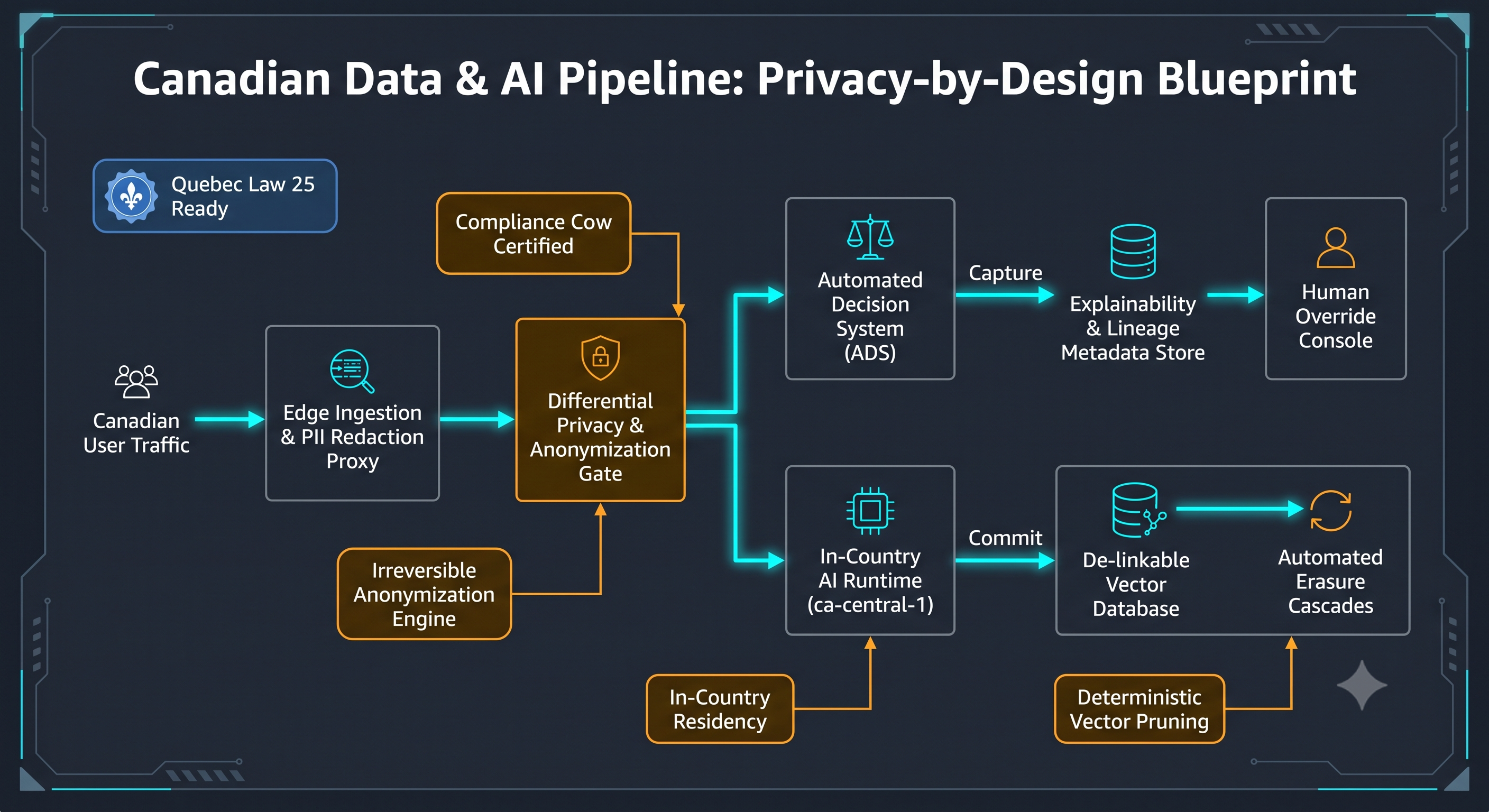
Enforce automated k-anonymity / differential privacy gates before datasets are pushed to vector stores or internal model fine-tuning jobs.
2. Implement Automated Decision System (ADS) Explainability Hooks
Under Law 25, individuals subjected to an automated decision have the statutory right to know the parameters, key reasons, and personal data that drove the outcome.
Store decision metadata (model version, prompt context snapshot, weights/heuristics scores, and retrieved vector chunk IDs) alongside the business transaction so support and compliance teams can reconstruct the exact decision path on demand.
3. Enforce Human-in-the-Loop Override Interfaces
Automated systems making high-impact decisions (credit assessment, fraud flagging, hiring triage) must provide an immediate human review mechanism.
Build direct API webhooks and internal dashboard tooling allowing authorized human operators to inspect, review, and countermand an algorithmic decision before downstream actions settle.
4. Pre-Egress Cross-Border Data Flow Auditing
Shipping user telemetry or RAG embeddings to US-hosted third-party inference endpoints without an upfront Privacy Impact Assessment (PIA) violates current provincial and evolving federal directives.
Implement proxy-level egress scanners that inspect outbound payloads for Canadian PII (SINs, health data, contact information) and route sensitive inference workloads exclusively to Canadian cloud availability zones (e.g., ca-central-1).
5. Deterministic Right-to-Erasure in Vector & Cache Stores
When a Canadian user exercises their right to deletion, clearing the transactional PostgreSQL row is not enough.
Design your RAG ingestion pipeline with deterministic chunk-to-user mappings. Implement deletion cascades that scrub orphaned embedding vectors, semantic caches, and transient queue logs across your cluster.
Discussion Question
When processing personal data in your RAG and machine learning pipelines, how is your team handling vector-level right-to-erasure and algorithmic explainability across provincial jurisdictions?
CTA (Join Techawks Canada)
Building robust, production-grade cloud architectures, AI systems, and secure data pipelines across the Canadian tech ecosystem? Join Techawks Canada to share blueprints, engineering practices, and system design patterns with peers nationwide.
Across Canada's tech corridor—from Toronto-Waterloo to Montreal and Vancouver—engineering teams are aggressively scaling LLMs, RAG pipelines, and automated decision engines. However, the regulatory ground has fundamentally shifted.
Between Quebec’s Law 25 carrying enforcement penalties up to C$25M or 4% of global turnover and Ottawa’s push toward modernized private-sector privacy regimes, Canadian engineering teams can no longer rely on legacy PIPEDA "check-the-box" consent forms.
When your data pipeline feeds automated decision systems or customer embeddings, architecture is compliance. Here is your 5-point production checklist to audit your pipelines:
1. Architect for the Statutory Anonymization vs. De-Identification Boundary
De-identified data (hashed user IDs, masked emails) remains personal data under Canadian standards and cannot be used freely without explicit purpose binding.
Anonymized data requires meeting a high technical standard: irreversible de-linkability under reasonable state-of-the-art re-identification risk analysis.
Enforce automated k-anonymity / differential privacy gates before datasets are pushed to vector stores or internal model fine-tuning jobs.
2. Implement Automated Decision System (ADS) Explainability Hooks
Under Law 25, individuals subjected to an automated decision have the statutory right to know the parameters, key reasons, and personal data that drove the outcome.
Store decision metadata (model version, prompt context snapshot, weights/heuristics scores, and retrieved vector chunk IDs) alongside the business transaction so support and compliance teams can reconstruct the exact decision path on demand.
3. Enforce Human-in-the-Loop Override Interfaces
Automated systems making high-impact decisions (credit assessment, fraud flagging, hiring triage) must provide an immediate human review mechanism.
Build direct API webhooks and internal dashboard tooling allowing authorized human operators to inspect, review, and countermand an algorithmic decision before downstream actions settle.
4. Pre-Egress Cross-Border Data Flow Auditing
Shipping user telemetry or RAG embeddings to US-hosted third-party inference endpoints without an upfront Privacy Impact Assessment (PIA) violates current provincial and evolving federal directives.
Implement proxy-level egress scanners that inspect outbound payloads for Canadian PII (SINs, health data, contact information) and route sensitive inference workloads exclusively to Canadian cloud availability zones (e.g., ca-central-1).
5. Deterministic Right-to-Erasure in Vector & Cache Stores
When a Canadian user exercises their right to deletion, clearing the transactional PostgreSQL row is not enough.
Design your RAG ingestion pipeline with deterministic chunk-to-user mappings. Implement deletion cascades that scrub orphaned embedding vectors, semantic caches, and transient queue logs across your cluster.
Discussion Question
When processing personal data in your RAG and machine learning pipelines, how is your team handling vector-level right-to-erasure and algorithmic explainability across provincial jurisdictions?
CTA (Join Techawks Canada)
Building robust, production-grade cloud architectures, AI systems, and secure data pipelines across the Canadian tech ecosystem? Join Techawks Canada to share blueprints, engineering practices, and system design patterns with peers nationwide.
Engineering Beyond PIPEDA: The 5-Point Canadian Privacy & AI Pipeline Checklist
Across Canada's tech corridor—from Toronto-Waterloo to Montreal and Vancouver—engineering teams are aggressively scaling LLMs, RAG pipelines, and automated decision engines. However, the regulatory ground has fundamentally shifted.
Between Quebec’s Law 25 carrying enforcement penalties up to C$25M or 4% of global turnover and Ottawa’s push toward modernized private-sector privacy regimes, Canadian engineering teams can no longer rely on legacy PIPEDA "check-the-box" consent forms.
When your data pipeline feeds automated decision systems or customer embeddings, architecture is compliance. Here is your 5-point production checklist to audit your pipelines:
1. Architect for the Statutory Anonymization vs. De-Identification Boundary
De-identified data (hashed user IDs, masked emails) remains personal data under Canadian standards and cannot be used freely without explicit purpose binding.
Anonymized data requires meeting a high technical standard: irreversible de-linkability under reasonable state-of-the-art re-identification risk analysis.
Enforce automated k-anonymity / differential privacy gates before datasets are pushed to vector stores or internal model fine-tuning jobs.
2. Implement Automated Decision System (ADS) Explainability Hooks
Under Law 25, individuals subjected to an automated decision have the statutory right to know the parameters, key reasons, and personal data that drove the outcome.
Store decision metadata (model version, prompt context snapshot, weights/heuristics scores, and retrieved vector chunk IDs) alongside the business transaction so support and compliance teams can reconstruct the exact decision path on demand.
3. Enforce Human-in-the-Loop Override Interfaces
Automated systems making high-impact decisions (credit assessment, fraud flagging, hiring triage) must provide an immediate human review mechanism.
Build direct API webhooks and internal dashboard tooling allowing authorized human operators to inspect, review, and countermand an algorithmic decision before downstream actions settle.
4. Pre-Egress Cross-Border Data Flow Auditing
Shipping user telemetry or RAG embeddings to US-hosted third-party inference endpoints without an upfront Privacy Impact Assessment (PIA) violates current provincial and evolving federal directives.
Implement proxy-level egress scanners that inspect outbound payloads for Canadian PII (SINs, health data, contact information) and route sensitive inference workloads exclusively to Canadian cloud availability zones (e.g., ca-central-1).
5. Deterministic Right-to-Erasure in Vector & Cache Stores
When a Canadian user exercises their right to deletion, clearing the transactional PostgreSQL row is not enough.
Design your RAG ingestion pipeline with deterministic chunk-to-user mappings. Implement deletion cascades that scrub orphaned embedding vectors, semantic caches, and transient queue logs across your cluster.
Discussion Question
When processing personal data in your RAG and machine learning pipelines, how is your team handling vector-level right-to-erasure and algorithmic explainability across provincial jurisdictions?
CTA (Join Techawks Canada)
Building robust, production-grade cloud architectures, AI systems, and secure data pipelines across the Canadian tech ecosystem? Join Techawks Canada to share blueprints, engineering practices, and system design patterns with peers nationwide.

 English
 Arabic
 French
 Spanish
 Portuguese
 Deutsch
 Turkish
 Dutch
Dutch
 Italiano
 Russian
 Portuguese (Brazil)
 Greek
Greek