


Myth vs. Fact: 4 Tech Culture Myths Diluting US Engineering Velocity
Building scalable software in the US market requires navigating high expectations for speed, compliance, and reliability. To maintain competitive velocity, engineering teams must separate popular tech folklore from battle-tested operational realities.
Here are four common myths that slow down high-performing engineering teams:
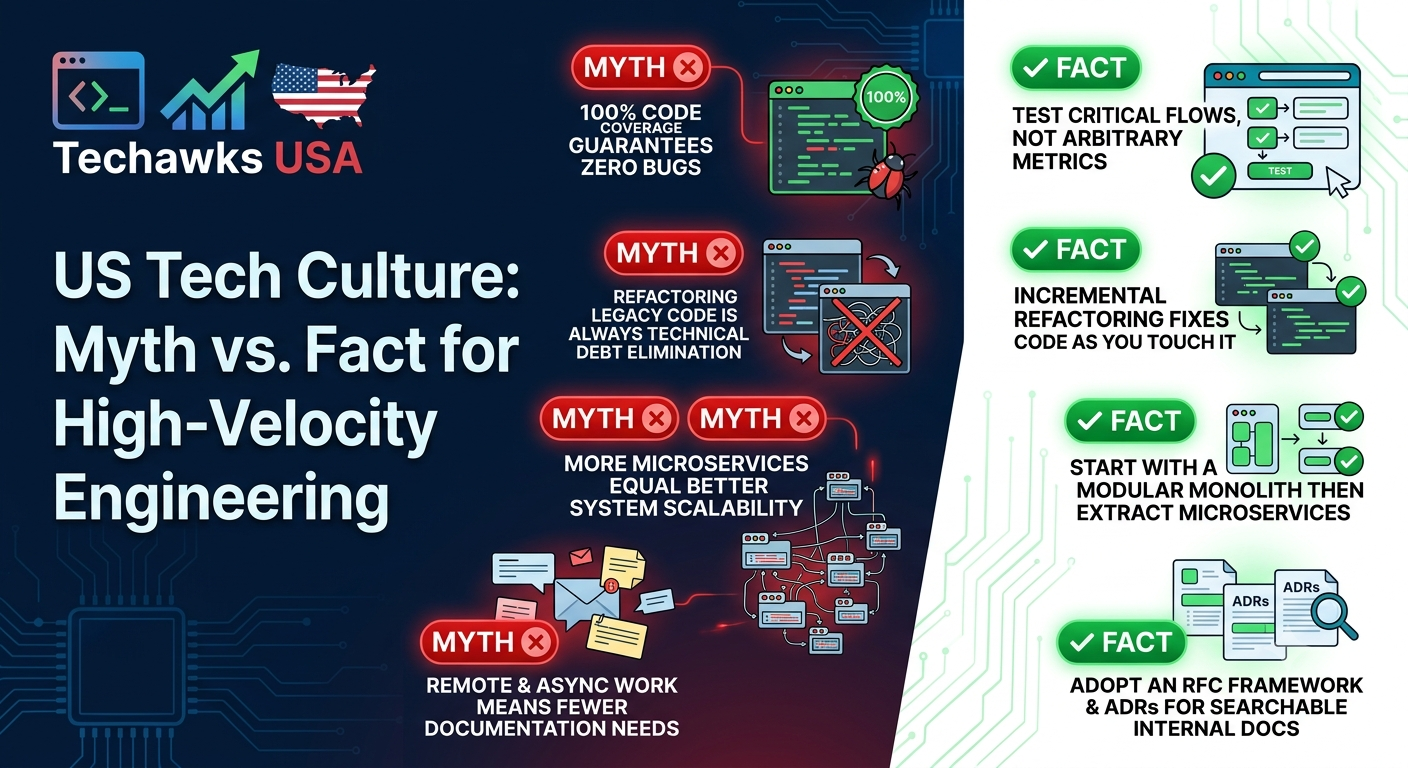
Myth 1: 100% Code Coverage Guarantees Zero Production Bugs
❌ Myth: Striving for 100% unit test coverage in CI/CD pipelines ensures your application won't fail in production.
✅ Fact: Unit tests validate isolated code paths, not complex integration points, race conditions, or third-party service failures. High coverage often incentivizes low-quality, trivial assertions just to pass metrics.
Actionable Advice: Target high-value integration and end-to-end (E2E) tests for critical user flows (e.g., checkout, authentication) instead of chasing arbitrary coverage percentages.
Myth 2: Refactoring Legacy Code is Always Technical Debt Elimination
❌ Myth: Rewriting legacy systems into modern frameworks or microservices always improves overall system health.
✅ Fact: Unplanned full rewrites frequently introduce new edge-case bugs and burn engineering quarters without adding direct business value.
Actionable Advice: Practice incremental refactoring (the Strangler Fig pattern) rather than complete rewrites. Fix code as you touch it for new feature work, and measure refactoring impact against concrete performance metrics.
Myth 3: More Microservices Equal Better System Scalability
❌ Myth: Decomposing every application domain into an independent microservice is the gold standard for high-scale architecture.
✅ Fact: Over-splitting domains creates massive operational overhead, complex network latency, and distributed tracing nightmares—often solving scale problems you don't actually have yet.
Actionable Advice: Start with a modular monolith with clear domain boundaries. Only extract independent microservices when individual component scale or team autonomy strictly demands it.
Myth 4: Remote & Async Work Means Fewer Documentation Needs
❌ Myth: Distributed teams can replace formal documentation with quick Slack messages and ad-hoc Zoom huddles.
✅ Fact: Lack of structured, searchable documentation leads to knowledge silos, onboarding friction, and technical decision drift across time zones.
Actionable Advice: Adopt an RFC (Request for Comments) framework for architectural changes, enforce PR template requirements, and treat internal docs as first-class engineering deliverables.
Key Takeaways
Quality over metrics: Meaningful integration tests and real-world observability trump vanity code coverage statistics.
Evolution over revolution: Incremental refactoring and modular architectures keep delivery velocity predictable while reducing operational risk.
Documentation is leverage: Asynchronous engineering culture relies on searchable architectural decision records (ADRs) to scale efficiently across distributed US teams.
CTA
🇺🇸 Ready to optimize your team's engineering velocity and master modern system design? Join the Techawks USA community to connect with senior engineers, access architecture guides, and join high-signal technical discussions!
👉 [Join Techawks USA]
Building scalable software in the US market requires navigating high expectations for speed, compliance, and reliability. To maintain competitive velocity, engineering teams must separate popular tech folklore from battle-tested operational realities.
Here are four common myths that slow down high-performing engineering teams:
Myth 1: 100% Code Coverage Guarantees Zero Production Bugs
❌ Myth: Striving for 100% unit test coverage in CI/CD pipelines ensures your application won't fail in production.
✅ Fact: Unit tests validate isolated code paths, not complex integration points, race conditions, or third-party service failures. High coverage often incentivizes low-quality, trivial assertions just to pass metrics.
Actionable Advice: Target high-value integration and end-to-end (E2E) tests for critical user flows (e.g., checkout, authentication) instead of chasing arbitrary coverage percentages.
Myth 2: Refactoring Legacy Code is Always Technical Debt Elimination
❌ Myth: Rewriting legacy systems into modern frameworks or microservices always improves overall system health.
✅ Fact: Unplanned full rewrites frequently introduce new edge-case bugs and burn engineering quarters without adding direct business value.
Actionable Advice: Practice incremental refactoring (the Strangler Fig pattern) rather than complete rewrites. Fix code as you touch it for new feature work, and measure refactoring impact against concrete performance metrics.
Myth 3: More Microservices Equal Better System Scalability
❌ Myth: Decomposing every application domain into an independent microservice is the gold standard for high-scale architecture.
✅ Fact: Over-splitting domains creates massive operational overhead, complex network latency, and distributed tracing nightmares—often solving scale problems you don't actually have yet.
Actionable Advice: Start with a modular monolith with clear domain boundaries. Only extract independent microservices when individual component scale or team autonomy strictly demands it.
Myth 4: Remote & Async Work Means Fewer Documentation Needs
❌ Myth: Distributed teams can replace formal documentation with quick Slack messages and ad-hoc Zoom huddles.
✅ Fact: Lack of structured, searchable documentation leads to knowledge silos, onboarding friction, and technical decision drift across time zones.
Actionable Advice: Adopt an RFC (Request for Comments) framework for architectural changes, enforce PR template requirements, and treat internal docs as first-class engineering deliverables.
Key Takeaways
Quality over metrics: Meaningful integration tests and real-world observability trump vanity code coverage statistics.
Evolution over revolution: Incremental refactoring and modular architectures keep delivery velocity predictable while reducing operational risk.
Documentation is leverage: Asynchronous engineering culture relies on searchable architectural decision records (ADRs) to scale efficiently across distributed US teams.
CTA
🇺🇸 Ready to optimize your team's engineering velocity and master modern system design? Join the Techawks USA community to connect with senior engineers, access architecture guides, and join high-signal technical discussions!
👉 [Join Techawks USA]
Myth vs. Fact: 4 Tech Culture Myths Diluting US Engineering Velocity
Building scalable software in the US market requires navigating high expectations for speed, compliance, and reliability. To maintain competitive velocity, engineering teams must separate popular tech folklore from battle-tested operational realities.
Here are four common myths that slow down high-performing engineering teams:
Myth 1: 100% Code Coverage Guarantees Zero Production Bugs
❌ Myth: Striving for 100% unit test coverage in CI/CD pipelines ensures your application won't fail in production.
✅ Fact: Unit tests validate isolated code paths, not complex integration points, race conditions, or third-party service failures. High coverage often incentivizes low-quality, trivial assertions just to pass metrics.
Actionable Advice: Target high-value integration and end-to-end (E2E) tests for critical user flows (e.g., checkout, authentication) instead of chasing arbitrary coverage percentages.
Myth 2: Refactoring Legacy Code is Always Technical Debt Elimination
❌ Myth: Rewriting legacy systems into modern frameworks or microservices always improves overall system health.
✅ Fact: Unplanned full rewrites frequently introduce new edge-case bugs and burn engineering quarters without adding direct business value.
Actionable Advice: Practice incremental refactoring (the Strangler Fig pattern) rather than complete rewrites. Fix code as you touch it for new feature work, and measure refactoring impact against concrete performance metrics.
Myth 3: More Microservices Equal Better System Scalability
❌ Myth: Decomposing every application domain into an independent microservice is the gold standard for high-scale architecture.
✅ Fact: Over-splitting domains creates massive operational overhead, complex network latency, and distributed tracing nightmares—often solving scale problems you don't actually have yet.
Actionable Advice: Start with a modular monolith with clear domain boundaries. Only extract independent microservices when individual component scale or team autonomy strictly demands it.
Myth 4: Remote & Async Work Means Fewer Documentation Needs
❌ Myth: Distributed teams can replace formal documentation with quick Slack messages and ad-hoc Zoom huddles.
✅ Fact: Lack of structured, searchable documentation leads to knowledge silos, onboarding friction, and technical decision drift across time zones.
Actionable Advice: Adopt an RFC (Request for Comments) framework for architectural changes, enforce PR template requirements, and treat internal docs as first-class engineering deliverables.
Key Takeaways
Quality over metrics: Meaningful integration tests and real-world observability trump vanity code coverage statistics.
Evolution over revolution: Incremental refactoring and modular architectures keep delivery velocity predictable while reducing operational risk.
Documentation is leverage: Asynchronous engineering culture relies on searchable architectural decision records (ADRs) to scale efficiently across distributed US teams.
CTA
🇺🇸 Ready to optimize your team's engineering velocity and master modern system design? Join the Techawks USA community to connect with senior engineers, access architecture guides, and join high-signal technical discussions!
👉 [Join Techawks USA]

 English
 Arabic
 French
 Spanish
 Portuguese
 Deutsch
 Turkish
 Dutch
Dutch
 Italiano
 Russian
 Portuguese (Brazil)
 Greek
Greek