


The Cascade Outage Trap: Why "Headroom Exhaustion" Kills Kubernetes Clusters (And the Day-2 Deployment Checklist)
Postmortems across major cloud-native providers (including GitHub’s August 2026 infrastructure incident) highlight an uncomfortable operational reality: routine rolling deployments routinely trigger catastrophic cascading failures when service mesh and platform sidecars run near capacity limits.
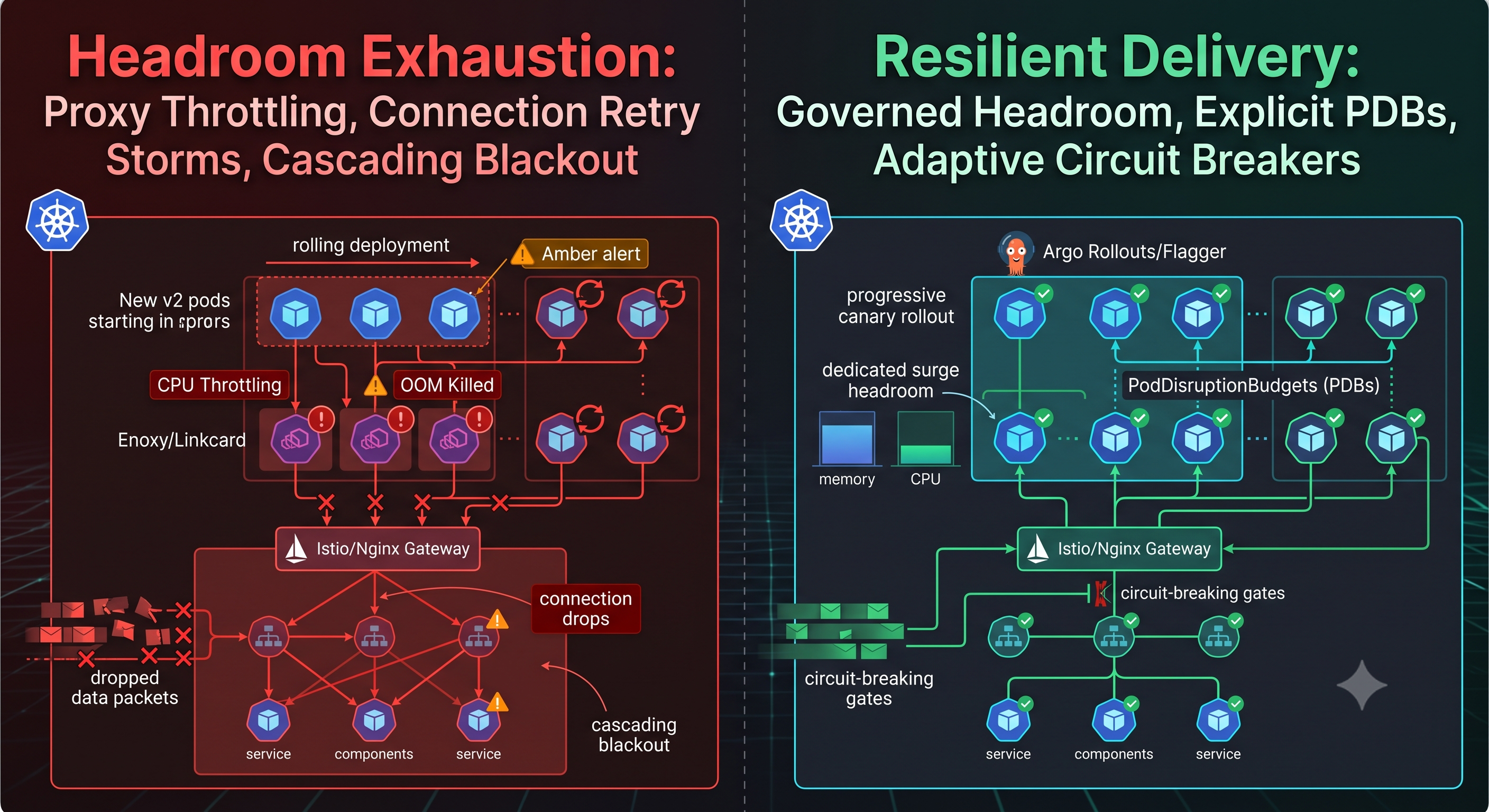
Here is what happens under the hood during a standard deployment:
When pods rotate, cluster compute headroom dips momentarily.
Proxy sidecars (Envoy, Linkerd, istio-proxy) and agent containers experience CPU throttling and memory pressure.
Pods enter OOMKilled crash loops, causing connection retries to compound across the shared ingress gateway and authentication services.
Load-balancer flow limits exhaust, turning a standard minor deployment into an unrecoverable multi-cluster blackout.
With over 82% of enterprise workloads now running Kubernetes in production, your deployments cannot treat pod capacity and sidecar overhead as an afterthought.
Before triggering your next large-scale production rollout or GitOps sync, run your cluster through this Day-2 resiliency checklist:
☸️ The 5-Point Rolling Deployment & Capacity Headroom Checklist
[ ] 1. Ingress & Service Mesh Surge Headroom: Do your ingress gateway nodes and sidecar proxies have at least 30% dedicated compute and memory buffers above peak usage? A rolling deployment temporarily spikes proxy connection handshakes—never run them near 90% allocation.
[ ] 2. PodDisruptionBudget (PDB) & MaxSurge Alignment: Validate that maxSurge and maxUnavailable in your deployment specs do not drop total active pod capacity below baseline traffic demand, especially during simultaneous auto-scaling events.
[ ] 3. Strict Sidecar Resource Isolation: Ensure infrastructure sidecars (logging agents, tracing, security daemons) have independent requests and limits explicitly defined. A runaway main container should never starve your telemetry or proxy sidecar of memory.
[ ] 4. Circuit Breaking & Exponential Backoff on Retries: When upstream pods restart, downstream clients must implement jittered exponential backoff. Without strict circuit breaking at the gateway layer, immediate retry storms will exhaust load-balancer socket connections.
[ ] 5. Automated Canary Gating (Halt on DNS/Mesh Latency): Configure your progressive delivery controllers (Argo Rollouts, Flagger) to halt canary progression not just on HTTP 5xx codes, but on proxy latency spikes, upstream connection drops, or CoreDNS query latency.
Discussion Question
When you roll out major cluster updates or large-scale deployments, how does your team protect against sidecar/proxy throttling and retry storms? Do you rely on automated canary rollouts, strict PDBs, or dedicated node pools for critical platform gateways?
CTA (Share Deployment Experiences)
Drop your war stories below! What was the sneakisiest deployment failure or cascading cluster outage you've had to debug in production, and what guardrail did you install to make sure it never happens again?
Postmortems across major cloud-native providers (including GitHub’s August 2026 infrastructure incident) highlight an uncomfortable operational reality: routine rolling deployments routinely trigger catastrophic cascading failures when service mesh and platform sidecars run near capacity limits.
Here is what happens under the hood during a standard deployment:
When pods rotate, cluster compute headroom dips momentarily.
Proxy sidecars (Envoy, Linkerd, istio-proxy) and agent containers experience CPU throttling and memory pressure.
Pods enter OOMKilled crash loops, causing connection retries to compound across the shared ingress gateway and authentication services.
Load-balancer flow limits exhaust, turning a standard minor deployment into an unrecoverable multi-cluster blackout.
With over 82% of enterprise workloads now running Kubernetes in production, your deployments cannot treat pod capacity and sidecar overhead as an afterthought.
Before triggering your next large-scale production rollout or GitOps sync, run your cluster through this Day-2 resiliency checklist:
☸️ The 5-Point Rolling Deployment & Capacity Headroom Checklist
[ ] 1. Ingress & Service Mesh Surge Headroom: Do your ingress gateway nodes and sidecar proxies have at least 30% dedicated compute and memory buffers above peak usage? A rolling deployment temporarily spikes proxy connection handshakes—never run them near 90% allocation.
[ ] 2. PodDisruptionBudget (PDB) & MaxSurge Alignment: Validate that maxSurge and maxUnavailable in your deployment specs do not drop total active pod capacity below baseline traffic demand, especially during simultaneous auto-scaling events.
[ ] 3. Strict Sidecar Resource Isolation: Ensure infrastructure sidecars (logging agents, tracing, security daemons) have independent requests and limits explicitly defined. A runaway main container should never starve your telemetry or proxy sidecar of memory.
[ ] 4. Circuit Breaking & Exponential Backoff on Retries: When upstream pods restart, downstream clients must implement jittered exponential backoff. Without strict circuit breaking at the gateway layer, immediate retry storms will exhaust load-balancer socket connections.
[ ] 5. Automated Canary Gating (Halt on DNS/Mesh Latency): Configure your progressive delivery controllers (Argo Rollouts, Flagger) to halt canary progression not just on HTTP 5xx codes, but on proxy latency spikes, upstream connection drops, or CoreDNS query latency.
Discussion Question
When you roll out major cluster updates or large-scale deployments, how does your team protect against sidecar/proxy throttling and retry storms? Do you rely on automated canary rollouts, strict PDBs, or dedicated node pools for critical platform gateways?
CTA (Share Deployment Experiences)
Drop your war stories below! What was the sneakisiest deployment failure or cascading cluster outage you've had to debug in production, and what guardrail did you install to make sure it never happens again?
The Cascade Outage Trap: Why "Headroom Exhaustion" Kills Kubernetes Clusters (And the Day-2 Deployment Checklist)
Postmortems across major cloud-native providers (including GitHub’s August 2026 infrastructure incident) highlight an uncomfortable operational reality: routine rolling deployments routinely trigger catastrophic cascading failures when service mesh and platform sidecars run near capacity limits.
Here is what happens under the hood during a standard deployment:
When pods rotate, cluster compute headroom dips momentarily.
Proxy sidecars (Envoy, Linkerd, istio-proxy) and agent containers experience CPU throttling and memory pressure.
Pods enter OOMKilled crash loops, causing connection retries to compound across the shared ingress gateway and authentication services.
Load-balancer flow limits exhaust, turning a standard minor deployment into an unrecoverable multi-cluster blackout.
With over 82% of enterprise workloads now running Kubernetes in production, your deployments cannot treat pod capacity and sidecar overhead as an afterthought.
Before triggering your next large-scale production rollout or GitOps sync, run your cluster through this Day-2 resiliency checklist:
☸️ The 5-Point Rolling Deployment & Capacity Headroom Checklist
[ ] 1. Ingress & Service Mesh Surge Headroom: Do your ingress gateway nodes and sidecar proxies have at least 30% dedicated compute and memory buffers above peak usage? A rolling deployment temporarily spikes proxy connection handshakes—never run them near 90% allocation.
[ ] 2. PodDisruptionBudget (PDB) & MaxSurge Alignment: Validate that maxSurge and maxUnavailable in your deployment specs do not drop total active pod capacity below baseline traffic demand, especially during simultaneous auto-scaling events.
[ ] 3. Strict Sidecar Resource Isolation: Ensure infrastructure sidecars (logging agents, tracing, security daemons) have independent requests and limits explicitly defined. A runaway main container should never starve your telemetry or proxy sidecar of memory.
[ ] 4. Circuit Breaking & Exponential Backoff on Retries: When upstream pods restart, downstream clients must implement jittered exponential backoff. Without strict circuit breaking at the gateway layer, immediate retry storms will exhaust load-balancer socket connections.
[ ] 5. Automated Canary Gating (Halt on DNS/Mesh Latency): Configure your progressive delivery controllers (Argo Rollouts, Flagger) to halt canary progression not just on HTTP 5xx codes, but on proxy latency spikes, upstream connection drops, or CoreDNS query latency.
Discussion Question
When you roll out major cluster updates or large-scale deployments, how does your team protect against sidecar/proxy throttling and retry storms? Do you rely on automated canary rollouts, strict PDBs, or dedicated node pools for critical platform gateways?
CTA (Share Deployment Experiences)
Drop your war stories below! What was the sneakisiest deployment failure or cascading cluster outage you've had to debug in production, and what guardrail did you install to make sure it never happens again?

 English
 Arabic
 Spanish
 Portuguese
 Deutsch
 Turkish
 Dutch
Dutch
 Italiano
 Russian
 Romaian
 Portuguese (Brazil)
 Greek
Greek