


The UK Resilience Challenge: Can Your Financial System Survive the Operational Resilience Test?
With strict standards set by regulators like the FCA and PRA, UK engineering teams must design systems that expect and recover from failure instantly. Put your software architecture through this 4-tier resilience challenge to see where your infrastructure stands.
The Challenge Scenario
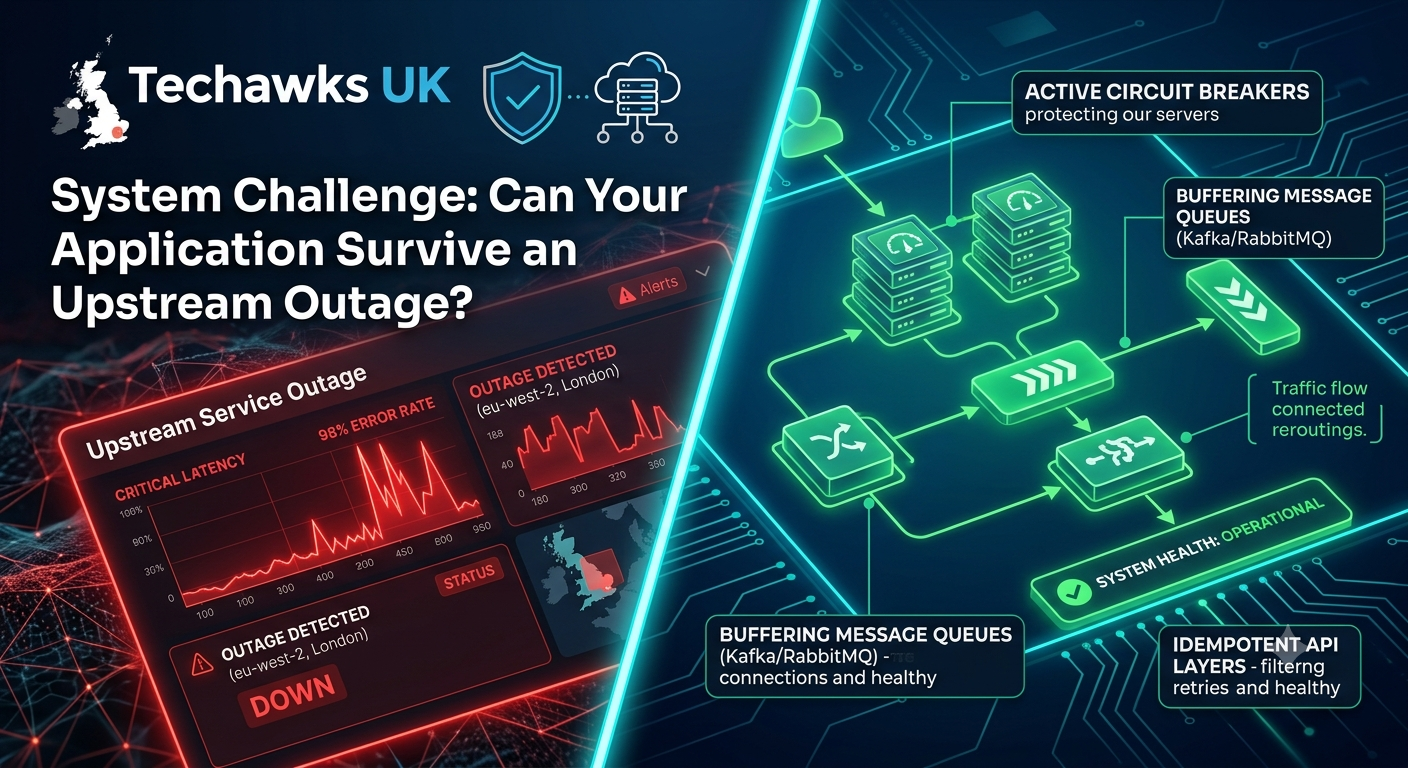
Scenario: A major upstream banking provider or cloud service provider in the eu-west-2 (London) region experiences a total API outage during peak UK trading/business hours.
Evaluate Your Architecture:
Level 1: Graceful Degradation & Fallbacks
The Test: Does an upstream API outage freeze your entire user interface or payment flow?
🛑 Fail: Synchronous API calls block client threads, leading to application hangs, high latency, and dropped user requests.
🛠️ The Fix: Implement asynchronous processing queues and circuit breaker patterns (e.g., using Resilience4j) to fall back to cached states or queued processing mode automatically.
Level 2: Zero-Downtime Data Synchronization
The Test: What happens to active database transactions during an availability zone failover?
🛑 Fail: Uncommitted transactions lead to duplicate charges, corrupted state, or data inconsistencies across microservices.
🛠️ The Fix: Use the Saga Pattern for distributed transactions combined with idempotency keys on all financial and state-changing API endpoints.
Level 3: Regulatory Compliance under Outage Conditions
The Test: Are audit trails and transaction logs preserved if a primary database node crashes mid-operation?
🛑 Fail: In-flight log buffers in volatile memory are lost, creating gaps in compliance reporting.
🛠️ The Fix: Stream audit logs asynchronously to write-ahead, multi-AZ persistent storage (e.g., Amazon Kinesis or Managed Kafka) before executing state changes.
Level 4: Chaos Engineering Readiness
The Test: Have you actually tested your system by intentionally terminating production container pods or cloud availability zones?
🛑 Fail: Failover procedures exist only on paper in runbooks and haven't been validated under live traffic.
🛠️ The Fix: Introduce controlled chaos engineering experiments (e.g., Chaos Mesh or AWS Fault Injection Simulator) in staging/production-like environments quarterly.
Key Takeaways
Design for inevitability: Outages will happen; operational resilience measures how seamlessly your system degrades without taking down the core platform.
Idempotency is mandatory: Safeguard user requests and payments against retry storms using strict idempotency keys across all write endpoints.
Test chaos in practice: Disaster recovery plans are unproven hypotheses until validated by automated fault injection.
CTA
🇬🇧 How did your system architecture score on the resilience test? Share your system design strategies, circuit breaker setups, or chaos engineering practices in the comments below! For more hands-on technical challenges, cloud architecture breakdowns, and UK developer discussions, join Techawks UK.
👉 [Join Techawks UK]
With strict standards set by regulators like the FCA and PRA, UK engineering teams must design systems that expect and recover from failure instantly. Put your software architecture through this 4-tier resilience challenge to see where your infrastructure stands.
The Challenge Scenario
Scenario: A major upstream banking provider or cloud service provider in the eu-west-2 (London) region experiences a total API outage during peak UK trading/business hours.
Evaluate Your Architecture:
Level 1: Graceful Degradation & Fallbacks
The Test: Does an upstream API outage freeze your entire user interface or payment flow?
🛑 Fail: Synchronous API calls block client threads, leading to application hangs, high latency, and dropped user requests.
🛠️ The Fix: Implement asynchronous processing queues and circuit breaker patterns (e.g., using Resilience4j) to fall back to cached states or queued processing mode automatically.
Level 2: Zero-Downtime Data Synchronization
The Test: What happens to active database transactions during an availability zone failover?
🛑 Fail: Uncommitted transactions lead to duplicate charges, corrupted state, or data inconsistencies across microservices.
🛠️ The Fix: Use the Saga Pattern for distributed transactions combined with idempotency keys on all financial and state-changing API endpoints.
Level 3: Regulatory Compliance under Outage Conditions
The Test: Are audit trails and transaction logs preserved if a primary database node crashes mid-operation?
🛑 Fail: In-flight log buffers in volatile memory are lost, creating gaps in compliance reporting.
🛠️ The Fix: Stream audit logs asynchronously to write-ahead, multi-AZ persistent storage (e.g., Amazon Kinesis or Managed Kafka) before executing state changes.
Level 4: Chaos Engineering Readiness
The Test: Have you actually tested your system by intentionally terminating production container pods or cloud availability zones?
🛑 Fail: Failover procedures exist only on paper in runbooks and haven't been validated under live traffic.
🛠️ The Fix: Introduce controlled chaos engineering experiments (e.g., Chaos Mesh or AWS Fault Injection Simulator) in staging/production-like environments quarterly.
Key Takeaways
Design for inevitability: Outages will happen; operational resilience measures how seamlessly your system degrades without taking down the core platform.
Idempotency is mandatory: Safeguard user requests and payments against retry storms using strict idempotency keys across all write endpoints.
Test chaos in practice: Disaster recovery plans are unproven hypotheses until validated by automated fault injection.
CTA
🇬🇧 How did your system architecture score on the resilience test? Share your system design strategies, circuit breaker setups, or chaos engineering practices in the comments below! For more hands-on technical challenges, cloud architecture breakdowns, and UK developer discussions, join Techawks UK.
👉 [Join Techawks UK]
The UK Resilience Challenge: Can Your Financial System Survive the Operational Resilience Test?
With strict standards set by regulators like the FCA and PRA, UK engineering teams must design systems that expect and recover from failure instantly. Put your software architecture through this 4-tier resilience challenge to see where your infrastructure stands.
The Challenge Scenario
Scenario: A major upstream banking provider or cloud service provider in the eu-west-2 (London) region experiences a total API outage during peak UK trading/business hours.
Evaluate Your Architecture:
Level 1: Graceful Degradation & Fallbacks
The Test: Does an upstream API outage freeze your entire user interface or payment flow?
🛑 Fail: Synchronous API calls block client threads, leading to application hangs, high latency, and dropped user requests.
🛠️ The Fix: Implement asynchronous processing queues and circuit breaker patterns (e.g., using Resilience4j) to fall back to cached states or queued processing mode automatically.
Level 2: Zero-Downtime Data Synchronization
The Test: What happens to active database transactions during an availability zone failover?
🛑 Fail: Uncommitted transactions lead to duplicate charges, corrupted state, or data inconsistencies across microservices.
🛠️ The Fix: Use the Saga Pattern for distributed transactions combined with idempotency keys on all financial and state-changing API endpoints.
Level 3: Regulatory Compliance under Outage Conditions
The Test: Are audit trails and transaction logs preserved if a primary database node crashes mid-operation?
🛑 Fail: In-flight log buffers in volatile memory are lost, creating gaps in compliance reporting.
🛠️ The Fix: Stream audit logs asynchronously to write-ahead, multi-AZ persistent storage (e.g., Amazon Kinesis or Managed Kafka) before executing state changes.
Level 4: Chaos Engineering Readiness
The Test: Have you actually tested your system by intentionally terminating production container pods or cloud availability zones?
🛑 Fail: Failover procedures exist only on paper in runbooks and haven't been validated under live traffic.
🛠️ The Fix: Introduce controlled chaos engineering experiments (e.g., Chaos Mesh or AWS Fault Injection Simulator) in staging/production-like environments quarterly.
Key Takeaways
Design for inevitability: Outages will happen; operational resilience measures how seamlessly your system degrades without taking down the core platform.
Idempotency is mandatory: Safeguard user requests and payments against retry storms using strict idempotency keys across all write endpoints.
Test chaos in practice: Disaster recovery plans are unproven hypotheses until validated by automated fault injection.
CTA
🇬🇧 How did your system architecture score on the resilience test? Share your system design strategies, circuit breaker setups, or chaos engineering practices in the comments below! For more hands-on technical challenges, cloud architecture breakdowns, and UK developer discussions, join Techawks UK.
👉 [Join Techawks UK]

 English
 Arabic
 French
 Spanish
 Portuguese
 Turkish
 Dutch
Dutch
 Italiano
 Russian
 Romaian
 Portuguese (Brazil)
 Greek
Greek