


Myth vs. Fact: 4 Tech Myths Holding UK Software Teams Back
Building world-class software in the UK tech ecosystem requires balancing rapid execution with strict regulatory frameworks and modern cloud architecture. To keep your team performing at peak velocity, you need to separate persistent engineering myths from operational reality.
Here are four common myths impacting UK development teams:
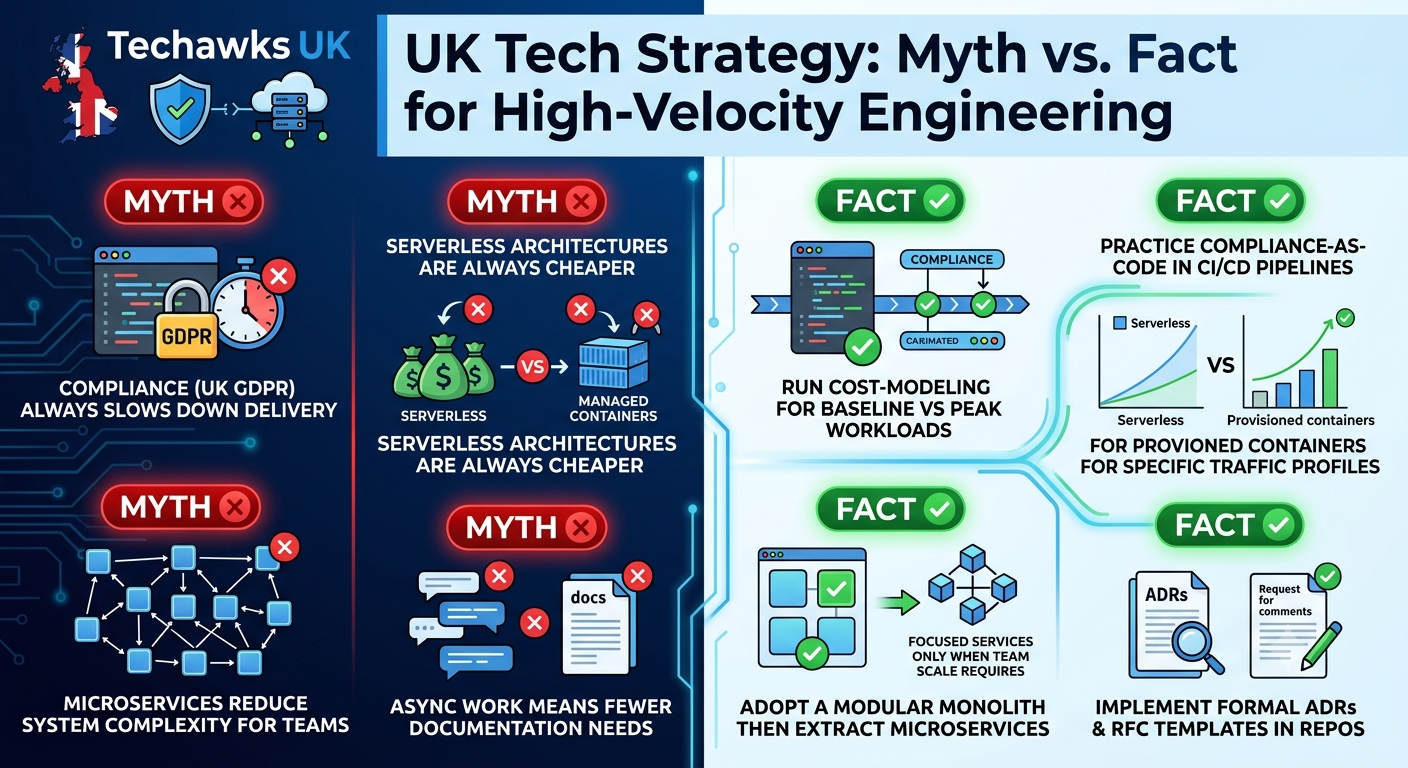
Myth 1: Compliance (UK GDPR & DORA) is an Afterthought for the Security Team
❌ Myth: Developers can build features freely, and compliance/legal teams will audit data privacy and security controls right before release.
✅ Fact: Retrofitting data governance, encryption, and audit logging into completed software architectures creates massive engineering bottlenecks and delays releases by weeks.
Actionable Advice: Practice Compliance-as-Code. Define data classification schemas, field-level encryption, and automated compliance checks directly inside your CI/CD pipelines during initial development.
Myth 2: Serverless Architectures are Always Cheaper Than Provisioned Containers
❌ Myth: Moving microservices entirely to Serverless (e.g., AWS Lambda, Azure Functions) will automatically cut cloud infrastructure costs across all workloads.
✅ Fact: While serverless excels for unpredictable or low-volume traffic, steady-state, high-concurrency microservices can quickly become significantly more expensive on pay-per-execution models compared to managed Kubernetes (EKS/AKS) or ECS clusters.
Actionable Advice: Run cost-modeling calculations for baseline vs. peak workloads. Use Serverless for event-driven processing and API gateways, while keeping core high-throughput microservices on auto-scaling containerized nodes.
Myth 3: Microservices Reduce System Complexity for Growing Teams
❌ Myth: Breaking an application into dozens of small services makes system management and feature development simpler for medium-sized engineering teams.
✅ Fact: Without mature platform engineering, microservices shift complexity from application code to operational infrastructure—leading to service sprawl, distributed tracing headaches, and deployment friction.
Actionable Advice: Adopt a Modular Monolith first with well-defined domain boundaries. Extract individual domains into standalone microservices only when team scale or independent resource deployment strictly requires it.
Myth 4: Async Work Means Fewer Documentation Standards
❌ Myth: Distributed or hybrid teams operating across UK time zones can rely on quick Slack/Teams messages rather than writing structured documentation.
✅ Fact: Ad-hoc communication leads to fragmented knowledge, context switching, and architectural decision drift, which slows down developer onboarding.
Actionable Advice: Implement a formal Architecture Decision Record (ADR) process and RFC templates stored directly in your primary code repositories to track decisions asynchronously.
Key Takeaways
Shift security and compliance left: Automating privacy checks early in development prevents release delays and costly structural redesigns.
Match architecture to workload profile: Don't assume serverless or microservices fit every use case; base infrastructure choices on actual throughput patterns.
Document for async efficiency: Centralized, repository-backed documentation reduces context switching and empowers remote teams across the UK.
CTA
🇬🇧 Looking to streamline your engineering practices and build resilient, compliant cloud systems in the UK? Join the Techawks UK community to connect with senior developers, access technical guides, and lead the conversation!
👉 [Join Techawks UK]
Building world-class software in the UK tech ecosystem requires balancing rapid execution with strict regulatory frameworks and modern cloud architecture. To keep your team performing at peak velocity, you need to separate persistent engineering myths from operational reality.
Here are four common myths impacting UK development teams:
Myth 1: Compliance (UK GDPR & DORA) is an Afterthought for the Security Team
❌ Myth: Developers can build features freely, and compliance/legal teams will audit data privacy and security controls right before release.
✅ Fact: Retrofitting data governance, encryption, and audit logging into completed software architectures creates massive engineering bottlenecks and delays releases by weeks.
Actionable Advice: Practice Compliance-as-Code. Define data classification schemas, field-level encryption, and automated compliance checks directly inside your CI/CD pipelines during initial development.
Myth 2: Serverless Architectures are Always Cheaper Than Provisioned Containers
❌ Myth: Moving microservices entirely to Serverless (e.g., AWS Lambda, Azure Functions) will automatically cut cloud infrastructure costs across all workloads.
✅ Fact: While serverless excels for unpredictable or low-volume traffic, steady-state, high-concurrency microservices can quickly become significantly more expensive on pay-per-execution models compared to managed Kubernetes (EKS/AKS) or ECS clusters.
Actionable Advice: Run cost-modeling calculations for baseline vs. peak workloads. Use Serverless for event-driven processing and API gateways, while keeping core high-throughput microservices on auto-scaling containerized nodes.
Myth 3: Microservices Reduce System Complexity for Growing Teams
❌ Myth: Breaking an application into dozens of small services makes system management and feature development simpler for medium-sized engineering teams.
✅ Fact: Without mature platform engineering, microservices shift complexity from application code to operational infrastructure—leading to service sprawl, distributed tracing headaches, and deployment friction.
Actionable Advice: Adopt a Modular Monolith first with well-defined domain boundaries. Extract individual domains into standalone microservices only when team scale or independent resource deployment strictly requires it.
Myth 4: Async Work Means Fewer Documentation Standards
❌ Myth: Distributed or hybrid teams operating across UK time zones can rely on quick Slack/Teams messages rather than writing structured documentation.
✅ Fact: Ad-hoc communication leads to fragmented knowledge, context switching, and architectural decision drift, which slows down developer onboarding.
Actionable Advice: Implement a formal Architecture Decision Record (ADR) process and RFC templates stored directly in your primary code repositories to track decisions asynchronously.
Key Takeaways
Shift security and compliance left: Automating privacy checks early in development prevents release delays and costly structural redesigns.
Match architecture to workload profile: Don't assume serverless or microservices fit every use case; base infrastructure choices on actual throughput patterns.
Document for async efficiency: Centralized, repository-backed documentation reduces context switching and empowers remote teams across the UK.
CTA
🇬🇧 Looking to streamline your engineering practices and build resilient, compliant cloud systems in the UK? Join the Techawks UK community to connect with senior developers, access technical guides, and lead the conversation!
👉 [Join Techawks UK]
Myth vs. Fact: 4 Tech Myths Holding UK Software Teams Back
Building world-class software in the UK tech ecosystem requires balancing rapid execution with strict regulatory frameworks and modern cloud architecture. To keep your team performing at peak velocity, you need to separate persistent engineering myths from operational reality.
Here are four common myths impacting UK development teams:
Myth 1: Compliance (UK GDPR & DORA) is an Afterthought for the Security Team
❌ Myth: Developers can build features freely, and compliance/legal teams will audit data privacy and security controls right before release.
✅ Fact: Retrofitting data governance, encryption, and audit logging into completed software architectures creates massive engineering bottlenecks and delays releases by weeks.
Actionable Advice: Practice Compliance-as-Code. Define data classification schemas, field-level encryption, and automated compliance checks directly inside your CI/CD pipelines during initial development.
Myth 2: Serverless Architectures are Always Cheaper Than Provisioned Containers
❌ Myth: Moving microservices entirely to Serverless (e.g., AWS Lambda, Azure Functions) will automatically cut cloud infrastructure costs across all workloads.
✅ Fact: While serverless excels for unpredictable or low-volume traffic, steady-state, high-concurrency microservices can quickly become significantly more expensive on pay-per-execution models compared to managed Kubernetes (EKS/AKS) or ECS clusters.
Actionable Advice: Run cost-modeling calculations for baseline vs. peak workloads. Use Serverless for event-driven processing and API gateways, while keeping core high-throughput microservices on auto-scaling containerized nodes.
Myth 3: Microservices Reduce System Complexity for Growing Teams
❌ Myth: Breaking an application into dozens of small services makes system management and feature development simpler for medium-sized engineering teams.
✅ Fact: Without mature platform engineering, microservices shift complexity from application code to operational infrastructure—leading to service sprawl, distributed tracing headaches, and deployment friction.
Actionable Advice: Adopt a Modular Monolith first with well-defined domain boundaries. Extract individual domains into standalone microservices only when team scale or independent resource deployment strictly requires it.
Myth 4: Async Work Means Fewer Documentation Standards
❌ Myth: Distributed or hybrid teams operating across UK time zones can rely on quick Slack/Teams messages rather than writing structured documentation.
✅ Fact: Ad-hoc communication leads to fragmented knowledge, context switching, and architectural decision drift, which slows down developer onboarding.
Actionable Advice: Implement a formal Architecture Decision Record (ADR) process and RFC templates stored directly in your primary code repositories to track decisions asynchronously.
Key Takeaways
Shift security and compliance left: Automating privacy checks early in development prevents release delays and costly structural redesigns.
Match architecture to workload profile: Don't assume serverless or microservices fit every use case; base infrastructure choices on actual throughput patterns.
Document for async efficiency: Centralized, repository-backed documentation reduces context switching and empowers remote teams across the UK.
CTA
🇬🇧 Looking to streamline your engineering practices and build resilient, compliant cloud systems in the UK? Join the Techawks UK community to connect with senior developers, access technical guides, and lead the conversation!
👉 [Join Techawks UK]

 English
 French
 Spanish
 Portuguese
 Deutsch
 Turkish
 Dutch
Dutch
 Italiano
 Russian
 Romaian
 Portuguese (Brazil)
 Greek
Greek