


Architecting for India-Scale: 4 Cache Invalidation Patterns for High-Concurrency Spikes
When building consumer apps in India, traffic rarely scales linearly. It hits in sudden, violent bursts. If your caching strategy relies solely on simple key-value TTLs, your backend will inevitably face cache stampedes, stale read cascades, or database pool exhaustion.
Here is a practical breakdown of how to harden your caching layer using Redis and Go/Node.js microservices.1. The Probabilistic Early Expiration Pattern (XFetch)Standard TTLs cause cache stampedes: when a high-traffic key expires, 5,000 concurrent threads miss the cache simultaneously and query Postgres/MongoDB at once.The Problem: Database CPU spikes to 100%, causing connection timeouts.
The Fix: Recompute the cached value in the background before it officially expires, based on read frequency and computation time.
Implementation Logic:Calculate delta: $\Delta = -\beta \times \delta \times \ln(\text{rand}())$If (Time.now - delta) > TTL, let the current worker thread refresh the cache asynchronously while continuing to serve the warm cache to everyone else.2. Mutex-Locked Cache AsideIf you cannot use probabilistic expiration, enforce a distributed mutex lock on a cache miss.
When a thread detects a cache miss, it acquires a lightweight Redis lock (SET resource_lock my_random_token NX PX 3000).Only the thread holding the lock queries the primary database and repopulates Redis.
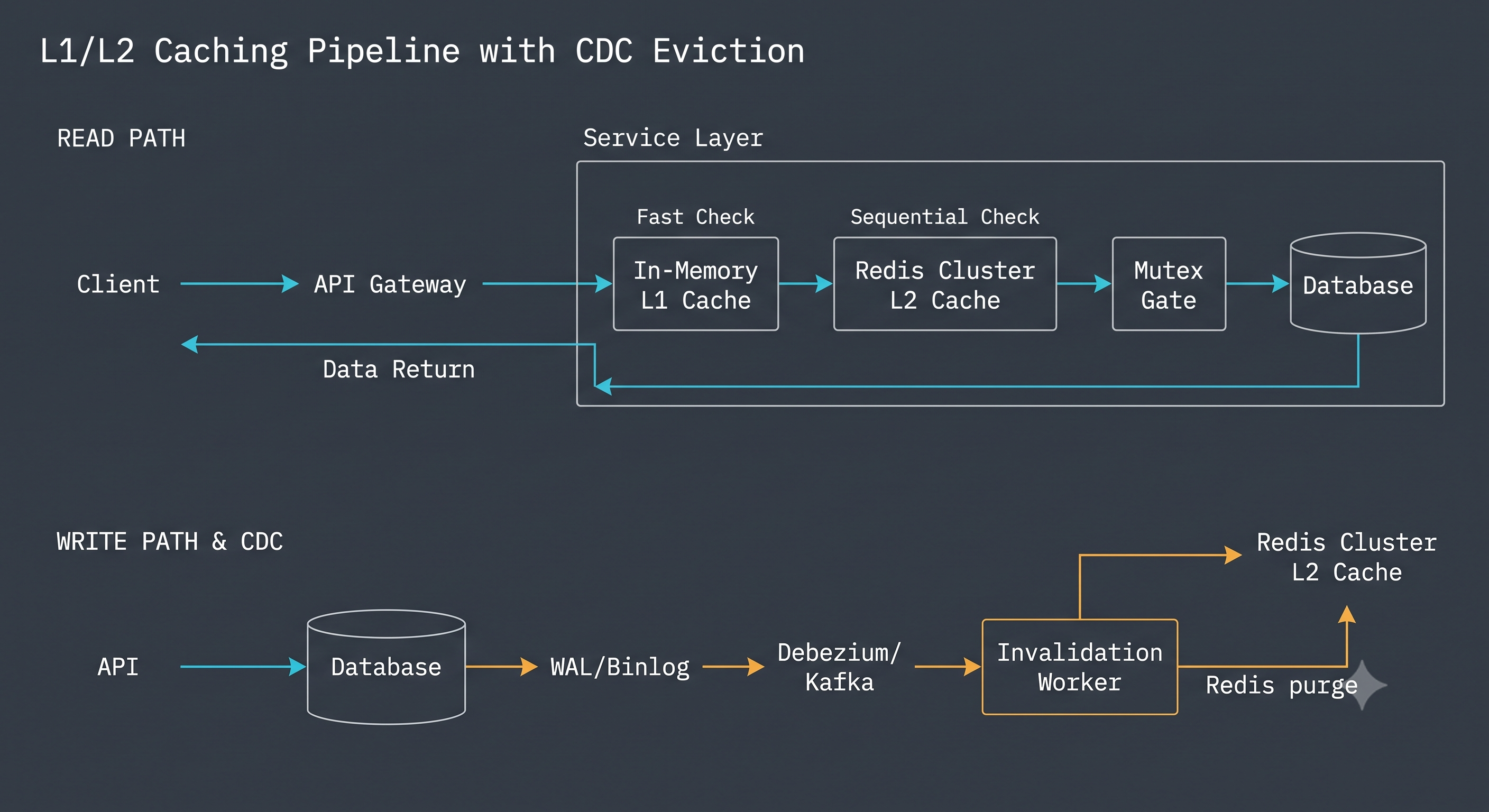
All other concurrent requests wait 50ms and retry fetching from Redis, completely shielding the database from redundant queries.3. Read-Through with Local In-Memory Fallback (L1/L2 Cache)Network round-trips to an external Redis cluster can saturate network interfaces during multi-million RPM events.L1 (In-Memory): Store read-heavy, low-churn configuration and catalog data in-process (e.g., Go sync.
Map or Node.js lru-cache) with a tight 30–60 second expiration.L2 (Distributed):
Redis Cluster with proper shard distribution.
Execution: Always check L1 first. If missed, query L2. If missed in L2, hit the database via Mutex and backfill both layers.4. Event-Driven Cache Eviction via CDC (Change Data Capture)Never let write APIs directly trigger extensive cache invalidations across distributed fleets; network failures leave orphan stale keys.
Route database binlogs (PostgreSQL WAL / MySQL Binlog) through Debezium into an Apache Kafka or Redpanda topic.A dedicated consumer group handles Redis cache invalidations asynchronously. This completely decouples your write path latency from cache hygiene.
Key Takeaways
Kill Cache Stampedes: Implement probabilistic background refresh (XFetch) or distributed mutex locks instead of static TTLs on critical paths.Layer Your Defense: Combine an in-memory L1 cache (in-process) with a distributed L2 cache (Redis) to shave network overhead during flash spikes.
Decouple Invalidation: Move write-side cache invalidation out of your request-response cycle and into an event-driven CDC pipeline.
CTA
Building high-throughput, fault-tolerant systems across India’s engineering ecosystem?Join Techawks India to discuss backend design, distributed systems trade-offs, and production post-mortems with fellow senior engineers and architects. Link in the comments.
When building consumer apps in India, traffic rarely scales linearly. It hits in sudden, violent bursts. If your caching strategy relies solely on simple key-value TTLs, your backend will inevitably face cache stampedes, stale read cascades, or database pool exhaustion.
Here is a practical breakdown of how to harden your caching layer using Redis and Go/Node.js microservices.1. The Probabilistic Early Expiration Pattern (XFetch)Standard TTLs cause cache stampedes: when a high-traffic key expires, 5,000 concurrent threads miss the cache simultaneously and query Postgres/MongoDB at once.The Problem: Database CPU spikes to 100%, causing connection timeouts.
The Fix: Recompute the cached value in the background before it officially expires, based on read frequency and computation time.
Implementation Logic:Calculate delta: $\Delta = -\beta \times \delta \times \ln(\text{rand}())$If (Time.now - delta) > TTL, let the current worker thread refresh the cache asynchronously while continuing to serve the warm cache to everyone else.2. Mutex-Locked Cache AsideIf you cannot use probabilistic expiration, enforce a distributed mutex lock on a cache miss.
When a thread detects a cache miss, it acquires a lightweight Redis lock (SET resource_lock my_random_token NX PX 3000).Only the thread holding the lock queries the primary database and repopulates Redis.
All other concurrent requests wait 50ms and retry fetching from Redis, completely shielding the database from redundant queries.3. Read-Through with Local In-Memory Fallback (L1/L2 Cache)Network round-trips to an external Redis cluster can saturate network interfaces during multi-million RPM events.L1 (In-Memory): Store read-heavy, low-churn configuration and catalog data in-process (e.g., Go sync.
Map or Node.js lru-cache) with a tight 30–60 second expiration.L2 (Distributed):
Redis Cluster with proper shard distribution.
Execution: Always check L1 first. If missed, query L2. If missed in L2, hit the database via Mutex and backfill both layers.4. Event-Driven Cache Eviction via CDC (Change Data Capture)Never let write APIs directly trigger extensive cache invalidations across distributed fleets; network failures leave orphan stale keys.
Route database binlogs (PostgreSQL WAL / MySQL Binlog) through Debezium into an Apache Kafka or Redpanda topic.A dedicated consumer group handles Redis cache invalidations asynchronously. This completely decouples your write path latency from cache hygiene.
Key Takeaways
Kill Cache Stampedes: Implement probabilistic background refresh (XFetch) or distributed mutex locks instead of static TTLs on critical paths.Layer Your Defense: Combine an in-memory L1 cache (in-process) with a distributed L2 cache (Redis) to shave network overhead during flash spikes.
Decouple Invalidation: Move write-side cache invalidation out of your request-response cycle and into an event-driven CDC pipeline.
CTA
Building high-throughput, fault-tolerant systems across India’s engineering ecosystem?Join Techawks India to discuss backend design, distributed systems trade-offs, and production post-mortems with fellow senior engineers and architects. Link in the comments.
Architecting for India-Scale: 4 Cache Invalidation Patterns for High-Concurrency Spikes
When building consumer apps in India, traffic rarely scales linearly. It hits in sudden, violent bursts. If your caching strategy relies solely on simple key-value TTLs, your backend will inevitably face cache stampedes, stale read cascades, or database pool exhaustion.
Here is a practical breakdown of how to harden your caching layer using Redis and Go/Node.js microservices.1. The Probabilistic Early Expiration Pattern (XFetch)Standard TTLs cause cache stampedes: when a high-traffic key expires, 5,000 concurrent threads miss the cache simultaneously and query Postgres/MongoDB at once.The Problem: Database CPU spikes to 100%, causing connection timeouts.
The Fix: Recompute the cached value in the background before it officially expires, based on read frequency and computation time.
Implementation Logic:Calculate delta: $\Delta = -\beta \times \delta \times \ln(\text{rand}())$If (Time.now - delta) > TTL, let the current worker thread refresh the cache asynchronously while continuing to serve the warm cache to everyone else.2. Mutex-Locked Cache AsideIf you cannot use probabilistic expiration, enforce a distributed mutex lock on a cache miss.
When a thread detects a cache miss, it acquires a lightweight Redis lock (SET resource_lock my_random_token NX PX 3000).Only the thread holding the lock queries the primary database and repopulates Redis.
All other concurrent requests wait 50ms and retry fetching from Redis, completely shielding the database from redundant queries.3. Read-Through with Local In-Memory Fallback (L1/L2 Cache)Network round-trips to an external Redis cluster can saturate network interfaces during multi-million RPM events.L1 (In-Memory): Store read-heavy, low-churn configuration and catalog data in-process (e.g., Go sync.
Map or Node.js lru-cache) with a tight 30–60 second expiration.L2 (Distributed):
Redis Cluster with proper shard distribution.
Execution: Always check L1 first. If missed, query L2. If missed in L2, hit the database via Mutex and backfill both layers.4. Event-Driven Cache Eviction via CDC (Change Data Capture)Never let write APIs directly trigger extensive cache invalidations across distributed fleets; network failures leave orphan stale keys.
Route database binlogs (PostgreSQL WAL / MySQL Binlog) through Debezium into an Apache Kafka or Redpanda topic.A dedicated consumer group handles Redis cache invalidations asynchronously. This completely decouples your write path latency from cache hygiene.
Key Takeaways
Kill Cache Stampedes: Implement probabilistic background refresh (XFetch) or distributed mutex locks instead of static TTLs on critical paths.Layer Your Defense: Combine an in-memory L1 cache (in-process) with a distributed L2 cache (Redis) to shave network overhead during flash spikes.
Decouple Invalidation: Move write-side cache invalidation out of your request-response cycle and into an event-driven CDC pipeline.
CTA
Building high-throughput, fault-tolerant systems across India’s engineering ecosystem?Join Techawks India to discuss backend design, distributed systems trade-offs, and production post-mortems with fellow senior engineers and architects. Link in the comments.

 English
 Arabic
 French
 Spanish
 Portuguese
 Deutsch
 Turkish
 Dutch
Dutch
 Russian
 Romaian
 Portuguese (Brazil)
 Greek
Greek