


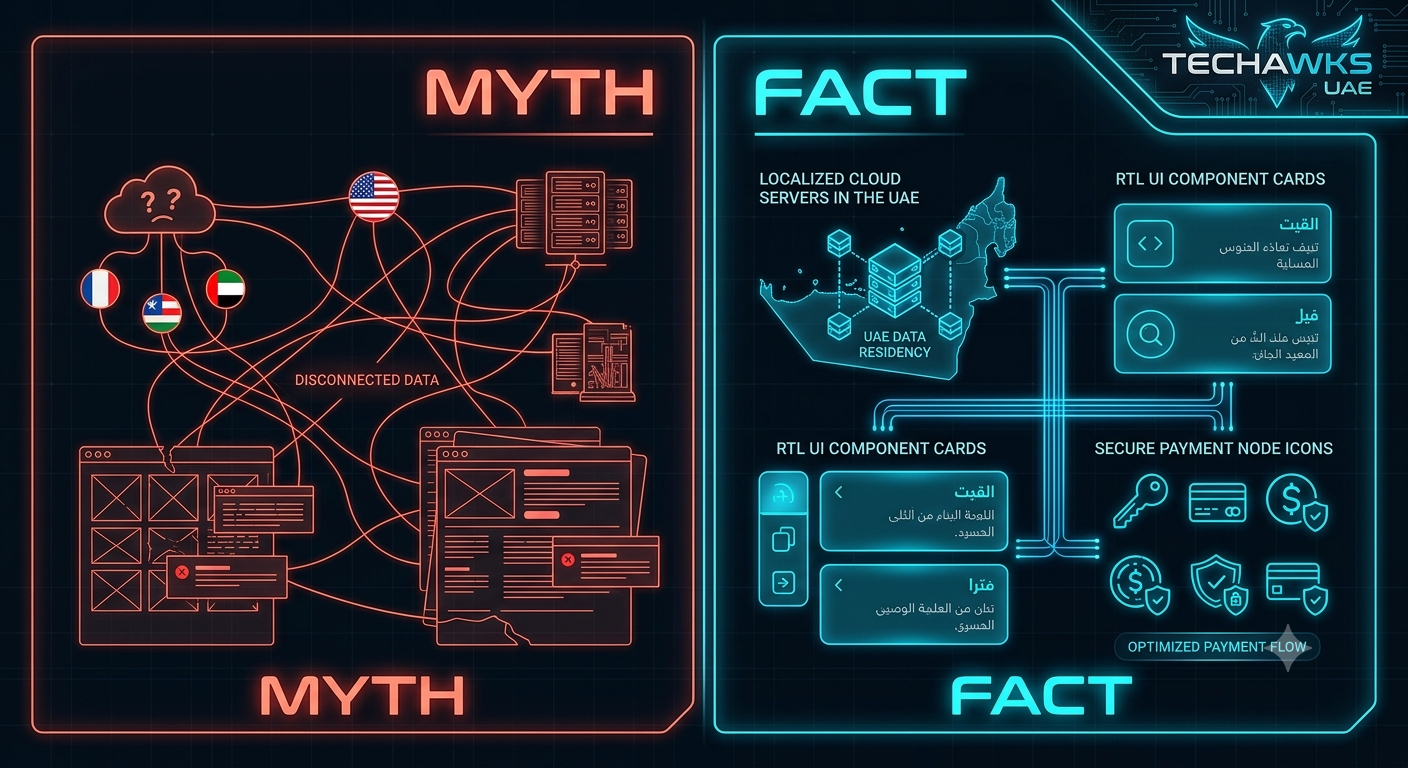
Debunking the Top 4 Tech Infrastructure Myths in the UAE
Myth #1: "Hosting data on any major global cloud region automatically satisfies UAE data compliance."
Fact: Data residency laws depend on data sensitivity.
The Reality: Under UAE Federal Decree-Law No. 45/2021 (PDPL), certain types of sensitive personal or regulated industry data must reside within local borders. While general public applications can leverage global nodes, hosting health, financial, or government-adjacent data often requires local regions (such as AWS me-central-1 or Azure UAE nodes).
Action: Audit your data classification levels before selecting your primary database host.
Myth #2: "Translating app text to Arabic is enough for local product adoption."
Fact: Localization is a structural UX effort, not just a translation task.
The Reality: True regional localization requires full Right-to-Left (RTL) layout adaptation. Simply translating text without flipping UI elements, adjusting font rendering, or redesigning navigation flows creates clunky user experiences that hurt conversion.
Action: Design with CSS logical properties (like margin-inline-start) from day one to ensure UI flexibility across both LTR and RTL layouts.
Myth #3: "Global payment gateways are all you need to convert UAE customers."
Fact: Local payment preferences directly impact cart abandonment.
The Reality: While credit cards are widely used, a huge portion of UAE consumers prefer frictionless options like Apple Pay, localized debit options, and regional Buy-Now-Pay-Later (BNPL) providers.
Action: Integrate local payment aggregators or native regional APIs to offer a comprehensive checkout experience.
Myth #4: "Enterprise communications work identically across all global regions without local tweaks."
Fact: Regional network and telecom dynamics require proactive setup.
The Reality: Unoptimized real-time communication protocols (VoIP, WebRTC) and un-cached media streams can suffer from higher latency or blocking if not configured with local enterprise-grade VPNs or regional CDN edge locations.
Action: Deploy Middle East CDN edge nodes and test WebRTC fallback protocols specifically across UAE networks.
Key Takeaways
Verify Residency Requirements: Always map data sensitivity against local PDPL guidelines before locking down hosting infrastructure.
Layout > Direct Translation: Build modular UI components natively designed for Right-to-Left (RTL) workflows.
Optimize for Local Checkout: Reduce drop-off rates by offering payment methods native to Middle Eastern consumer habits.
CTA
Want to build smarter tech in the Emirates? Join Techawks UAE today to exchange vetted technical insights, optimize your stack, and connect with peer developers across the region!
Myth #1: "Hosting data on any major global cloud region automatically satisfies UAE data compliance."
Fact: Data residency laws depend on data sensitivity.
The Reality: Under UAE Federal Decree-Law No. 45/2021 (PDPL), certain types of sensitive personal or regulated industry data must reside within local borders. While general public applications can leverage global nodes, hosting health, financial, or government-adjacent data often requires local regions (such as AWS me-central-1 or Azure UAE nodes).
Action: Audit your data classification levels before selecting your primary database host.
Myth #2: "Translating app text to Arabic is enough for local product adoption."
Fact: Localization is a structural UX effort, not just a translation task.
The Reality: True regional localization requires full Right-to-Left (RTL) layout adaptation. Simply translating text without flipping UI elements, adjusting font rendering, or redesigning navigation flows creates clunky user experiences that hurt conversion.
Action: Design with CSS logical properties (like margin-inline-start) from day one to ensure UI flexibility across both LTR and RTL layouts.
Myth #3: "Global payment gateways are all you need to convert UAE customers."
Fact: Local payment preferences directly impact cart abandonment.
The Reality: While credit cards are widely used, a huge portion of UAE consumers prefer frictionless options like Apple Pay, localized debit options, and regional Buy-Now-Pay-Later (BNPL) providers.
Action: Integrate local payment aggregators or native regional APIs to offer a comprehensive checkout experience.
Myth #4: "Enterprise communications work identically across all global regions without local tweaks."
Fact: Regional network and telecom dynamics require proactive setup.
The Reality: Unoptimized real-time communication protocols (VoIP, WebRTC) and un-cached media streams can suffer from higher latency or blocking if not configured with local enterprise-grade VPNs or regional CDN edge locations.
Action: Deploy Middle East CDN edge nodes and test WebRTC fallback protocols specifically across UAE networks.
Key Takeaways
Verify Residency Requirements: Always map data sensitivity against local PDPL guidelines before locking down hosting infrastructure.
Layout > Direct Translation: Build modular UI components natively designed for Right-to-Left (RTL) workflows.
Optimize for Local Checkout: Reduce drop-off rates by offering payment methods native to Middle Eastern consumer habits.
CTA
Want to build smarter tech in the Emirates? Join Techawks UAE today to exchange vetted technical insights, optimize your stack, and connect with peer developers across the region!
Debunking the Top 4 Tech Infrastructure Myths in the UAE
Myth #1: "Hosting data on any major global cloud region automatically satisfies UAE data compliance."
Fact: Data residency laws depend on data sensitivity.
The Reality: Under UAE Federal Decree-Law No. 45/2021 (PDPL), certain types of sensitive personal or regulated industry data must reside within local borders. While general public applications can leverage global nodes, hosting health, financial, or government-adjacent data often requires local regions (such as AWS me-central-1 or Azure UAE nodes).
Action: Audit your data classification levels before selecting your primary database host.
Myth #2: "Translating app text to Arabic is enough for local product adoption."
Fact: Localization is a structural UX effort, not just a translation task.
The Reality: True regional localization requires full Right-to-Left (RTL) layout adaptation. Simply translating text without flipping UI elements, adjusting font rendering, or redesigning navigation flows creates clunky user experiences that hurt conversion.
Action: Design with CSS logical properties (like margin-inline-start) from day one to ensure UI flexibility across both LTR and RTL layouts.
Myth #3: "Global payment gateways are all you need to convert UAE customers."
Fact: Local payment preferences directly impact cart abandonment.
The Reality: While credit cards are widely used, a huge portion of UAE consumers prefer frictionless options like Apple Pay, localized debit options, and regional Buy-Now-Pay-Later (BNPL) providers.
Action: Integrate local payment aggregators or native regional APIs to offer a comprehensive checkout experience.
Myth #4: "Enterprise communications work identically across all global regions without local tweaks."
Fact: Regional network and telecom dynamics require proactive setup.
The Reality: Unoptimized real-time communication protocols (VoIP, WebRTC) and un-cached media streams can suffer from higher latency or blocking if not configured with local enterprise-grade VPNs or regional CDN edge locations.
Action: Deploy Middle East CDN edge nodes and test WebRTC fallback protocols specifically across UAE networks.
Key Takeaways
Verify Residency Requirements: Always map data sensitivity against local PDPL guidelines before locking down hosting infrastructure.
Layout > Direct Translation: Build modular UI components natively designed for Right-to-Left (RTL) workflows.
Optimize for Local Checkout: Reduce drop-off rates by offering payment methods native to Middle Eastern consumer habits.
CTA
Want to build smarter tech in the Emirates? Join Techawks UAE today to exchange vetted technical insights, optimize your stack, and connect with peer developers across the region!

 Arabic
 French
 Spanish
 Portuguese
 Deutsch
 Turkish
 Dutch
Dutch
 Italiano
 Russian
 Romaian
 Portuguese (Brazil)
 Greek
Greek