


The Interconnection Queue Trap: Why US Cloud Architects Must Design for Megawatts, Not Just Flops
The conversation in US enterprise infrastructure has quietly pivoted from silicon procurement to energized capacity. Hyperscalers and tier-1 colocation hubs across Northern Virginia, Texas (ERCOT), and the Pacific Northwest are hitting hard interconnection walls with local utilities.
If your team is deploying dense training clusters or hosting private enterprise inference nodes, capacity planning can no longer treat the data center as an abstract, infinite utility.
Here is what infrastructure and platform leads must understand about the new constraints:
1. The Geography of Compute Has Decoupled from Latency
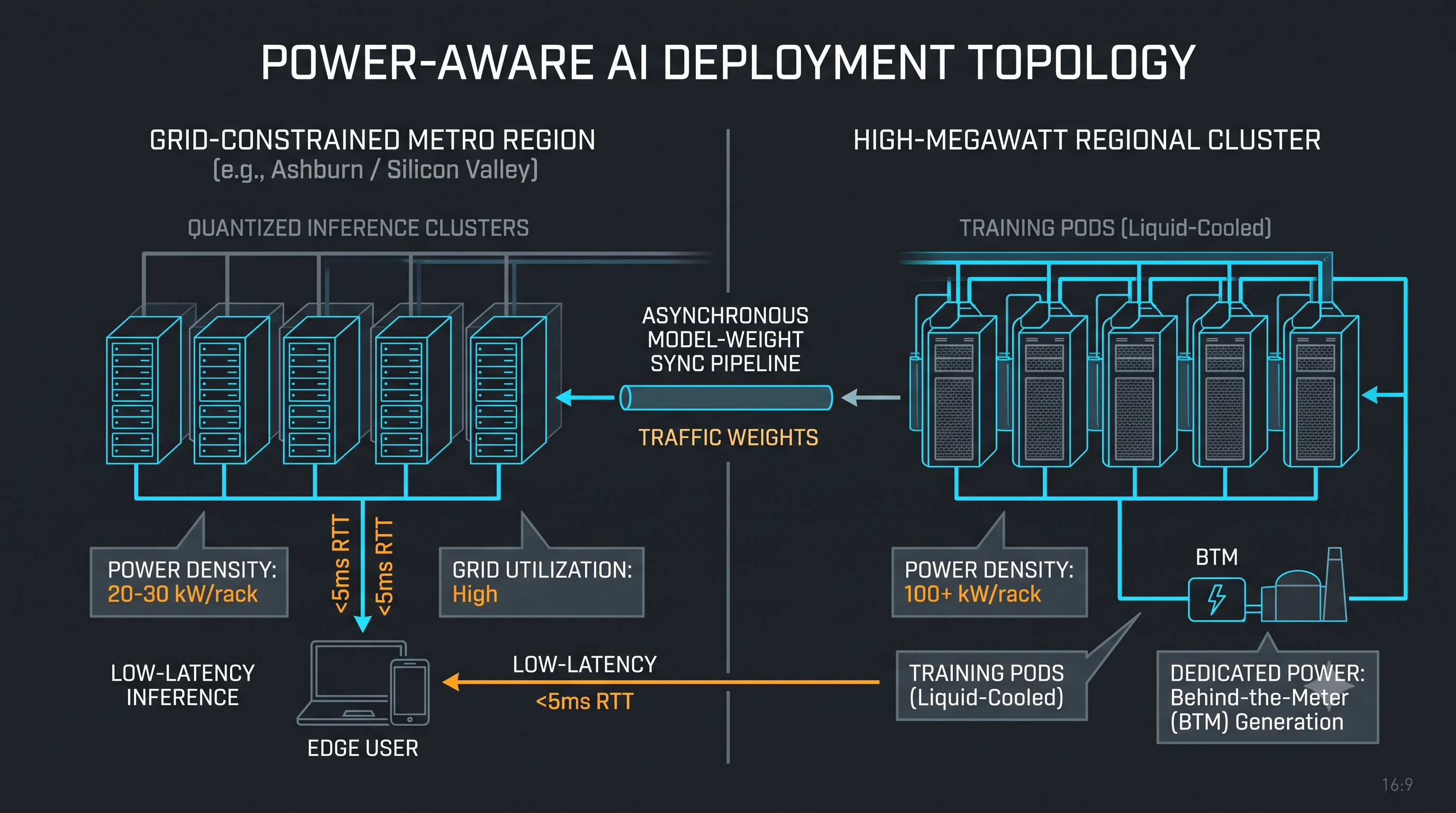
Historically, US engineering teams colocated data centers near primary fiber routes (Ashburn, Silicon Valley, Dallas) to preserve single-digit millisecond round trips. Today, massive parameter pre-training and batch fine-tuning workloads are shifting to stranded energy zones—secondary markets in the Midwest and Mountain West where behind-the-meter nuclear, hydroelectric, or wind generation bypasses public grid transmission delays.
2. Workload Bifurcation: Asynchronous vs. Synchronous
Because power is distributed unevenly, cloud architects must architect around a strict dichotomy:
Latency-Insensitive Asynchronous Workloads (Training/Batch Embeddings): Routed to "power-first" geographical regions. These clusters prioritize high Power Usage Effectiveness (PUE) and raw megawatt availability over edge proximity.
Latency-Sensitive Synchronous Workloads (Real-Time Agentic Loops/Inference): Retained in dense edge or metro centers, requiring heavy model compression (FP4/INT4 quantization, speculative decoding, and flash-attention kernels) to minimize rack thermal density (kW/rack) within legacy power limits.
3. The Takeaway for Systems Architects
Designing resilient distributed systems today means factoring power budgets directly into your infrastructure-as-code and scheduling layers. Tools like Kubernetes-native custom schedulers must now balance not just CPU/GPU memory, but thermal throttling boundaries, dynamic power draw limits, and inter-region egress costs across geographically fragmented clusters.
Discussion Question
US engineering leads and cloud architects: Is the regional grid power squeeze currently forcing your organization to rethink multi-region deployment strategies, or are you solving the thermal/power bottleneck purely through model quantization and software-level efficiency?
CTA (Join Techawks USA)
Join Techawks USA for engineering roundtables, system architecture breakdowns, and peer discussions tackling modern cloud infrastructure challenges.
The conversation in US enterprise infrastructure has quietly pivoted from silicon procurement to energized capacity. Hyperscalers and tier-1 colocation hubs across Northern Virginia, Texas (ERCOT), and the Pacific Northwest are hitting hard interconnection walls with local utilities.
If your team is deploying dense training clusters or hosting private enterprise inference nodes, capacity planning can no longer treat the data center as an abstract, infinite utility.
Here is what infrastructure and platform leads must understand about the new constraints:
1. The Geography of Compute Has Decoupled from Latency
Historically, US engineering teams colocated data centers near primary fiber routes (Ashburn, Silicon Valley, Dallas) to preserve single-digit millisecond round trips. Today, massive parameter pre-training and batch fine-tuning workloads are shifting to stranded energy zones—secondary markets in the Midwest and Mountain West where behind-the-meter nuclear, hydroelectric, or wind generation bypasses public grid transmission delays.
2. Workload Bifurcation: Asynchronous vs. Synchronous
Because power is distributed unevenly, cloud architects must architect around a strict dichotomy:
Latency-Insensitive Asynchronous Workloads (Training/Batch Embeddings): Routed to "power-first" geographical regions. These clusters prioritize high Power Usage Effectiveness (PUE) and raw megawatt availability over edge proximity.
Latency-Sensitive Synchronous Workloads (Real-Time Agentic Loops/Inference): Retained in dense edge or metro centers, requiring heavy model compression (FP4/INT4 quantization, speculative decoding, and flash-attention kernels) to minimize rack thermal density (kW/rack) within legacy power limits.
3. The Takeaway for Systems Architects
Designing resilient distributed systems today means factoring power budgets directly into your infrastructure-as-code and scheduling layers. Tools like Kubernetes-native custom schedulers must now balance not just CPU/GPU memory, but thermal throttling boundaries, dynamic power draw limits, and inter-region egress costs across geographically fragmented clusters.
Discussion Question
US engineering leads and cloud architects: Is the regional grid power squeeze currently forcing your organization to rethink multi-region deployment strategies, or are you solving the thermal/power bottleneck purely through model quantization and software-level efficiency?
CTA (Join Techawks USA)
Join Techawks USA for engineering roundtables, system architecture breakdowns, and peer discussions tackling modern cloud infrastructure challenges.
The Interconnection Queue Trap: Why US Cloud Architects Must Design for Megawatts, Not Just Flops
The conversation in US enterprise infrastructure has quietly pivoted from silicon procurement to energized capacity. Hyperscalers and tier-1 colocation hubs across Northern Virginia, Texas (ERCOT), and the Pacific Northwest are hitting hard interconnection walls with local utilities.
If your team is deploying dense training clusters or hosting private enterprise inference nodes, capacity planning can no longer treat the data center as an abstract, infinite utility.
Here is what infrastructure and platform leads must understand about the new constraints:
1. The Geography of Compute Has Decoupled from Latency
Historically, US engineering teams colocated data centers near primary fiber routes (Ashburn, Silicon Valley, Dallas) to preserve single-digit millisecond round trips. Today, massive parameter pre-training and batch fine-tuning workloads are shifting to stranded energy zones—secondary markets in the Midwest and Mountain West where behind-the-meter nuclear, hydroelectric, or wind generation bypasses public grid transmission delays.
2. Workload Bifurcation: Asynchronous vs. Synchronous
Because power is distributed unevenly, cloud architects must architect around a strict dichotomy:
Latency-Insensitive Asynchronous Workloads (Training/Batch Embeddings): Routed to "power-first" geographical regions. These clusters prioritize high Power Usage Effectiveness (PUE) and raw megawatt availability over edge proximity.
Latency-Sensitive Synchronous Workloads (Real-Time Agentic Loops/Inference): Retained in dense edge or metro centers, requiring heavy model compression (FP4/INT4 quantization, speculative decoding, and flash-attention kernels) to minimize rack thermal density (kW/rack) within legacy power limits.
3. The Takeaway for Systems Architects
Designing resilient distributed systems today means factoring power budgets directly into your infrastructure-as-code and scheduling layers. Tools like Kubernetes-native custom schedulers must now balance not just CPU/GPU memory, but thermal throttling boundaries, dynamic power draw limits, and inter-region egress costs across geographically fragmented clusters.
Discussion Question
US engineering leads and cloud architects: Is the regional grid power squeeze currently forcing your organization to rethink multi-region deployment strategies, or are you solving the thermal/power bottleneck purely through model quantization and software-level efficiency?
CTA (Join Techawks USA)
Join Techawks USA for engineering roundtables, system architecture breakdowns, and peer discussions tackling modern cloud infrastructure challenges.

 Arabic
 French
 Spanish
 Portuguese
 Deutsch
 Turkish
 Dutch
Dutch
 Italiano
 Russian
 Romaian
 Portuguese (Brazil)
 Greek
Greek