


Beyond GPU Subsidies: Why Canada’s Sovereign AI Push Hinges on Federated Data Lineage
Canada's AI Sovereign Compute Infrastructure Program (SCIP) marks a decisive commitment to domestic infrastructure: keeping compute capacity, model training, and IP retention inside Canadian borders.
However, building domestic GPU superclusters only solves the hardware layer. In practice, Canadian technology teams face a unique regulatory architecture: federal frameworks like PIPEDA and the Artificial Intelligence and Data Act (AIDA / Bill C-27) layered directly on top of provincial mandates (such as Quebec’s strict Law 25).
If an engineering team in Montreal, Toronto, or Vancouver wants to fine-tune a model on domestic public infrastructure, aggregating enterprise or public-sector data into a centralized training bucket frequently triggers cross-provincial compliance violations.
Here is how Canadian data engineers and systems architects must adapt:
1. The End of the Monolithic Training Lakehouse
Aggregating healthcare records, banking transactions, or municipal telemetry from Ontario, Quebec, and British Columbia into a single central data warehouse is increasingly untenable due to strict purpose-limitation, consent tracking, and provincial data transfer rules.
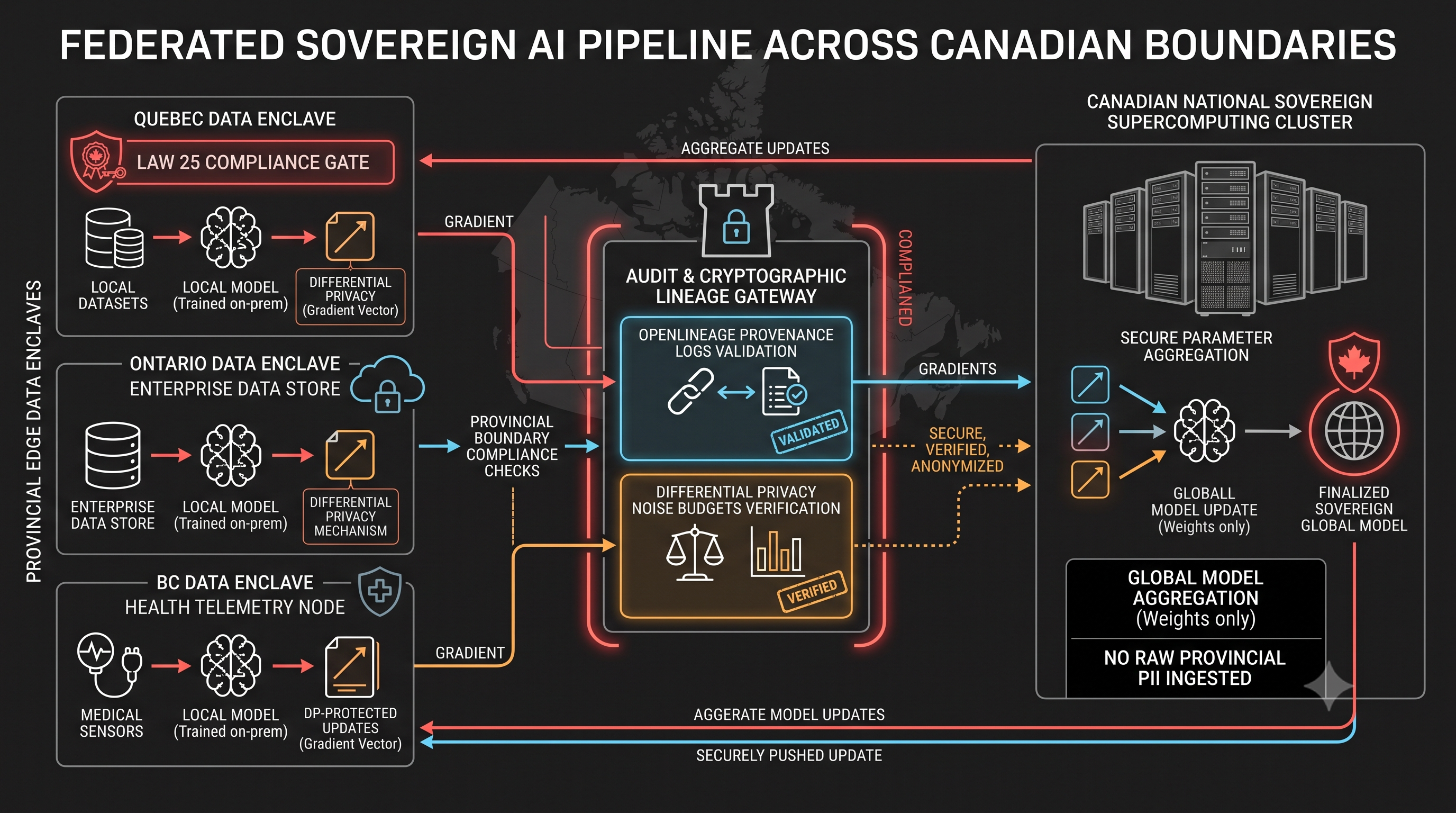
The Architecture Shift: Teams must transition to Federated Learning (FL) and Distributed Parameter Orchestration. Rather than moving raw datasets to the compute cluster, orchestrators push gradient aggregation jobs to isolated provincial nodes, returning only parameter updates back to the national sovereign core.
2. Verifiable Data Lineage as an AIDA/Law 25 Primitive
Under high-impact AI definitions, Canadian regulators require auditable documentation of data provenance, bias mitigation, and systemic risk. A standard metadata catalog or Git commit hash is no longer sufficient.
The Implementation: Modern data engineering pipelines require immutable, cryptographic provenance tracing (such as OpenLineage integrated with signed software bill of materials / SBOM-like schemas for datasets). Every feature transformation, tokenization rule, and data filtering step must be permanently paired with the model artifact to withstand algorithmic transparency audits.
3. Privacy-Preserving Synthetic Twins for Cross-Border R&D
Canadian teams operating across the US–Canada border or running multi-national pipelines cannot treat raw domestic data as globally portable.
The Implementation: Production pipelines are implementing differential privacy (DP) pipelines at the ingestion gateway. By generating mathematically bounded synthetic datasets (DP-SGD) inside the Canadian sovereign enclave, engineers can develop, debug, and benchmark architectures across distributed teams without ever exporting regulated Canadian PII.
Discussion Question
For engineering leads and architects building across Toronto, Montreal, Vancouver, Calgary, and Ottawa: Is your organization moving toward federated data orchestration to navigate provincial privacy laws (like Quebec Law 25), or are you solving data isolation through synthetic generation and localized private cloud zones?
CTA (Join Techawks Canada)
Join Techawks Canada to participate in deep-dive architecture discussions, data engineering meetups, and technical roundtables defining Canada’s sovereign tech future.
Canada's AI Sovereign Compute Infrastructure Program (SCIP) marks a decisive commitment to domestic infrastructure: keeping compute capacity, model training, and IP retention inside Canadian borders.
However, building domestic GPU superclusters only solves the hardware layer. In practice, Canadian technology teams face a unique regulatory architecture: federal frameworks like PIPEDA and the Artificial Intelligence and Data Act (AIDA / Bill C-27) layered directly on top of provincial mandates (such as Quebec’s strict Law 25).
If an engineering team in Montreal, Toronto, or Vancouver wants to fine-tune a model on domestic public infrastructure, aggregating enterprise or public-sector data into a centralized training bucket frequently triggers cross-provincial compliance violations.
Here is how Canadian data engineers and systems architects must adapt:
1. The End of the Monolithic Training Lakehouse
Aggregating healthcare records, banking transactions, or municipal telemetry from Ontario, Quebec, and British Columbia into a single central data warehouse is increasingly untenable due to strict purpose-limitation, consent tracking, and provincial data transfer rules.
The Architecture Shift: Teams must transition to Federated Learning (FL) and Distributed Parameter Orchestration. Rather than moving raw datasets to the compute cluster, orchestrators push gradient aggregation jobs to isolated provincial nodes, returning only parameter updates back to the national sovereign core.
2. Verifiable Data Lineage as an AIDA/Law 25 Primitive
Under high-impact AI definitions, Canadian regulators require auditable documentation of data provenance, bias mitigation, and systemic risk. A standard metadata catalog or Git commit hash is no longer sufficient.
The Implementation: Modern data engineering pipelines require immutable, cryptographic provenance tracing (such as OpenLineage integrated with signed software bill of materials / SBOM-like schemas for datasets). Every feature transformation, tokenization rule, and data filtering step must be permanently paired with the model artifact to withstand algorithmic transparency audits.
3. Privacy-Preserving Synthetic Twins for Cross-Border R&D
Canadian teams operating across the US–Canada border or running multi-national pipelines cannot treat raw domestic data as globally portable.
The Implementation: Production pipelines are implementing differential privacy (DP) pipelines at the ingestion gateway. By generating mathematically bounded synthetic datasets (DP-SGD) inside the Canadian sovereign enclave, engineers can develop, debug, and benchmark architectures across distributed teams without ever exporting regulated Canadian PII.
Discussion Question
For engineering leads and architects building across Toronto, Montreal, Vancouver, Calgary, and Ottawa: Is your organization moving toward federated data orchestration to navigate provincial privacy laws (like Quebec Law 25), or are you solving data isolation through synthetic generation and localized private cloud zones?
CTA (Join Techawks Canada)
Join Techawks Canada to participate in deep-dive architecture discussions, data engineering meetups, and technical roundtables defining Canada’s sovereign tech future.
Beyond GPU Subsidies: Why Canada’s Sovereign AI Push Hinges on Federated Data Lineage
Canada's AI Sovereign Compute Infrastructure Program (SCIP) marks a decisive commitment to domestic infrastructure: keeping compute capacity, model training, and IP retention inside Canadian borders.
However, building domestic GPU superclusters only solves the hardware layer. In practice, Canadian technology teams face a unique regulatory architecture: federal frameworks like PIPEDA and the Artificial Intelligence and Data Act (AIDA / Bill C-27) layered directly on top of provincial mandates (such as Quebec’s strict Law 25).
If an engineering team in Montreal, Toronto, or Vancouver wants to fine-tune a model on domestic public infrastructure, aggregating enterprise or public-sector data into a centralized training bucket frequently triggers cross-provincial compliance violations.
Here is how Canadian data engineers and systems architects must adapt:
1. The End of the Monolithic Training Lakehouse
Aggregating healthcare records, banking transactions, or municipal telemetry from Ontario, Quebec, and British Columbia into a single central data warehouse is increasingly untenable due to strict purpose-limitation, consent tracking, and provincial data transfer rules.
The Architecture Shift: Teams must transition to Federated Learning (FL) and Distributed Parameter Orchestration. Rather than moving raw datasets to the compute cluster, orchestrators push gradient aggregation jobs to isolated provincial nodes, returning only parameter updates back to the national sovereign core.
2. Verifiable Data Lineage as an AIDA/Law 25 Primitive
Under high-impact AI definitions, Canadian regulators require auditable documentation of data provenance, bias mitigation, and systemic risk. A standard metadata catalog or Git commit hash is no longer sufficient.
The Implementation: Modern data engineering pipelines require immutable, cryptographic provenance tracing (such as OpenLineage integrated with signed software bill of materials / SBOM-like schemas for datasets). Every feature transformation, tokenization rule, and data filtering step must be permanently paired with the model artifact to withstand algorithmic transparency audits.
3. Privacy-Preserving Synthetic Twins for Cross-Border R&D
Canadian teams operating across the US–Canada border or running multi-national pipelines cannot treat raw domestic data as globally portable.
The Implementation: Production pipelines are implementing differential privacy (DP) pipelines at the ingestion gateway. By generating mathematically bounded synthetic datasets (DP-SGD) inside the Canadian sovereign enclave, engineers can develop, debug, and benchmark architectures across distributed teams without ever exporting regulated Canadian PII.
Discussion Question
For engineering leads and architects building across Toronto, Montreal, Vancouver, Calgary, and Ottawa: Is your organization moving toward federated data orchestration to navigate provincial privacy laws (like Quebec Law 25), or are you solving data isolation through synthetic generation and localized private cloud zones?
CTA (Join Techawks Canada)
Join Techawks Canada to participate in deep-dive architecture discussions, data engineering meetups, and technical roundtables defining Canada’s sovereign tech future.

 Arabic
 French
 Spanish
 Portuguese
 Deutsch
 Turkish
 Dutch
Dutch
 Italiano
 Russian
 Romaian
 Portuguese (Brazil)
 Greek
Greek