


The Ephemeral State Blind Spot: Why GitOps Reconcilers Fail Against Dynamic Runtime Drift
GitOps (via Argo CD or Flux) is now the default control loop for Kubernetes infrastructure. Commits represent intent, and pull-based controllers continuously reconcile cluster state to match the repository.
However, as production clusters take on dynamic workloads—such as horizontal autoscalers (KEDA), mutating admission webhooks, dynamic secret rotators (OpenBao / External Secrets Operator), and multi-cluster orchestrators—the naive assumption that "all state lives in Git" falls apart.
When an in-cluster controller alters a deployment at runtime (e.g., resizing pod specs based on real-time utilization, injecting sidecar proxies, or updating status annotations), standard GitOps controllers face two critical failure modes:
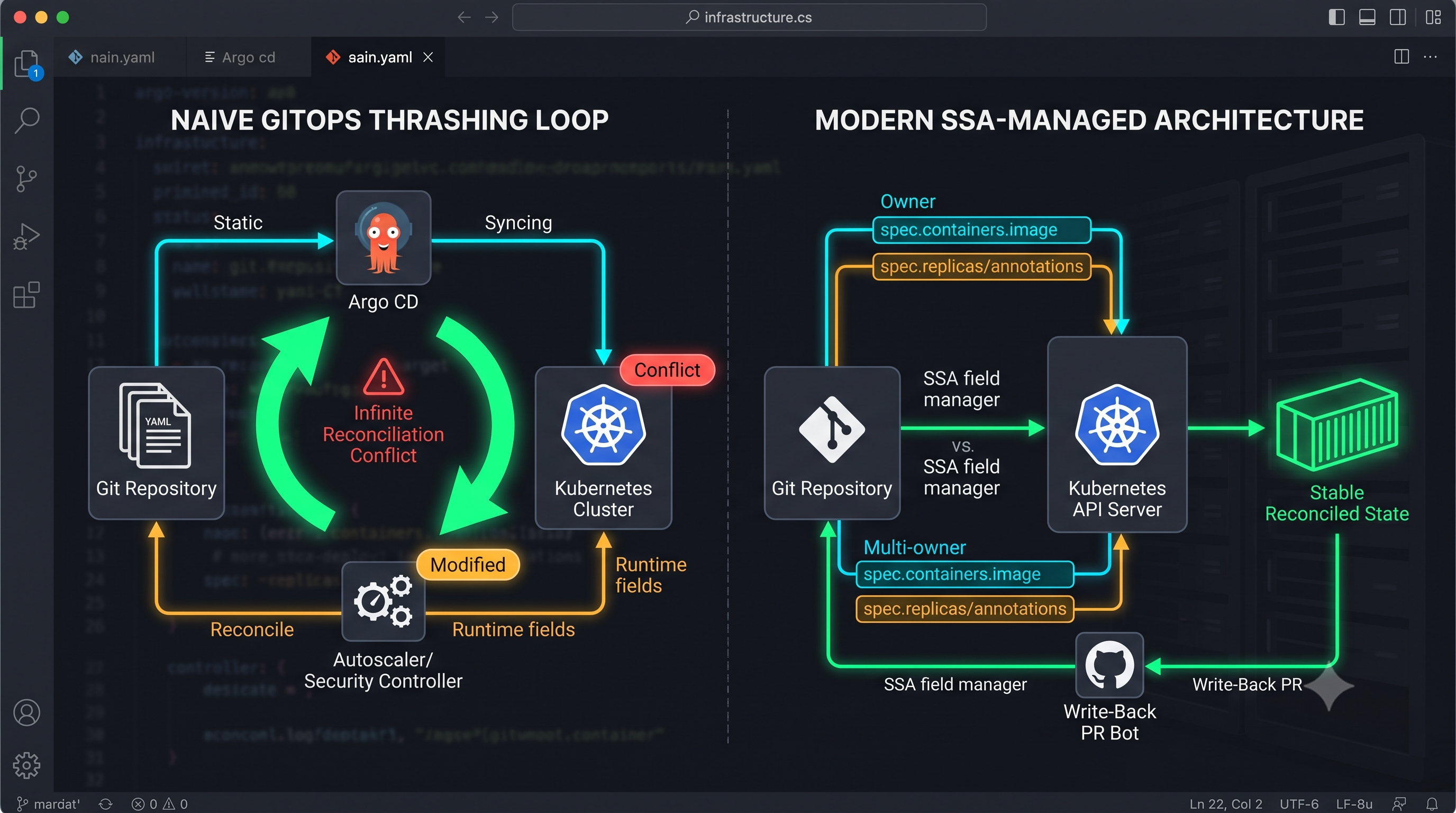
Reconciliation Thrashing (Fight Loops): The GitOps engine detects an out-of-band change, treats it as unauthorized configuration drift, and blindly overwrites it back to the static Git manifest—fighting your autoscaling or security controllers in an infinite loop.
Configuration Ghost Drift: Teams add blanket ignoreDifferences rules to silence false diffs, inadvertently blinding operators to genuine adversarial tampering or unreviewed manual patches.
To resolve the friction between immutable declarations and dynamic runtime adaptations, platform engineering teams are evolving from Static GitOps to Bidirectional State Reconciliation:
1. Explicit Field Ownership via Server-Side Apply (SSA)
Client-side applies (kubectl apply) treat manifests as monolithic objects. Migrating GitOps reconcilers to utilize native Kubernetes Server-Side Apply (SSA) allows multiple controllers to safely share ownership of a single resource.
Git owns the base declarative schema (e.g., container image, base ports, security context).
In-cluster controllers (e.g., autoscalers, mesh sidecar injectors) maintain explicit field ownership over dynamic sub-paths (e.g., spec.replicas, spec.template.metadata.annotations).
Conflicts trigger explicit merge rejection instead of silent, destructive overwrites.
2. Decouple Static Intent from Dynamic Compositions (Control Plane Abstraction)
Stop committing raw, environment-specific YAML manifests across dozens of branches.
Platform teams are shifting toward composable control planes (e.g., Crossplane or OpenTofu operators paired with GitOps). Developers declare high-level intent via custom resources (CRDs), while dynamic controllers generate the ephemeral runtime plumbing without polluting Git history with thousand-line commit churn.
3. Automated Bidirectional Feedback Loops (Write-Back Bots)
When an automated controller legitimately modifies a persistent cluster property (such as an automated vulnerability patch or a permanent rightsizing recommendation), an automated GitOps write-back agent opens a synthetic pull request back to the repository. This keeps the Git audit trail intact without relying on engineers to manually backport cluster state.
Discussion Question
For DevOps, platform engineers, and cloud architects: How is your team currently handling dynamic in-cluster modifications with Argo CD or Flux? Are you leveraging Server-Side Apply field management, relying on selective diff-ignoring, or using automated write-back pipelines to maintain your Git audit trail?
CTA (Share deployment experiences)
Share your GitOps architecture patterns, edge-case sync headaches, and how you manage dynamic controllers in production down in the comments!
GitOps (via Argo CD or Flux) is now the default control loop for Kubernetes infrastructure. Commits represent intent, and pull-based controllers continuously reconcile cluster state to match the repository.
However, as production clusters take on dynamic workloads—such as horizontal autoscalers (KEDA), mutating admission webhooks, dynamic secret rotators (OpenBao / External Secrets Operator), and multi-cluster orchestrators—the naive assumption that "all state lives in Git" falls apart.
When an in-cluster controller alters a deployment at runtime (e.g., resizing pod specs based on real-time utilization, injecting sidecar proxies, or updating status annotations), standard GitOps controllers face two critical failure modes:
Reconciliation Thrashing (Fight Loops): The GitOps engine detects an out-of-band change, treats it as unauthorized configuration drift, and blindly overwrites it back to the static Git manifest—fighting your autoscaling or security controllers in an infinite loop.
Configuration Ghost Drift: Teams add blanket ignoreDifferences rules to silence false diffs, inadvertently blinding operators to genuine adversarial tampering or unreviewed manual patches.
To resolve the friction between immutable declarations and dynamic runtime adaptations, platform engineering teams are evolving from Static GitOps to Bidirectional State Reconciliation:
1. Explicit Field Ownership via Server-Side Apply (SSA)
Client-side applies (kubectl apply) treat manifests as monolithic objects. Migrating GitOps reconcilers to utilize native Kubernetes Server-Side Apply (SSA) allows multiple controllers to safely share ownership of a single resource.
Git owns the base declarative schema (e.g., container image, base ports, security context).
In-cluster controllers (e.g., autoscalers, mesh sidecar injectors) maintain explicit field ownership over dynamic sub-paths (e.g., spec.replicas, spec.template.metadata.annotations).
Conflicts trigger explicit merge rejection instead of silent, destructive overwrites.
2. Decouple Static Intent from Dynamic Compositions (Control Plane Abstraction)
Stop committing raw, environment-specific YAML manifests across dozens of branches.
Platform teams are shifting toward composable control planes (e.g., Crossplane or OpenTofu operators paired with GitOps). Developers declare high-level intent via custom resources (CRDs), while dynamic controllers generate the ephemeral runtime plumbing without polluting Git history with thousand-line commit churn.
3. Automated Bidirectional Feedback Loops (Write-Back Bots)
When an automated controller legitimately modifies a persistent cluster property (such as an automated vulnerability patch or a permanent rightsizing recommendation), an automated GitOps write-back agent opens a synthetic pull request back to the repository. This keeps the Git audit trail intact without relying on engineers to manually backport cluster state.
Discussion Question
For DevOps, platform engineers, and cloud architects: How is your team currently handling dynamic in-cluster modifications with Argo CD or Flux? Are you leveraging Server-Side Apply field management, relying on selective diff-ignoring, or using automated write-back pipelines to maintain your Git audit trail?
CTA (Share deployment experiences)
Share your GitOps architecture patterns, edge-case sync headaches, and how you manage dynamic controllers in production down in the comments!
The Ephemeral State Blind Spot: Why GitOps Reconcilers Fail Against Dynamic Runtime Drift
GitOps (via Argo CD or Flux) is now the default control loop for Kubernetes infrastructure. Commits represent intent, and pull-based controllers continuously reconcile cluster state to match the repository.
However, as production clusters take on dynamic workloads—such as horizontal autoscalers (KEDA), mutating admission webhooks, dynamic secret rotators (OpenBao / External Secrets Operator), and multi-cluster orchestrators—the naive assumption that "all state lives in Git" falls apart.
When an in-cluster controller alters a deployment at runtime (e.g., resizing pod specs based on real-time utilization, injecting sidecar proxies, or updating status annotations), standard GitOps controllers face two critical failure modes:
Reconciliation Thrashing (Fight Loops): The GitOps engine detects an out-of-band change, treats it as unauthorized configuration drift, and blindly overwrites it back to the static Git manifest—fighting your autoscaling or security controllers in an infinite loop.
Configuration Ghost Drift: Teams add blanket ignoreDifferences rules to silence false diffs, inadvertently blinding operators to genuine adversarial tampering or unreviewed manual patches.
To resolve the friction between immutable declarations and dynamic runtime adaptations, platform engineering teams are evolving from Static GitOps to Bidirectional State Reconciliation:
1. Explicit Field Ownership via Server-Side Apply (SSA)
Client-side applies (kubectl apply) treat manifests as monolithic objects. Migrating GitOps reconcilers to utilize native Kubernetes Server-Side Apply (SSA) allows multiple controllers to safely share ownership of a single resource.
Git owns the base declarative schema (e.g., container image, base ports, security context).
In-cluster controllers (e.g., autoscalers, mesh sidecar injectors) maintain explicit field ownership over dynamic sub-paths (e.g., spec.replicas, spec.template.metadata.annotations).
Conflicts trigger explicit merge rejection instead of silent, destructive overwrites.
2. Decouple Static Intent from Dynamic Compositions (Control Plane Abstraction)
Stop committing raw, environment-specific YAML manifests across dozens of branches.
Platform teams are shifting toward composable control planes (e.g., Crossplane or OpenTofu operators paired with GitOps). Developers declare high-level intent via custom resources (CRDs), while dynamic controllers generate the ephemeral runtime plumbing without polluting Git history with thousand-line commit churn.
3. Automated Bidirectional Feedback Loops (Write-Back Bots)
When an automated controller legitimately modifies a persistent cluster property (such as an automated vulnerability patch or a permanent rightsizing recommendation), an automated GitOps write-back agent opens a synthetic pull request back to the repository. This keeps the Git audit trail intact without relying on engineers to manually backport cluster state.
Discussion Question
For DevOps, platform engineers, and cloud architects: How is your team currently handling dynamic in-cluster modifications with Argo CD or Flux? Are you leveraging Server-Side Apply field management, relying on selective diff-ignoring, or using automated write-back pipelines to maintain your Git audit trail?
CTA (Share deployment experiences)
Share your GitOps architecture patterns, edge-case sync headaches, and how you manage dynamic controllers in production down in the comments!

 English
 Arabic
 French
 Portuguese
 Deutsch
 Turkish
 Dutch
Dutch
 Italiano
 Russian
 Romaian
 Portuguese (Brazil)
 Greek
Greek