


Why the Traditional Product Roadmap is Dead: Moving from Feature Outputs to Outcome-Driven Principles
Product management has reached a critical inflection point. For years, standard operating procedure meant building dense, calendar-locked roadmaps packed with specific feature requests. But as modern product development accelerates, this output-obsessed approach backfires. It forces teams to build things on schedule that users might not even want or need.
Forward-thinking product organizations are trading rigid feature lists for Outcome-Driven Product Principles.
Why does this shift matter? Because great product strategy isn't about how many features you ship; it's about the behavioral changes and business value you unlock.
How to transition your team to outcome-driven planning:
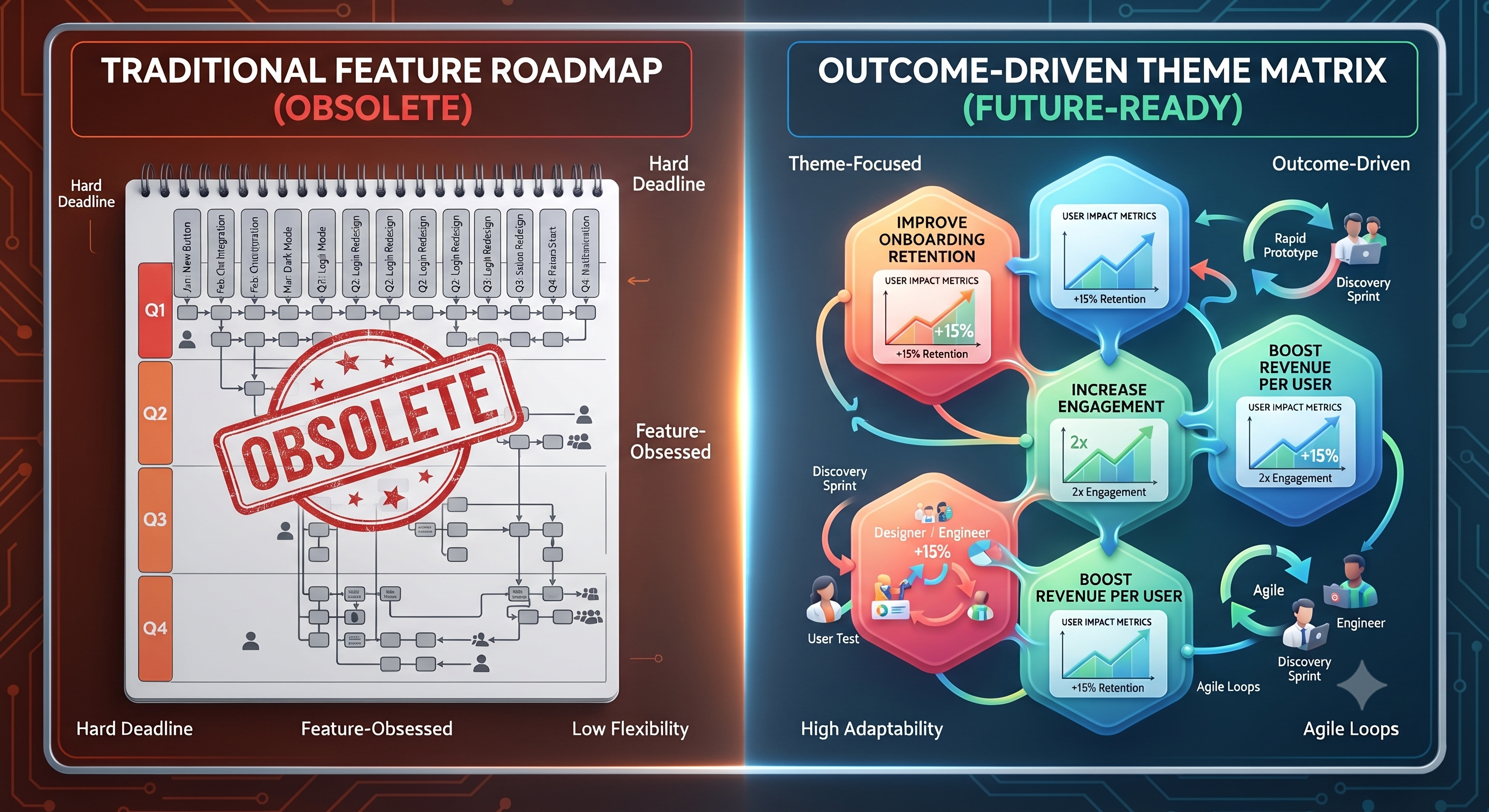
Anchor Around Themes, Not Deadlines: Group your product vision by strategic goals (e.g., "Improve onboarding retention by 15%") rather than listing specific buttons to build in Q3.
Empower Tiny Discovery Squads: Pair one designer and one engineer together to rapidly prototype, test with real users, and validate assumptions in days—not months.
Design for Transparency & Trust: When integrating AI or automation features into your UX, never hide the system's logic. Give users clear provenance, feedback loops, and easy override mechanisms to build long-term confidence.
Discussion Question
How does your team currently balance long-term strategic planning with the need to rapidly adapt to user feedback and new tech capabilities?
CTA (Join Product, UX & Design)
Want to master modern product discovery, design systems, and outcome-focused roadmapping alongside top product leaders? Join Product, UX & Design today and shape the future of digital experiences!
Product management has reached a critical inflection point. For years, standard operating procedure meant building dense, calendar-locked roadmaps packed with specific feature requests. But as modern product development accelerates, this output-obsessed approach backfires. It forces teams to build things on schedule that users might not even want or need.
Forward-thinking product organizations are trading rigid feature lists for Outcome-Driven Product Principles.
Why does this shift matter? Because great product strategy isn't about how many features you ship; it's about the behavioral changes and business value you unlock.
How to transition your team to outcome-driven planning:
Anchor Around Themes, Not Deadlines: Group your product vision by strategic goals (e.g., "Improve onboarding retention by 15%") rather than listing specific buttons to build in Q3.
Empower Tiny Discovery Squads: Pair one designer and one engineer together to rapidly prototype, test with real users, and validate assumptions in days—not months.
Design for Transparency & Trust: When integrating AI or automation features into your UX, never hide the system's logic. Give users clear provenance, feedback loops, and easy override mechanisms to build long-term confidence.
Discussion Question
How does your team currently balance long-term strategic planning with the need to rapidly adapt to user feedback and new tech capabilities?
CTA (Join Product, UX & Design)
Want to master modern product discovery, design systems, and outcome-focused roadmapping alongside top product leaders? Join Product, UX & Design today and shape the future of digital experiences!
Why the Traditional Product Roadmap is Dead: Moving from Feature Outputs to Outcome-Driven Principles
Product management has reached a critical inflection point. For years, standard operating procedure meant building dense, calendar-locked roadmaps packed with specific feature requests. But as modern product development accelerates, this output-obsessed approach backfires. It forces teams to build things on schedule that users might not even want or need.
Forward-thinking product organizations are trading rigid feature lists for Outcome-Driven Product Principles.
Why does this shift matter? Because great product strategy isn't about how many features you ship; it's about the behavioral changes and business value you unlock.
How to transition your team to outcome-driven planning:
Anchor Around Themes, Not Deadlines: Group your product vision by strategic goals (e.g., "Improve onboarding retention by 15%") rather than listing specific buttons to build in Q3.
Empower Tiny Discovery Squads: Pair one designer and one engineer together to rapidly prototype, test with real users, and validate assumptions in days—not months.
Design for Transparency & Trust: When integrating AI or automation features into your UX, never hide the system's logic. Give users clear provenance, feedback loops, and easy override mechanisms to build long-term confidence.
Discussion Question
How does your team currently balance long-term strategic planning with the need to rapidly adapt to user feedback and new tech capabilities?
CTA (Join Product, UX & Design)
Want to master modern product discovery, design systems, and outcome-focused roadmapping alongside top product leaders? Join Product, UX & Design today and shape the future of digital experiences!

 English
 Arabic
 Spanish
 Portuguese
 Deutsch
 Turkish
 Dutch
Dutch
 Italiano
 Russian
 Romaian
 Portuguese (Brazil)
 Greek
Greek