


Beyond the Prompt: Why US Tech Teams Are Pivoting from Isolated LLMs to Multi-Agent Orchestration
Across Silicon Valley, New York, and tech ecosystems nationwide, the conversation has fundamentally shifted. Early adoption focused on single Large Language Models answering questions or generating snippets. Today, enterprise leaders are discovering that isolated models hit a hard ceiling when tackling complex, messy, end-to-end workflows.
The solution driving modern software and systems engineering is Multi-Agent Orchestration.
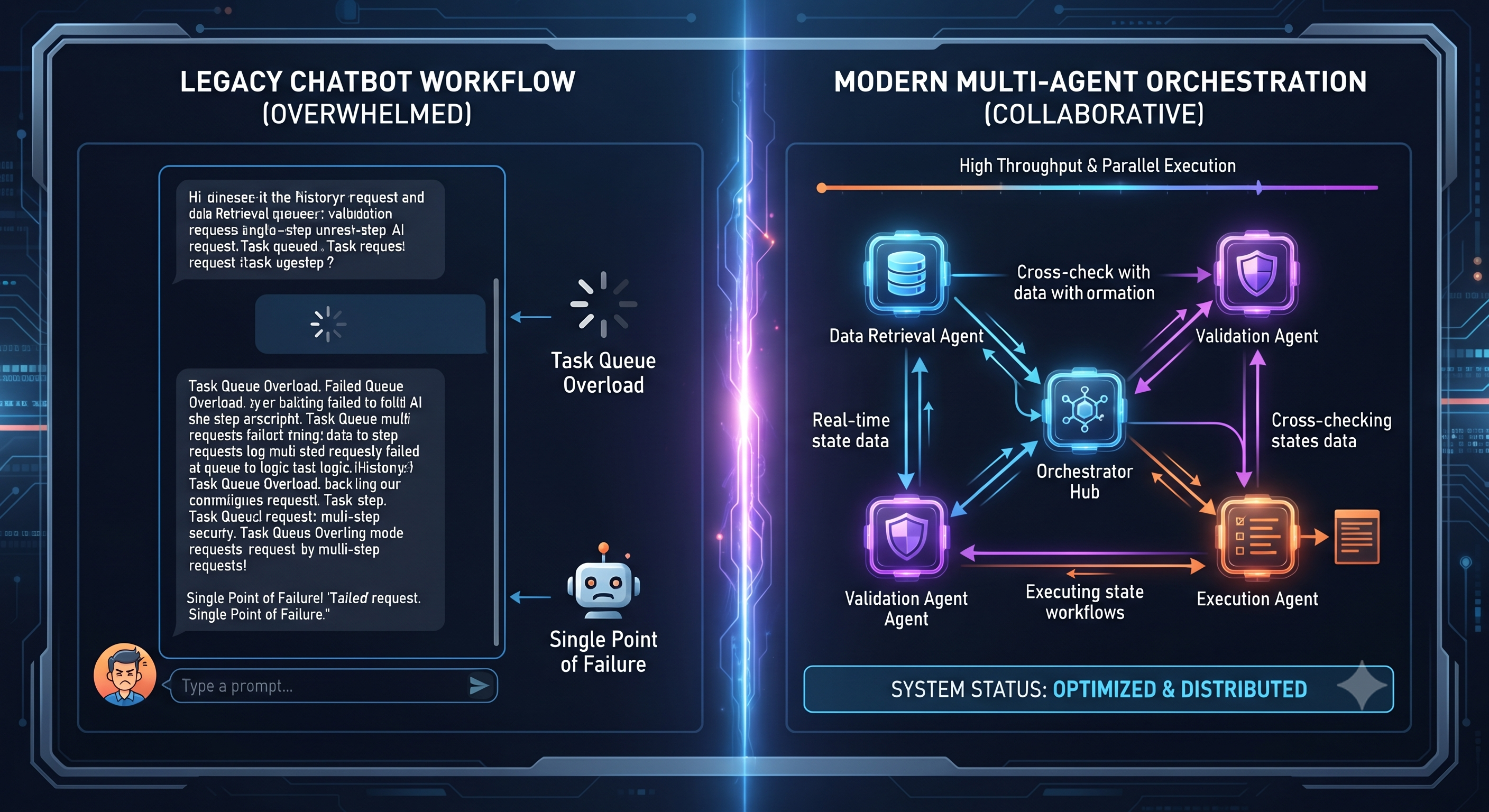
Instead of relying on one overworked model to do everything, multi-agent systems divide complex operations among specialized, autonomous AI agents that communicate, cross-check, and execute tasks collaboratively.
How to architect multi-agent systems effectively:
Define Modular Roles: Assign specific personas and tools to individual agents (e.g., a data-retrieval agent, a validation agent, and an execution agent) rather than giving a single prompt too many responsibilities.
Implement Strict State Management: Give agents persistent memory and structured state checkpoints so they can track multi-step progress without losing context or hallucinating mid-workflow.
Enforce Deterministic Guardrails: Wrap probabilistic agent outputs in programmatic validation loops and API boundaries to ensure safety, compliance, and zero rogue actions before data touches core systems.
Discussion Question
What has been your experience moving from single-prompt interactions to complex, multi-agent systems in your development cycles? Where do you encounter the biggest coordination bottlenecks?
CTA (Join Techawks USA)
Want to stay ahead of US tech trends, connect with engineering leaders, and master advanced AI architecture and cloud workflows? Join Techawks USA today and connect with the country's sharpest builders!
Across Silicon Valley, New York, and tech ecosystems nationwide, the conversation has fundamentally shifted. Early adoption focused on single Large Language Models answering questions or generating snippets. Today, enterprise leaders are discovering that isolated models hit a hard ceiling when tackling complex, messy, end-to-end workflows.
The solution driving modern software and systems engineering is Multi-Agent Orchestration.
Instead of relying on one overworked model to do everything, multi-agent systems divide complex operations among specialized, autonomous AI agents that communicate, cross-check, and execute tasks collaboratively.
How to architect multi-agent systems effectively:
Define Modular Roles: Assign specific personas and tools to individual agents (e.g., a data-retrieval agent, a validation agent, and an execution agent) rather than giving a single prompt too many responsibilities.
Implement Strict State Management: Give agents persistent memory and structured state checkpoints so they can track multi-step progress without losing context or hallucinating mid-workflow.
Enforce Deterministic Guardrails: Wrap probabilistic agent outputs in programmatic validation loops and API boundaries to ensure safety, compliance, and zero rogue actions before data touches core systems.
Discussion Question
What has been your experience moving from single-prompt interactions to complex, multi-agent systems in your development cycles? Where do you encounter the biggest coordination bottlenecks?
CTA (Join Techawks USA)
Want to stay ahead of US tech trends, connect with engineering leaders, and master advanced AI architecture and cloud workflows? Join Techawks USA today and connect with the country's sharpest builders!
Beyond the Prompt: Why US Tech Teams Are Pivoting from Isolated LLMs to Multi-Agent Orchestration
Across Silicon Valley, New York, and tech ecosystems nationwide, the conversation has fundamentally shifted. Early adoption focused on single Large Language Models answering questions or generating snippets. Today, enterprise leaders are discovering that isolated models hit a hard ceiling when tackling complex, messy, end-to-end workflows.
The solution driving modern software and systems engineering is Multi-Agent Orchestration.
Instead of relying on one overworked model to do everything, multi-agent systems divide complex operations among specialized, autonomous AI agents that communicate, cross-check, and execute tasks collaboratively.
How to architect multi-agent systems effectively:
Define Modular Roles: Assign specific personas and tools to individual agents (e.g., a data-retrieval agent, a validation agent, and an execution agent) rather than giving a single prompt too many responsibilities.
Implement Strict State Management: Give agents persistent memory and structured state checkpoints so they can track multi-step progress without losing context or hallucinating mid-workflow.
Enforce Deterministic Guardrails: Wrap probabilistic agent outputs in programmatic validation loops and API boundaries to ensure safety, compliance, and zero rogue actions before data touches core systems.
Discussion Question
What has been your experience moving from single-prompt interactions to complex, multi-agent systems in your development cycles? Where do you encounter the biggest coordination bottlenecks?
CTA (Join Techawks USA)
Want to stay ahead of US tech trends, connect with engineering leaders, and master advanced AI architecture and cloud workflows? Join Techawks USA today and connect with the country's sharpest builders!

 English
 Arabic
 French
 Spanish
 Portuguese
 Deutsch
 Turkish
 Dutch
Dutch
 Italiano
 Russian
 Portuguese (Brazil)
 Greek
Greek