


Moving Beyond the Experiment: Why US Enterprise Tech is Pivoting to Process-Led AI Governance
Across Silicon Valley, New York, and enterprise tech corridors nationwide, the narrative has shifted dramatically. Industry data shows that while over 90% of companies have integrated AI into their strategic outlook, nearly half struggle with inconsistent value measurement and risk management.
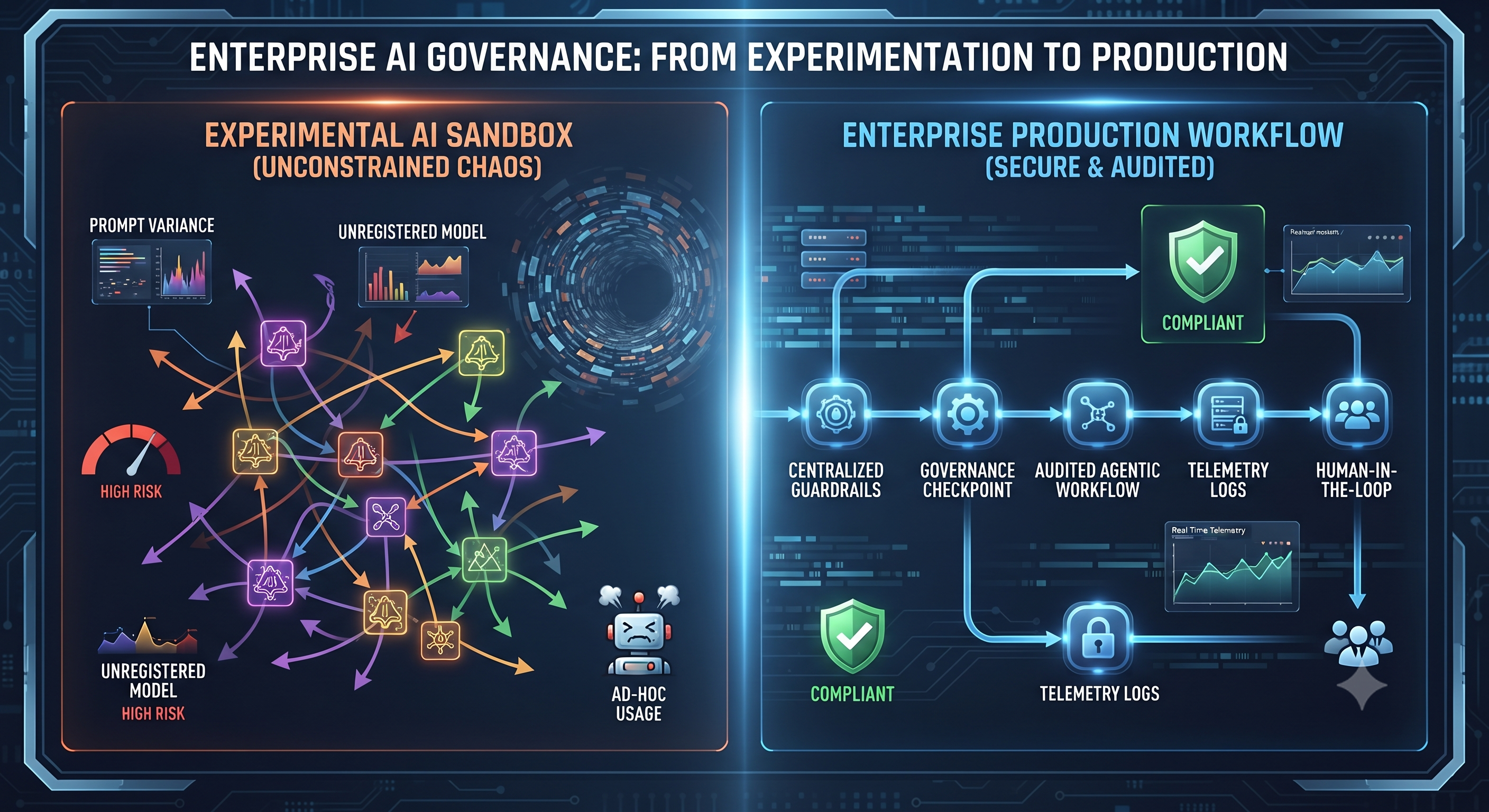
The era of "doing a bit of AI everywhere" without a cohesive framework is officially over. Modern enterprise architecture requires moving from unstructured tech-push initiatives to process-led AI governance.
How to structure production-grade AI systems:
Define Unified Supervision Guardrails: Establish clear, centralized rules for what can be automated, what requires human-in-the-loop oversight, and how data flows across multi-cloud environments.
Shift from Prompts to Agentic Workflows: Structure your applications around multi-step, tool-enabled agents that operate within strict boundaries rather than loose, unconstrained chat windows.
Embed Traceability and Auditing: Build robust logging and telemetry directly into your deployment pipelines so every automated decision or tool call is completely transparent and defensible before your board or regulators.
Discussion Question
How is your team tackling AI governance and risk management as you scale applications from pilot stage to full enterprise production?
CTA (Join Techawks USA)
Want to connect with leading US engineering executives, system architects, and builders navigating the future of enterprise tech? Join Techawks USA today and connect with the country's sharpest tech professionals!
Across Silicon Valley, New York, and enterprise tech corridors nationwide, the narrative has shifted dramatically. Industry data shows that while over 90% of companies have integrated AI into their strategic outlook, nearly half struggle with inconsistent value measurement and risk management.
The era of "doing a bit of AI everywhere" without a cohesive framework is officially over. Modern enterprise architecture requires moving from unstructured tech-push initiatives to process-led AI governance.
How to structure production-grade AI systems:
Define Unified Supervision Guardrails: Establish clear, centralized rules for what can be automated, what requires human-in-the-loop oversight, and how data flows across multi-cloud environments.
Shift from Prompts to Agentic Workflows: Structure your applications around multi-step, tool-enabled agents that operate within strict boundaries rather than loose, unconstrained chat windows.
Embed Traceability and Auditing: Build robust logging and telemetry directly into your deployment pipelines so every automated decision or tool call is completely transparent and defensible before your board or regulators.
Discussion Question
How is your team tackling AI governance and risk management as you scale applications from pilot stage to full enterprise production?
CTA (Join Techawks USA)
Want to connect with leading US engineering executives, system architects, and builders navigating the future of enterprise tech? Join Techawks USA today and connect with the country's sharpest tech professionals!
Moving Beyond the Experiment: Why US Enterprise Tech is Pivoting to Process-Led AI Governance
Across Silicon Valley, New York, and enterprise tech corridors nationwide, the narrative has shifted dramatically. Industry data shows that while over 90% of companies have integrated AI into their strategic outlook, nearly half struggle with inconsistent value measurement and risk management.
The era of "doing a bit of AI everywhere" without a cohesive framework is officially over. Modern enterprise architecture requires moving from unstructured tech-push initiatives to process-led AI governance.
How to structure production-grade AI systems:
Define Unified Supervision Guardrails: Establish clear, centralized rules for what can be automated, what requires human-in-the-loop oversight, and how data flows across multi-cloud environments.
Shift from Prompts to Agentic Workflows: Structure your applications around multi-step, tool-enabled agents that operate within strict boundaries rather than loose, unconstrained chat windows.
Embed Traceability and Auditing: Build robust logging and telemetry directly into your deployment pipelines so every automated decision or tool call is completely transparent and defensible before your board or regulators.
Discussion Question
How is your team tackling AI governance and risk management as you scale applications from pilot stage to full enterprise production?
CTA (Join Techawks USA)
Want to connect with leading US engineering executives, system architects, and builders navigating the future of enterprise tech? Join Techawks USA today and connect with the country's sharpest tech professionals!

 English
 Arabic
 French
 Spanish
 Deutsch
 Turkish
 Dutch
Dutch
 Italiano
 Russian
 Romaian
 Portuguese (Brazil)
 Greek
Greek