


Pruning the Cloud Bill: 4 Production-Tested FinOps Patterns for Engineering Teams
Most architectural diagrams account for availability, latency, and fault tolerance, but completely ignore runtime cost. In US cloud environments (across AWS, GCP, and Azure), unmonitored egress, idle multi-AZ allocations, and oversized clusters quietly drain enterprise budgets faster than traffic spikes ever could.
Here are 4 battle-tested architectural adjustments your team can implement to cut infrastructure overhead without sacrificing reliability:
Eliminate Cross-AZ Data Transfer Leaks
The Reality: Inter-Availability Zone (AZ) data transfer is one of the most common hidden line items on cloud bills, often running $0.01 per GB in both directions. When high-throughput microservices or distributed caches chatter across zone boundaries, costs compound rapidly.
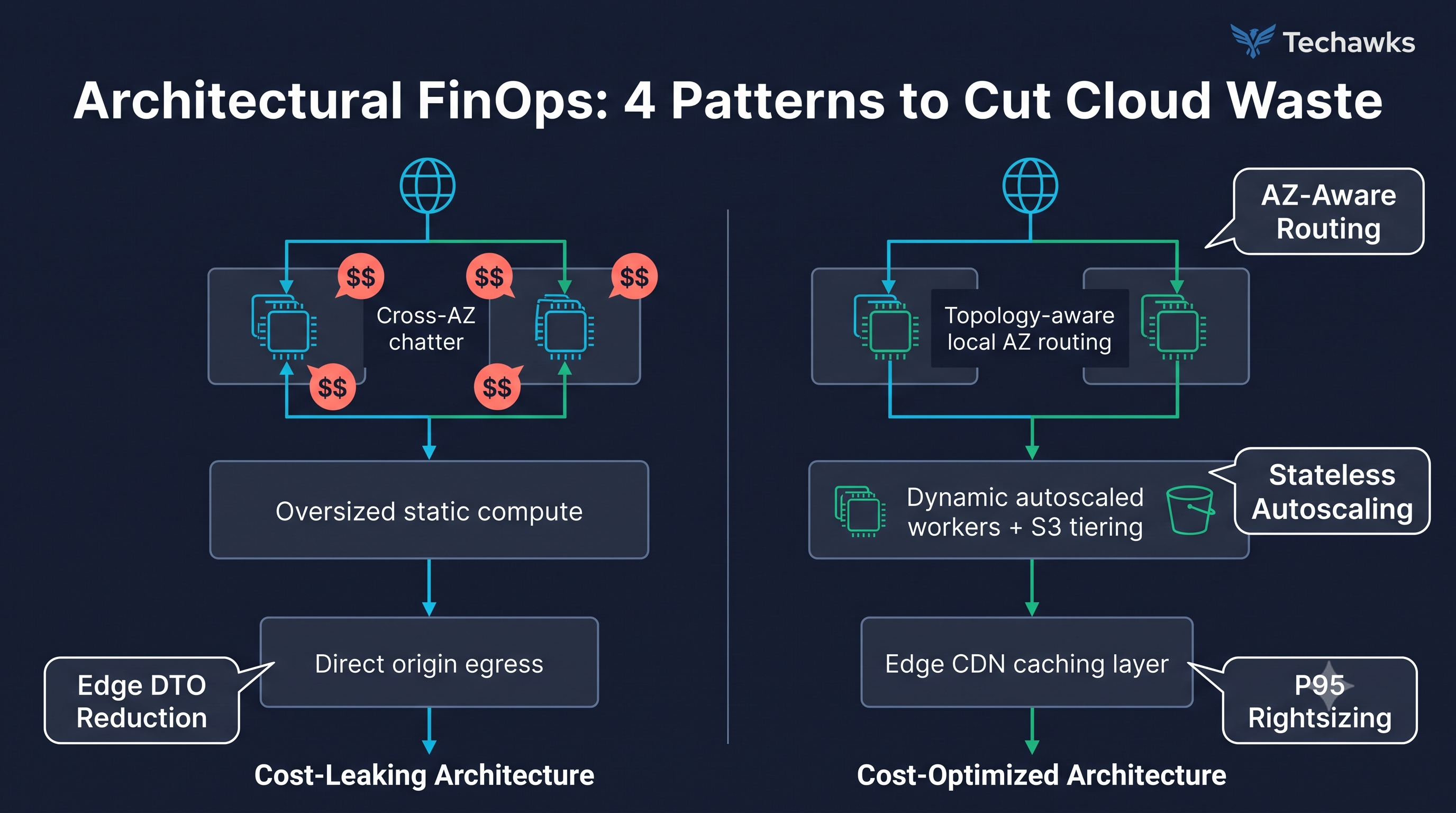
The Pattern: Implement AZ-aware routing. Configure your service mesh or ingress controllers (e.g., Kubernetes Topology Aware Hints) to route service-to-service calls strictly within the same AZ, falling back across zones only during failovers or endpoint exhaustion.
Decouple Stateful Storage from Compute Lifecycles
The Reality: Running heavy stateful workloads on always-on, high-memory virtual machines leads to persistent underutilization during off-peak hours.
The Pattern: Offload persistent application state to managed object storage (S3/GCS) paired with lightweight, stateless workers orchestrated by Karpenter or cluster autoscalers. Take advantage of automated lifecycle tiering (moving data from Standard to Infrequent Access/Glacier) driven by access frequency policies rather than static cron jobs.
Adopt Tiered Egress with Distributed Caching
The Reality: Serving media, binary payloads, and static API fragments directly from origin VPCs inflates internet egress charges at peak US peak-hour rates.
The Pattern: Push cache-control logic to edge CDN workers (Cloudflare Workers, CloudFront Functions). Strip unnecessary response headers, enable aggressive edge compression (Brotli/zstd), and serve repeat reads from points of presence (PoPs) to minimize origin data transfer out (DTO).
Right-Size via Telemetry, Not Guesswork
The Reality: Developers routinely request 4x the memory and CPU needed "just in case," leaving baseline cluster utilization hovering around 15–20%.
The Pattern: Enforce Kubernetes Vertical Pod Autoscaler (VPA) in recommendation mode across staging and non-critical services. Tie resource limits to P95 historical usage metrics rather than arbitrary developer estimates, and schedule non-production environments to spin down completely outside business hours.
Key Takeaways
Zone awareness saves margin: Align microservice traffic within single availability zones to stop paying double-hop cross-AZ egress taxes.
Tier your data paths: Rely on automated object storage lifecycles and CDN edge caching to keep egress away from expensive compute origins.
Measure before you size: Replace "safe guess" instance provisioning with telemetry-driven rightsizing pinned to P95 workloads.
Cost is an engineering metric: Design your architecture with cost-per-request visibility directly inside your CI/CD and observability dashboards.
CTA
Looking to master cloud architecture, FinOps discipline, and high-scale system design?
Join Techawks USA — connect with top engineering leads, exchange production strategies, and stay ahead of the technology curve. [Link to Join]
Most architectural diagrams account for availability, latency, and fault tolerance, but completely ignore runtime cost. In US cloud environments (across AWS, GCP, and Azure), unmonitored egress, idle multi-AZ allocations, and oversized clusters quietly drain enterprise budgets faster than traffic spikes ever could.
Here are 4 battle-tested architectural adjustments your team can implement to cut infrastructure overhead without sacrificing reliability:
Eliminate Cross-AZ Data Transfer Leaks
The Reality: Inter-Availability Zone (AZ) data transfer is one of the most common hidden line items on cloud bills, often running $0.01 per GB in both directions. When high-throughput microservices or distributed caches chatter across zone boundaries, costs compound rapidly.
The Pattern: Implement AZ-aware routing. Configure your service mesh or ingress controllers (e.g., Kubernetes Topology Aware Hints) to route service-to-service calls strictly within the same AZ, falling back across zones only during failovers or endpoint exhaustion.
Decouple Stateful Storage from Compute Lifecycles
The Reality: Running heavy stateful workloads on always-on, high-memory virtual machines leads to persistent underutilization during off-peak hours.
The Pattern: Offload persistent application state to managed object storage (S3/GCS) paired with lightweight, stateless workers orchestrated by Karpenter or cluster autoscalers. Take advantage of automated lifecycle tiering (moving data from Standard to Infrequent Access/Glacier) driven by access frequency policies rather than static cron jobs.
Adopt Tiered Egress with Distributed Caching
The Reality: Serving media, binary payloads, and static API fragments directly from origin VPCs inflates internet egress charges at peak US peak-hour rates.
The Pattern: Push cache-control logic to edge CDN workers (Cloudflare Workers, CloudFront Functions). Strip unnecessary response headers, enable aggressive edge compression (Brotli/zstd), and serve repeat reads from points of presence (PoPs) to minimize origin data transfer out (DTO).
Right-Size via Telemetry, Not Guesswork
The Reality: Developers routinely request 4x the memory and CPU needed "just in case," leaving baseline cluster utilization hovering around 15–20%.
The Pattern: Enforce Kubernetes Vertical Pod Autoscaler (VPA) in recommendation mode across staging and non-critical services. Tie resource limits to P95 historical usage metrics rather than arbitrary developer estimates, and schedule non-production environments to spin down completely outside business hours.
Key Takeaways
Zone awareness saves margin: Align microservice traffic within single availability zones to stop paying double-hop cross-AZ egress taxes.
Tier your data paths: Rely on automated object storage lifecycles and CDN edge caching to keep egress away from expensive compute origins.
Measure before you size: Replace "safe guess" instance provisioning with telemetry-driven rightsizing pinned to P95 workloads.
Cost is an engineering metric: Design your architecture with cost-per-request visibility directly inside your CI/CD and observability dashboards.
CTA
Looking to master cloud architecture, FinOps discipline, and high-scale system design?
Join Techawks USA — connect with top engineering leads, exchange production strategies, and stay ahead of the technology curve. [Link to Join]
Pruning the Cloud Bill: 4 Production-Tested FinOps Patterns for Engineering Teams
Most architectural diagrams account for availability, latency, and fault tolerance, but completely ignore runtime cost. In US cloud environments (across AWS, GCP, and Azure), unmonitored egress, idle multi-AZ allocations, and oversized clusters quietly drain enterprise budgets faster than traffic spikes ever could.
Here are 4 battle-tested architectural adjustments your team can implement to cut infrastructure overhead without sacrificing reliability:
Eliminate Cross-AZ Data Transfer Leaks
The Reality: Inter-Availability Zone (AZ) data transfer is one of the most common hidden line items on cloud bills, often running $0.01 per GB in both directions. When high-throughput microservices or distributed caches chatter across zone boundaries, costs compound rapidly.
The Pattern: Implement AZ-aware routing. Configure your service mesh or ingress controllers (e.g., Kubernetes Topology Aware Hints) to route service-to-service calls strictly within the same AZ, falling back across zones only during failovers or endpoint exhaustion.
Decouple Stateful Storage from Compute Lifecycles
The Reality: Running heavy stateful workloads on always-on, high-memory virtual machines leads to persistent underutilization during off-peak hours.
The Pattern: Offload persistent application state to managed object storage (S3/GCS) paired with lightweight, stateless workers orchestrated by Karpenter or cluster autoscalers. Take advantage of automated lifecycle tiering (moving data from Standard to Infrequent Access/Glacier) driven by access frequency policies rather than static cron jobs.
Adopt Tiered Egress with Distributed Caching
The Reality: Serving media, binary payloads, and static API fragments directly from origin VPCs inflates internet egress charges at peak US peak-hour rates.
The Pattern: Push cache-control logic to edge CDN workers (Cloudflare Workers, CloudFront Functions). Strip unnecessary response headers, enable aggressive edge compression (Brotli/zstd), and serve repeat reads from points of presence (PoPs) to minimize origin data transfer out (DTO).
Right-Size via Telemetry, Not Guesswork
The Reality: Developers routinely request 4x the memory and CPU needed "just in case," leaving baseline cluster utilization hovering around 15–20%.
The Pattern: Enforce Kubernetes Vertical Pod Autoscaler (VPA) in recommendation mode across staging and non-critical services. Tie resource limits to P95 historical usage metrics rather than arbitrary developer estimates, and schedule non-production environments to spin down completely outside business hours.
Key Takeaways
Zone awareness saves margin: Align microservice traffic within single availability zones to stop paying double-hop cross-AZ egress taxes.
Tier your data paths: Rely on automated object storage lifecycles and CDN edge caching to keep egress away from expensive compute origins.
Measure before you size: Replace "safe guess" instance provisioning with telemetry-driven rightsizing pinned to P95 workloads.
Cost is an engineering metric: Design your architecture with cost-per-request visibility directly inside your CI/CD and observability dashboards.
CTA
Looking to master cloud architecture, FinOps discipline, and high-scale system design?
Join Techawks USA — connect with top engineering leads, exchange production strategies, and stay ahead of the technology curve. [Link to Join]

 Arabic
 French
 Spanish
 Portuguese
 Deutsch
 Turkish
 Dutch
Dutch
 Italiano
 Russian
 Romaian
 Portuguese (Brazil)
 Greek
Greek