


Resilience by Design: 4 Engineering Patterns for Navigating UK Data Boundaries and Operational Rigour
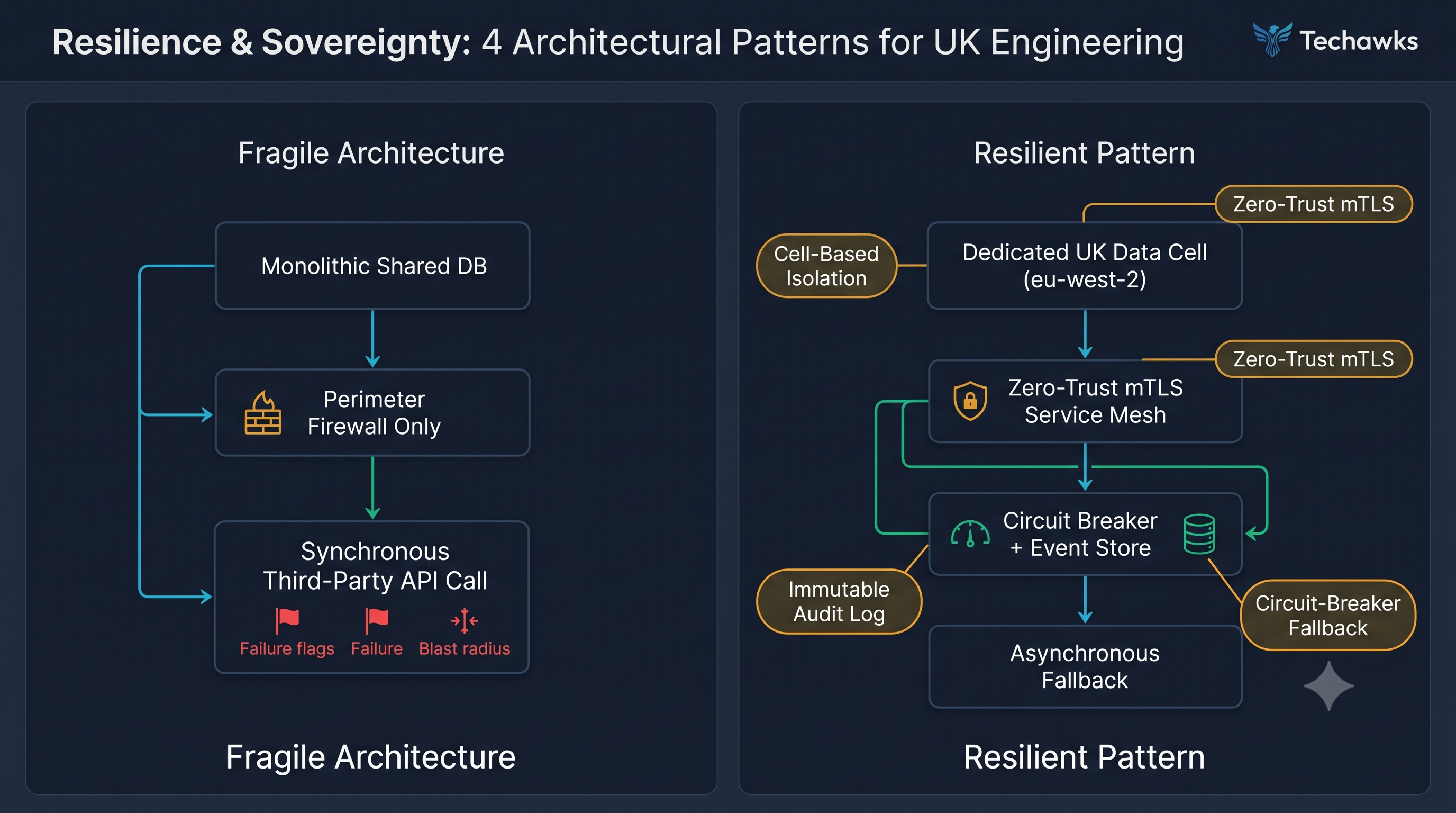
Building systems for UK and cross-border European workloads demands a dual focus: rock-solid operational availability and precise boundary enforcement. Whether handling open banking APIs, GDPR/UK Data Protection constraints, or hybrid multi-cloud failovers, traditional "monolithic data store" patterns fall short.
Here are 4 practical architectural patterns engineered for UK enterprise and startup environments:
Cell-Based Architecture for Regional Data Sovereignty
The Reality: Blending UK customer datasets with wider EU or US tenants in a single shared database complicates cross-border compliance and turns blast radiuses into systemic failures.
The Pattern: Partition your architecture into self-contained "cells" (independent instances of your full application stack with isolated databases). Assign UK workloads to a dedicated regional cell (e.g., AWS eu-west-2 London) so that data storage, encryption keys, and processing pipelines remain physically and logically compartmentalized.
Immutable Audit Trails via Event Sourcing
The Reality: Retrofitting regulatory auditing, compliance logs, and transaction tracing onto traditional relational CRUD tables leads to performance degradation and inconsistent historic state.
The Pattern: Shift high-compliance flows (ledgering, identity verification, account modifications) to event sourcing. Store changes as an append-only sequence of immutable events using an event log (such as Kafka or dedicated event stores). Build read projections asynchronously, giving teams instant mathematical auditability without slowing write operations.
Chaos Engineering & Graceful Degradation for Interbank/Partner APIs
The Reality: UK fintech and enterprise services rely extensively on external APIs—credit agencies, Open Banking aggregators, and identity verification partners—which frequently suffer transient outages.
The Pattern: Implement aggressive circuit breakers (Resilience4j/Envoy) paired with synthetic fallback states. When a downstream partner slows or fails, trip the circuit early, return cached or degraded functional defaults, and run automated chaos experiments (injecting latency and synthetic 500s) during staging deployments.
Zero-Trust Service Meshes with mTLS and Ephemeral Tokens
The Reality: Perimeter-only network firewalls leave east-west microservice traffic exposed if a single peripheral endpoint is breached.
The Pattern: Deploy a service mesh (Istio/Linkerd) that enforces mutual TLS (mTLS) for all inter-service communication by default. Pair this with SPIFFE/SPIRE-backed short-lived cryptographic identities to guarantee that every service authenticates per-request, satisfying both internal security benchmarks and external compliance standards.
Key Takeaways
Compartmentalize by boundary: Use cell-based isolation to naturally enforce UK data residency without writing complex filtering logic into application code.
Audit by default: Adopt append-only event sourcing for mission-critical paths to ensure historical traceability and tamper-proof records.
Isolate third-party failure: Wrap external partner integrations in circuit breakers with deterministic fallbacks to keep the core user journey online.
Zero trust inside the perimeter: Enforce mTLS and short-lived credentials across all internal microservice calls to secure internal data transit.
CTA
Looking to master scalable architecture, regulatory engineering, and backend resilience in the UK ecosystem?
Join Techawks UK — connect with engineering leaders, exchange real-world architectural post-mortems, and level up your system design skills with the UK tech community. [Link to Join]
Building systems for UK and cross-border European workloads demands a dual focus: rock-solid operational availability and precise boundary enforcement. Whether handling open banking APIs, GDPR/UK Data Protection constraints, or hybrid multi-cloud failovers, traditional "monolithic data store" patterns fall short.
Here are 4 practical architectural patterns engineered for UK enterprise and startup environments:
Cell-Based Architecture for Regional Data Sovereignty
The Reality: Blending UK customer datasets with wider EU or US tenants in a single shared database complicates cross-border compliance and turns blast radiuses into systemic failures.
The Pattern: Partition your architecture into self-contained "cells" (independent instances of your full application stack with isolated databases). Assign UK workloads to a dedicated regional cell (e.g., AWS eu-west-2 London) so that data storage, encryption keys, and processing pipelines remain physically and logically compartmentalized.
Immutable Audit Trails via Event Sourcing
The Reality: Retrofitting regulatory auditing, compliance logs, and transaction tracing onto traditional relational CRUD tables leads to performance degradation and inconsistent historic state.
The Pattern: Shift high-compliance flows (ledgering, identity verification, account modifications) to event sourcing. Store changes as an append-only sequence of immutable events using an event log (such as Kafka or dedicated event stores). Build read projections asynchronously, giving teams instant mathematical auditability without slowing write operations.
Chaos Engineering & Graceful Degradation for Interbank/Partner APIs
The Reality: UK fintech and enterprise services rely extensively on external APIs—credit agencies, Open Banking aggregators, and identity verification partners—which frequently suffer transient outages.
The Pattern: Implement aggressive circuit breakers (Resilience4j/Envoy) paired with synthetic fallback states. When a downstream partner slows or fails, trip the circuit early, return cached or degraded functional defaults, and run automated chaos experiments (injecting latency and synthetic 500s) during staging deployments.
Zero-Trust Service Meshes with mTLS and Ephemeral Tokens
The Reality: Perimeter-only network firewalls leave east-west microservice traffic exposed if a single peripheral endpoint is breached.
The Pattern: Deploy a service mesh (Istio/Linkerd) that enforces mutual TLS (mTLS) for all inter-service communication by default. Pair this with SPIFFE/SPIRE-backed short-lived cryptographic identities to guarantee that every service authenticates per-request, satisfying both internal security benchmarks and external compliance standards.
Key Takeaways
Compartmentalize by boundary: Use cell-based isolation to naturally enforce UK data residency without writing complex filtering logic into application code.
Audit by default: Adopt append-only event sourcing for mission-critical paths to ensure historical traceability and tamper-proof records.
Isolate third-party failure: Wrap external partner integrations in circuit breakers with deterministic fallbacks to keep the core user journey online.
Zero trust inside the perimeter: Enforce mTLS and short-lived credentials across all internal microservice calls to secure internal data transit.
CTA
Looking to master scalable architecture, regulatory engineering, and backend resilience in the UK ecosystem?
Join Techawks UK — connect with engineering leaders, exchange real-world architectural post-mortems, and level up your system design skills with the UK tech community. [Link to Join]
Resilience by Design: 4 Engineering Patterns for Navigating UK Data Boundaries and Operational Rigour
Building systems for UK and cross-border European workloads demands a dual focus: rock-solid operational availability and precise boundary enforcement. Whether handling open banking APIs, GDPR/UK Data Protection constraints, or hybrid multi-cloud failovers, traditional "monolithic data store" patterns fall short.
Here are 4 practical architectural patterns engineered for UK enterprise and startup environments:
Cell-Based Architecture for Regional Data Sovereignty
The Reality: Blending UK customer datasets with wider EU or US tenants in a single shared database complicates cross-border compliance and turns blast radiuses into systemic failures.
The Pattern: Partition your architecture into self-contained "cells" (independent instances of your full application stack with isolated databases). Assign UK workloads to a dedicated regional cell (e.g., AWS eu-west-2 London) so that data storage, encryption keys, and processing pipelines remain physically and logically compartmentalized.
Immutable Audit Trails via Event Sourcing
The Reality: Retrofitting regulatory auditing, compliance logs, and transaction tracing onto traditional relational CRUD tables leads to performance degradation and inconsistent historic state.
The Pattern: Shift high-compliance flows (ledgering, identity verification, account modifications) to event sourcing. Store changes as an append-only sequence of immutable events using an event log (such as Kafka or dedicated event stores). Build read projections asynchronously, giving teams instant mathematical auditability without slowing write operations.
Chaos Engineering & Graceful Degradation for Interbank/Partner APIs
The Reality: UK fintech and enterprise services rely extensively on external APIs—credit agencies, Open Banking aggregators, and identity verification partners—which frequently suffer transient outages.
The Pattern: Implement aggressive circuit breakers (Resilience4j/Envoy) paired with synthetic fallback states. When a downstream partner slows or fails, trip the circuit early, return cached or degraded functional defaults, and run automated chaos experiments (injecting latency and synthetic 500s) during staging deployments.
Zero-Trust Service Meshes with mTLS and Ephemeral Tokens
The Reality: Perimeter-only network firewalls leave east-west microservice traffic exposed if a single peripheral endpoint is breached.
The Pattern: Deploy a service mesh (Istio/Linkerd) that enforces mutual TLS (mTLS) for all inter-service communication by default. Pair this with SPIFFE/SPIRE-backed short-lived cryptographic identities to guarantee that every service authenticates per-request, satisfying both internal security benchmarks and external compliance standards.
Key Takeaways
Compartmentalize by boundary: Use cell-based isolation to naturally enforce UK data residency without writing complex filtering logic into application code.
Audit by default: Adopt append-only event sourcing for mission-critical paths to ensure historical traceability and tamper-proof records.
Isolate third-party failure: Wrap external partner integrations in circuit breakers with deterministic fallbacks to keep the core user journey online.
Zero trust inside the perimeter: Enforce mTLS and short-lived credentials across all internal microservice calls to secure internal data transit.
CTA
Looking to master scalable architecture, regulatory engineering, and backend resilience in the UK ecosystem?
Join Techawks UK — connect with engineering leaders, exchange real-world architectural post-mortems, and level up your system design skills with the UK tech community. [Link to Join]

 English
 French
 Spanish
 Portuguese
 Deutsch
 Turkish
 Dutch
Dutch
 Italiano
 Russian
 Romaian
 Portuguese (Brazil)
 Greek
Greek