


Scaling Across the GCC: 4 Architectural Patterns for Cross-Border Latency and Data Residency
Engineering teams operating out of Dubai and Abu Dhabi often serve users spanning the UAE, Saudi Arabia, Qatar, and wider international corridors. This brings two core architectural hurdles: navigating local cloud regions (such as AWS me-central-1 UAE or Azure UAE North) alongside compliance mandates (like the UAE Federal Personal Data Protection Law), while ensuring low-latency experiences across neighboring markets.
Here are 4 foundational architectural patterns engineered for scalable Middle East workloads:
In-Region Sovereign Pods with Federated Identity
The Reality: Certain sensitive datasets (government integrations, regulated financial data, healthcare records) cannot leave UAE borders, but core application analytics and global workflows require consolidation.
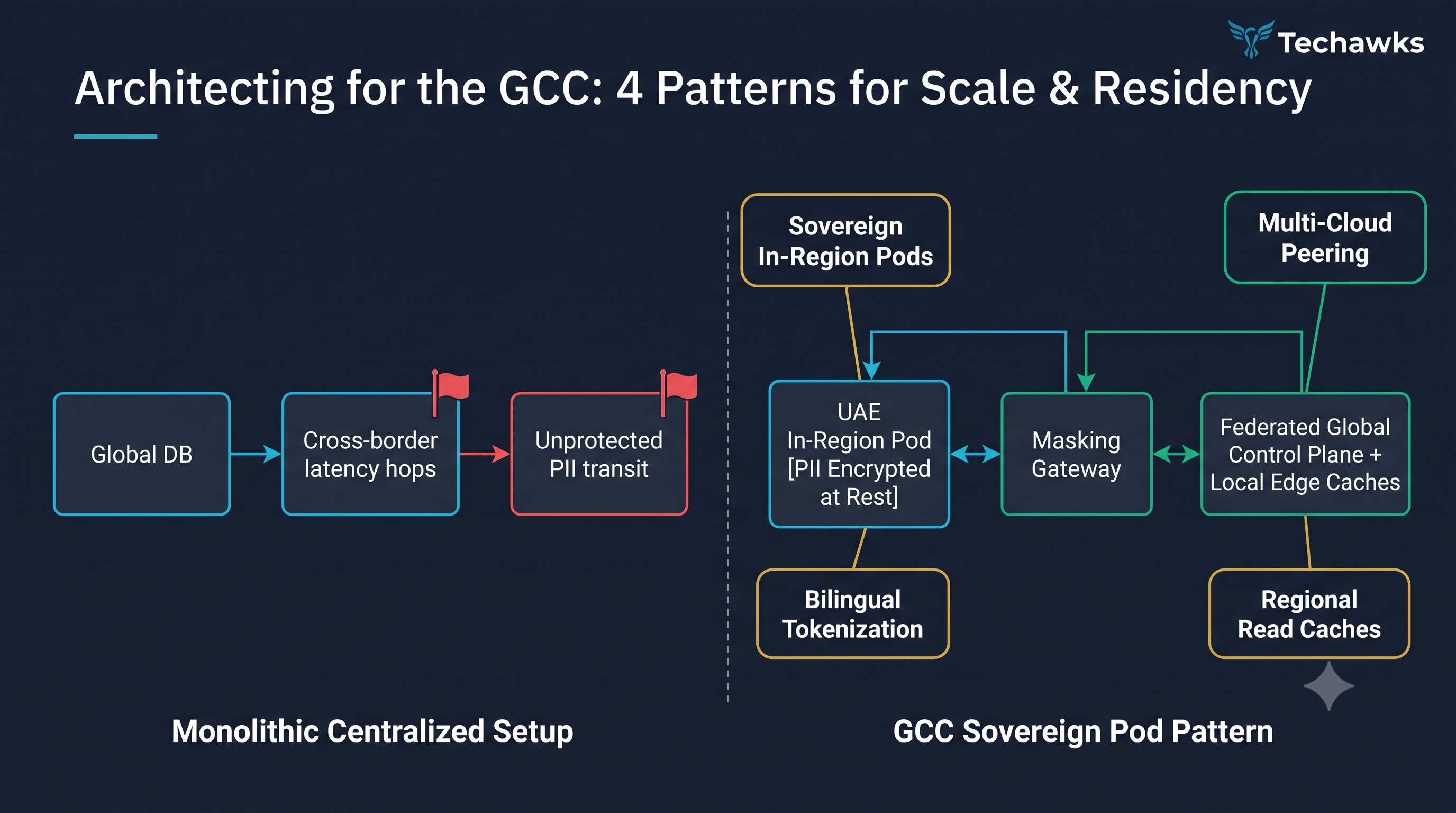
The Pattern: Implement a "Sovereign Pod" topology. Deploy self-contained operational pods inside local UAE cloud data centers that handle all PII ingestion, storage, and transaction execution locally. Export only anonymized, aggregated telemetry to cross-region control planes via an API gateway with automated data-masking policies.
Smart Multi-Cloud Peering Across Middle East Regions
The Reality: Enterprise clients in the GCC often mandate specific cloud providers (some on Azure UAE, others on AWS UAE or Google Cloud Doha/Dammam).
The Pattern: Decouple your infrastructure from vendor-specific transport layers by utilizing vendor-neutral multi-cloud interconnects and container orchestrators (Kubernetes via standard OpenTofu/Terraform modules). Enforce consistent service discovery using an abstracted service mesh layer rather than proprietary VPC peering.
Multi-Region Read Replicas with Regional Cache Warms
The Reality: While the GCC is geographically compact, routing all regional traffic back to a single primary database introduces unnecessary latency hops across regional carriers.
The Pattern: Use managed distributed databases with cross-region read replicas deployed across the primary GCC hubs. Pair this with localized edge caching points to handle read-heavy catalog, dynamic content, and static asset delivery without hitting primary transactional clusters.
Bilingual-First Data Schemas and Normalization Pipelines
The Reality: Handling bidirectional (RTL Arabic and LTR English) text, localization token sets, and localized search indexing as an afterthought introduces massive technical debt and slows search response times.
The Pattern: Design database schemas with native UTF-8 multi-locale fields from day one. In your search tier (Elasticsearch/OpenSearch), implement dual-analyzer pipelines: configure specific Arabic morphological tokenizers and root analyzers alongside standard English stemming at the ingestion layer rather than trying to handle script nuances at query time.
Key Takeaways
Design for local sovereignty: Keep customer PII inside local data center pods (e.g., UAE regions) while federating non-sensitive metadata globally.
Eliminate cross-border latency: Place read replicas and localized edge caches across major GCC points of presence to avoid unnecessary round-trips.
Abstract the cloud layer: Build with portable container standards to effortlessly accommodate enterprise clients across AWS, Azure, and GCP local zones.
Bilingual at the schema level: Treat Arabic and English tokenization, search indexing, and RTL formatting as core architectural specifications.
CTA
Looking to master distributed systems, regional cloud architecture, and engineering at scale across the Middle East?
Join Techawks UAE — connect with leading software architects, engineering directors, and tech innovators building the future of the MENA tech ecosystem. [Link to Join]
Engineering teams operating out of Dubai and Abu Dhabi often serve users spanning the UAE, Saudi Arabia, Qatar, and wider international corridors. This brings two core architectural hurdles: navigating local cloud regions (such as AWS me-central-1 UAE or Azure UAE North) alongside compliance mandates (like the UAE Federal Personal Data Protection Law), while ensuring low-latency experiences across neighboring markets.
Here are 4 foundational architectural patterns engineered for scalable Middle East workloads:
In-Region Sovereign Pods with Federated Identity
The Reality: Certain sensitive datasets (government integrations, regulated financial data, healthcare records) cannot leave UAE borders, but core application analytics and global workflows require consolidation.
The Pattern: Implement a "Sovereign Pod" topology. Deploy self-contained operational pods inside local UAE cloud data centers that handle all PII ingestion, storage, and transaction execution locally. Export only anonymized, aggregated telemetry to cross-region control planes via an API gateway with automated data-masking policies.
Smart Multi-Cloud Peering Across Middle East Regions
The Reality: Enterprise clients in the GCC often mandate specific cloud providers (some on Azure UAE, others on AWS UAE or Google Cloud Doha/Dammam).
The Pattern: Decouple your infrastructure from vendor-specific transport layers by utilizing vendor-neutral multi-cloud interconnects and container orchestrators (Kubernetes via standard OpenTofu/Terraform modules). Enforce consistent service discovery using an abstracted service mesh layer rather than proprietary VPC peering.
Multi-Region Read Replicas with Regional Cache Warms
The Reality: While the GCC is geographically compact, routing all regional traffic back to a single primary database introduces unnecessary latency hops across regional carriers.
The Pattern: Use managed distributed databases with cross-region read replicas deployed across the primary GCC hubs. Pair this with localized edge caching points to handle read-heavy catalog, dynamic content, and static asset delivery without hitting primary transactional clusters.
Bilingual-First Data Schemas and Normalization Pipelines
The Reality: Handling bidirectional (RTL Arabic and LTR English) text, localization token sets, and localized search indexing as an afterthought introduces massive technical debt and slows search response times.
The Pattern: Design database schemas with native UTF-8 multi-locale fields from day one. In your search tier (Elasticsearch/OpenSearch), implement dual-analyzer pipelines: configure specific Arabic morphological tokenizers and root analyzers alongside standard English stemming at the ingestion layer rather than trying to handle script nuances at query time.
Key Takeaways
Design for local sovereignty: Keep customer PII inside local data center pods (e.g., UAE regions) while federating non-sensitive metadata globally.
Eliminate cross-border latency: Place read replicas and localized edge caches across major GCC points of presence to avoid unnecessary round-trips.
Abstract the cloud layer: Build with portable container standards to effortlessly accommodate enterprise clients across AWS, Azure, and GCP local zones.
Bilingual at the schema level: Treat Arabic and English tokenization, search indexing, and RTL formatting as core architectural specifications.
CTA
Looking to master distributed systems, regional cloud architecture, and engineering at scale across the Middle East?
Join Techawks UAE — connect with leading software architects, engineering directors, and tech innovators building the future of the MENA tech ecosystem. [Link to Join]
Scaling Across the GCC: 4 Architectural Patterns for Cross-Border Latency and Data Residency
Engineering teams operating out of Dubai and Abu Dhabi often serve users spanning the UAE, Saudi Arabia, Qatar, and wider international corridors. This brings two core architectural hurdles: navigating local cloud regions (such as AWS me-central-1 UAE or Azure UAE North) alongside compliance mandates (like the UAE Federal Personal Data Protection Law), while ensuring low-latency experiences across neighboring markets.
Here are 4 foundational architectural patterns engineered for scalable Middle East workloads:
In-Region Sovereign Pods with Federated Identity
The Reality: Certain sensitive datasets (government integrations, regulated financial data, healthcare records) cannot leave UAE borders, but core application analytics and global workflows require consolidation.
The Pattern: Implement a "Sovereign Pod" topology. Deploy self-contained operational pods inside local UAE cloud data centers that handle all PII ingestion, storage, and transaction execution locally. Export only anonymized, aggregated telemetry to cross-region control planes via an API gateway with automated data-masking policies.
Smart Multi-Cloud Peering Across Middle East Regions
The Reality: Enterprise clients in the GCC often mandate specific cloud providers (some on Azure UAE, others on AWS UAE or Google Cloud Doha/Dammam).
The Pattern: Decouple your infrastructure from vendor-specific transport layers by utilizing vendor-neutral multi-cloud interconnects and container orchestrators (Kubernetes via standard OpenTofu/Terraform modules). Enforce consistent service discovery using an abstracted service mesh layer rather than proprietary VPC peering.
Multi-Region Read Replicas with Regional Cache Warms
The Reality: While the GCC is geographically compact, routing all regional traffic back to a single primary database introduces unnecessary latency hops across regional carriers.
The Pattern: Use managed distributed databases with cross-region read replicas deployed across the primary GCC hubs. Pair this with localized edge caching points to handle read-heavy catalog, dynamic content, and static asset delivery without hitting primary transactional clusters.
Bilingual-First Data Schemas and Normalization Pipelines
The Reality: Handling bidirectional (RTL Arabic and LTR English) text, localization token sets, and localized search indexing as an afterthought introduces massive technical debt and slows search response times.
The Pattern: Design database schemas with native UTF-8 multi-locale fields from day one. In your search tier (Elasticsearch/OpenSearch), implement dual-analyzer pipelines: configure specific Arabic morphological tokenizers and root analyzers alongside standard English stemming at the ingestion layer rather than trying to handle script nuances at query time.
Key Takeaways
Design for local sovereignty: Keep customer PII inside local data center pods (e.g., UAE regions) while federating non-sensitive metadata globally.
Eliminate cross-border latency: Place read replicas and localized edge caches across major GCC points of presence to avoid unnecessary round-trips.
Abstract the cloud layer: Build with portable container standards to effortlessly accommodate enterprise clients across AWS, Azure, and GCP local zones.
Bilingual at the schema level: Treat Arabic and English tokenization, search indexing, and RTL formatting as core architectural specifications.
CTA
Looking to master distributed systems, regional cloud architecture, and engineering at scale across the Middle East?
Join Techawks UAE — connect with leading software architects, engineering directors, and tech innovators building the future of the MENA tech ecosystem. [Link to Join]

 English
 Arabic
 French
 Spanish
 Portuguese
 Turkish
 Dutch
Dutch
 Italiano
 Russian
 Romaian
 Portuguese (Brazil)
 Greek
Greek