


East-to-West High Availability: 4 Architectural Patterns for Cross-Canada Cloud Resiliency
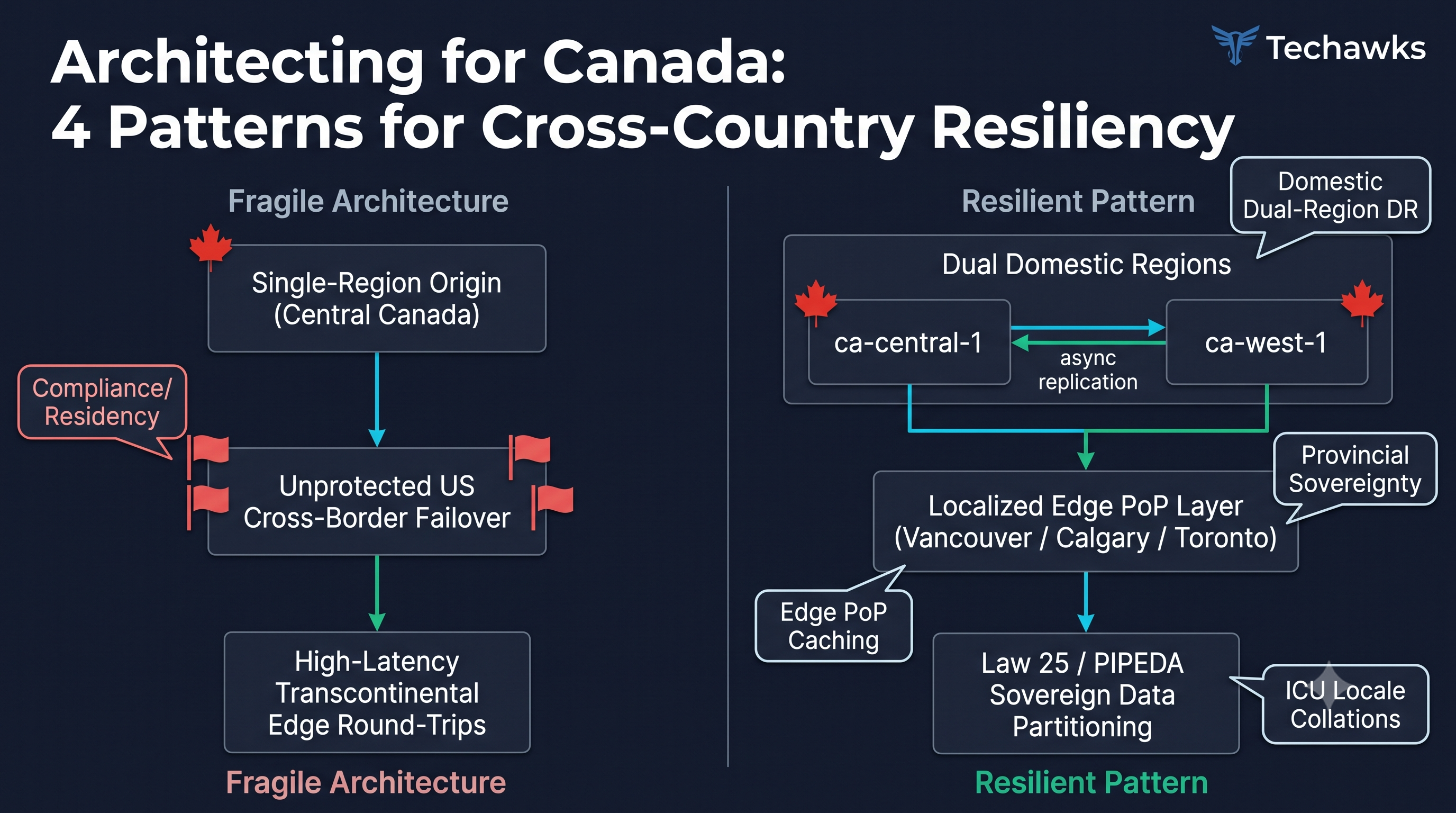
Building distributed systems for Canadian enterprises and scale-ups requires balancing data residency boundaries with continental high availability. Relying on a single primary data center in Central Canada (Montreal/Toronto) leaves Western Canadian users with significant round-trip network hops, while failovers routed into US regions risk violating compliance mandates.
Here are 4 foundational architectural patterns engineered for Canadian production systems:
In-Country Dual-Region Active-Passive Failover
The Reality: Previously, building automated multi-region disaster recovery often meant failing over across the border into US East or West regions, triggering complex cross-border data transfer assessments and compliance exposure.
The Pattern: Leverage in-country dual-region pairs (e.g., AWS ca-central-1 Montreal and ca-west-1 Calgary, or Azure Canada Central Toronto paired with Canada East). Set up asynchronous cross-region database replication (Aurora Global Database or Cosmos DB) with an automated Route 53/Azure Traffic Manager health probe, maintaining high availability without letting customer data leave Canadian borders.
Provincial Tenancy Partitioning & Consent-Gated Routing
The Reality: Stricter provincial frameworks (such as Quebec's Law 25) mandate rigorous privacy impact assessments before transferring personal information outside provincial borders, along with strict opt-in profiling controls.
The Pattern: Implement policy-driven data isolation at the ingress layer. Tag incoming payloads with jurisdictional metadata at your API gateway. Store Quebec resident PII in dedicated, regionally isolated database partitions with explicit consent logs, ensuring cross-boundary analytics pipelines ingest only pre-anonymized, de-identified event streams.
Coast-to-Coast Edge Acceleration with Read Caching
The Reality: Network latency between Vancouver and Montreal can hover around 60–75ms. For chatty frontends or mobile apps making chained API calls, this accumulates hundreds of milliseconds of unnecessary lag.
The Pattern: Distribute application edge logic across Canadian Points of Presence (Toronto, Montreal, Vancouver, Calgary). Deploy edge workers to handle token verification, terminate TLS sessions closer to the user, and serve cacheable queries directly from edge key-value stores to keep cross-country round-trips to an absolute minimum.
Bi-Directional Schema Neutrality for Multi-Lingual Workloads
The Reality: Canadian software frequently serves dual English and French user bases under federal and provincial accessibility mandates. Retrofitting localized sorting, collations, and multi-lingual full-text search onto production schemas causes persistent migration bottlenecks.
The Pattern: Standardize database encodings on utf8mb4 with explicit collation mappings (e.g., ICU-based collation) across search clusters and relational stores. Decouple localized text fields from core transactional entities using normalized localized projection tables, preventing search indexing skew across language variants.
Key Takeaways
Keep disaster recovery domestic: Pair Canadian Central and Western cloud regions to build 99.99% resilient failover paths without crossing international borders.
Isolate provincial boundaries: Use API-level metadata tagging to isolate sensitive provincial data in accordance with Law 25 and PIPEDA standards.
Neutralize transcontinental latency: Deploy edge PoP workers in Vancouver, Calgary, and Toronto to cache reads and terminate SSL handshakes locally.
Build localized schemas early: Implement UTF-8 ICU collations and dual-language search analyzers at the schema inception phase.
CTA
Looking to master cloud infrastructure, high-scale system design, and distributed systems built for the Canadian ecosystem?
Join Techawks Canada — connect with staff engineers, cloud architects, and tech innovators sharing real-world production playbooks across the country. [Link to Join]
Building distributed systems for Canadian enterprises and scale-ups requires balancing data residency boundaries with continental high availability. Relying on a single primary data center in Central Canada (Montreal/Toronto) leaves Western Canadian users with significant round-trip network hops, while failovers routed into US regions risk violating compliance mandates.
Here are 4 foundational architectural patterns engineered for Canadian production systems:
In-Country Dual-Region Active-Passive Failover
The Reality: Previously, building automated multi-region disaster recovery often meant failing over across the border into US East or West regions, triggering complex cross-border data transfer assessments and compliance exposure.
The Pattern: Leverage in-country dual-region pairs (e.g., AWS ca-central-1 Montreal and ca-west-1 Calgary, or Azure Canada Central Toronto paired with Canada East). Set up asynchronous cross-region database replication (Aurora Global Database or Cosmos DB) with an automated Route 53/Azure Traffic Manager health probe, maintaining high availability without letting customer data leave Canadian borders.
Provincial Tenancy Partitioning & Consent-Gated Routing
The Reality: Stricter provincial frameworks (such as Quebec's Law 25) mandate rigorous privacy impact assessments before transferring personal information outside provincial borders, along with strict opt-in profiling controls.
The Pattern: Implement policy-driven data isolation at the ingress layer. Tag incoming payloads with jurisdictional metadata at your API gateway. Store Quebec resident PII in dedicated, regionally isolated database partitions with explicit consent logs, ensuring cross-boundary analytics pipelines ingest only pre-anonymized, de-identified event streams.
Coast-to-Coast Edge Acceleration with Read Caching
The Reality: Network latency between Vancouver and Montreal can hover around 60–75ms. For chatty frontends or mobile apps making chained API calls, this accumulates hundreds of milliseconds of unnecessary lag.
The Pattern: Distribute application edge logic across Canadian Points of Presence (Toronto, Montreal, Vancouver, Calgary). Deploy edge workers to handle token verification, terminate TLS sessions closer to the user, and serve cacheable queries directly from edge key-value stores to keep cross-country round-trips to an absolute minimum.
Bi-Directional Schema Neutrality for Multi-Lingual Workloads
The Reality: Canadian software frequently serves dual English and French user bases under federal and provincial accessibility mandates. Retrofitting localized sorting, collations, and multi-lingual full-text search onto production schemas causes persistent migration bottlenecks.
The Pattern: Standardize database encodings on utf8mb4 with explicit collation mappings (e.g., ICU-based collation) across search clusters and relational stores. Decouple localized text fields from core transactional entities using normalized localized projection tables, preventing search indexing skew across language variants.
Key Takeaways
Keep disaster recovery domestic: Pair Canadian Central and Western cloud regions to build 99.99% resilient failover paths without crossing international borders.
Isolate provincial boundaries: Use API-level metadata tagging to isolate sensitive provincial data in accordance with Law 25 and PIPEDA standards.
Neutralize transcontinental latency: Deploy edge PoP workers in Vancouver, Calgary, and Toronto to cache reads and terminate SSL handshakes locally.
Build localized schemas early: Implement UTF-8 ICU collations and dual-language search analyzers at the schema inception phase.
CTA
Looking to master cloud infrastructure, high-scale system design, and distributed systems built for the Canadian ecosystem?
Join Techawks Canada — connect with staff engineers, cloud architects, and tech innovators sharing real-world production playbooks across the country. [Link to Join]
East-to-West High Availability: 4 Architectural Patterns for Cross-Canada Cloud Resiliency
Building distributed systems for Canadian enterprises and scale-ups requires balancing data residency boundaries with continental high availability. Relying on a single primary data center in Central Canada (Montreal/Toronto) leaves Western Canadian users with significant round-trip network hops, while failovers routed into US regions risk violating compliance mandates.
Here are 4 foundational architectural patterns engineered for Canadian production systems:
In-Country Dual-Region Active-Passive Failover
The Reality: Previously, building automated multi-region disaster recovery often meant failing over across the border into US East or West regions, triggering complex cross-border data transfer assessments and compliance exposure.
The Pattern: Leverage in-country dual-region pairs (e.g., AWS ca-central-1 Montreal and ca-west-1 Calgary, or Azure Canada Central Toronto paired with Canada East). Set up asynchronous cross-region database replication (Aurora Global Database or Cosmos DB) with an automated Route 53/Azure Traffic Manager health probe, maintaining high availability without letting customer data leave Canadian borders.
Provincial Tenancy Partitioning & Consent-Gated Routing
The Reality: Stricter provincial frameworks (such as Quebec's Law 25) mandate rigorous privacy impact assessments before transferring personal information outside provincial borders, along with strict opt-in profiling controls.
The Pattern: Implement policy-driven data isolation at the ingress layer. Tag incoming payloads with jurisdictional metadata at your API gateway. Store Quebec resident PII in dedicated, regionally isolated database partitions with explicit consent logs, ensuring cross-boundary analytics pipelines ingest only pre-anonymized, de-identified event streams.
Coast-to-Coast Edge Acceleration with Read Caching
The Reality: Network latency between Vancouver and Montreal can hover around 60–75ms. For chatty frontends or mobile apps making chained API calls, this accumulates hundreds of milliseconds of unnecessary lag.
The Pattern: Distribute application edge logic across Canadian Points of Presence (Toronto, Montreal, Vancouver, Calgary). Deploy edge workers to handle token verification, terminate TLS sessions closer to the user, and serve cacheable queries directly from edge key-value stores to keep cross-country round-trips to an absolute minimum.
Bi-Directional Schema Neutrality for Multi-Lingual Workloads
The Reality: Canadian software frequently serves dual English and French user bases under federal and provincial accessibility mandates. Retrofitting localized sorting, collations, and multi-lingual full-text search onto production schemas causes persistent migration bottlenecks.
The Pattern: Standardize database encodings on utf8mb4 with explicit collation mappings (e.g., ICU-based collation) across search clusters and relational stores. Decouple localized text fields from core transactional entities using normalized localized projection tables, preventing search indexing skew across language variants.
Key Takeaways
Keep disaster recovery domestic: Pair Canadian Central and Western cloud regions to build 99.99% resilient failover paths without crossing international borders.
Isolate provincial boundaries: Use API-level metadata tagging to isolate sensitive provincial data in accordance with Law 25 and PIPEDA standards.
Neutralize transcontinental latency: Deploy edge PoP workers in Vancouver, Calgary, and Toronto to cache reads and terminate SSL handshakes locally.
Build localized schemas early: Implement UTF-8 ICU collations and dual-language search analyzers at the schema inception phase.
CTA
Looking to master cloud infrastructure, high-scale system design, and distributed systems built for the Canadian ecosystem?
Join Techawks Canada — connect with staff engineers, cloud architects, and tech innovators sharing real-world production playbooks across the country. [Link to Join]

 English
 Arabic
 French
 Spanish
 Portuguese
 Deutsch
 Turkish
 Dutch
Dutch
 Italiano
 Russian
 Romaian
 Greek
Greek