


The 4 Subtle Mistakes Turning Your "Automated" Deployments Into Production Outages
When teams transition to declarative CI/CD and GitOps, the initial pipeline often looks flawless on paper: a commit triggers a container build, unit tests run, manifests update, and Kubernetes or ECS reconciles the state.
Yet, outages still happen during peak traffic. Here are 4 critical deployment anti-patterns teams encounter as systems scale:
Synthetic Health Checks Instead of Deep Readiness
Liveness and readiness probes that merely hit an unauthenticated /healthz endpoint returning HTTP 200 prove only that the web server process is alive. They do not confirm downstream database connection pool readiness, cache hydration, or migration state. When traffic shifts, requests queue up and pods deadlock.
The "All-at-Once" In-Place Update
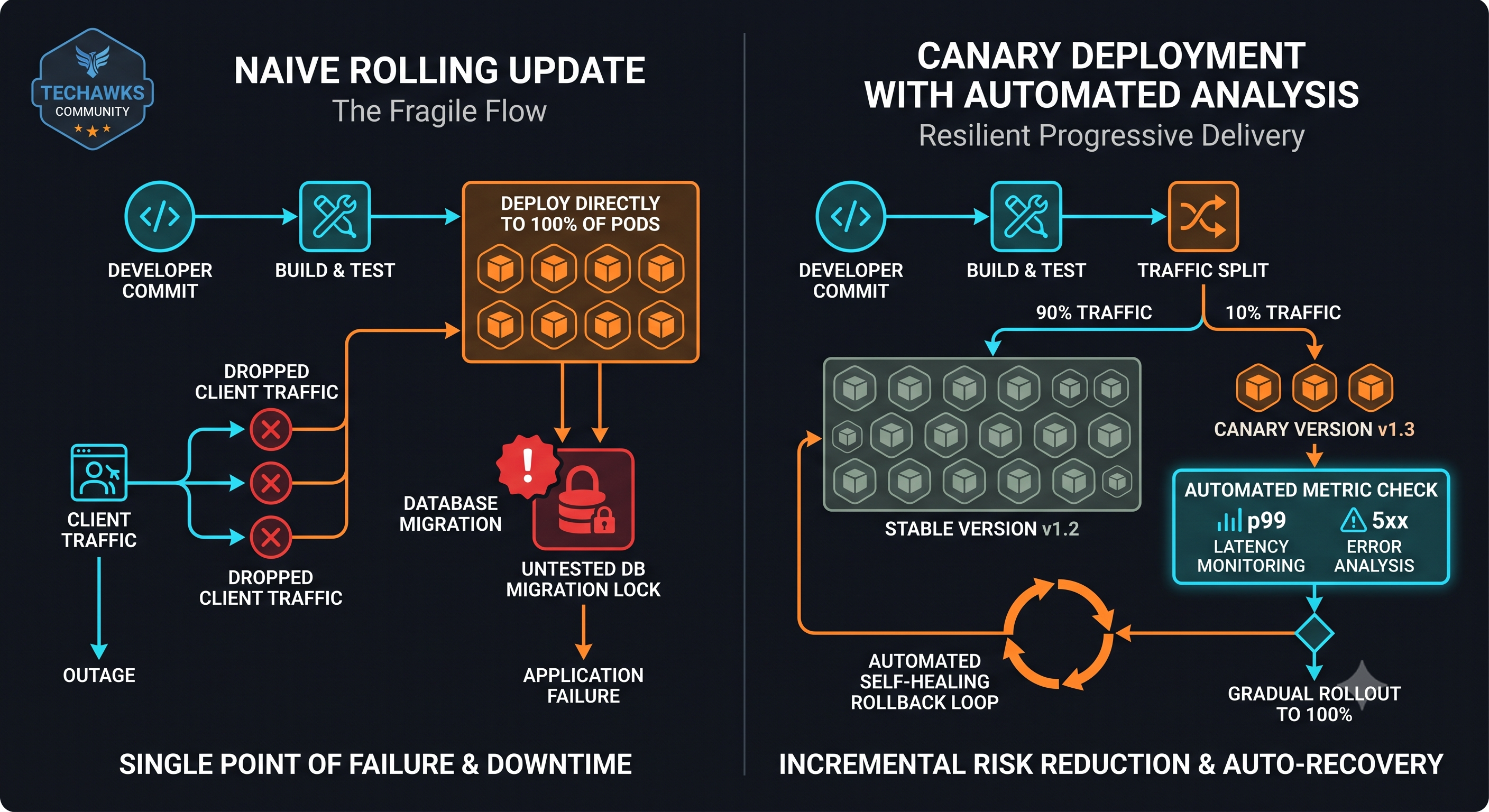
Rolling updates without active connection draining or proper termination grace periods lead to dropped packets. Even worse, releasing without traffic splitting (Canary or Blue/Green) means 100% of incoming users are exposed to subtle runtime bugs or memory leaks that passed basic unit tests.
Treating Database Migrations as In-Step Deployments
Coupling schema migrations directly to the application startup script guarantees downtime if a rollback is needed. If your new binary requires a dropped column or an altered constraint, your previous release version immediately breaks the moment an automated rollback triggers. Backward-compatible, multi-phase schema changes (Expand and Contract pattern) are non-negotiable.
Ignoring Progressive Delivery & Automated Rollbacks
A successful kubectl apply or task definition update only signals deployment delivery, not deployment health. If error rates climb on a 5% canary split and your pipeline requires human intervention at 2 AM to revert the manifest, the automation loop is incomplete.
Key Takeaways
Decouple migrations from application boots: Always follow the Expand/Contract pattern so current and previous container versions can run concurrently against the database.
Define health by functional dependencies: Readiness probes must validate essential downstream connectivity and warm caches before accepting external ingress traffic.
Embrace progressive delivery: Use tools like Argo Rollouts, Flagger, or AWS CodeDeploy with automated metric analysis (error budget burn, p99 latency) to halt rollouts automatically.
Graceful terminations matter: Configure preStop hooks and adjust termination grace periods to let inflight requests complete cleanly during rolling deployments.
CTA
What deployment failure taught your team the hardest lesson? Are you currently running full Canary rollouts with automated rollbacks, or are you still relying on basic rolling updates and manual monitoring?
Drop your setup and war stories in the comments below.
When teams transition to declarative CI/CD and GitOps, the initial pipeline often looks flawless on paper: a commit triggers a container build, unit tests run, manifests update, and Kubernetes or ECS reconciles the state.
Yet, outages still happen during peak traffic. Here are 4 critical deployment anti-patterns teams encounter as systems scale:
Synthetic Health Checks Instead of Deep Readiness
Liveness and readiness probes that merely hit an unauthenticated /healthz endpoint returning HTTP 200 prove only that the web server process is alive. They do not confirm downstream database connection pool readiness, cache hydration, or migration state. When traffic shifts, requests queue up and pods deadlock.
The "All-at-Once" In-Place Update
Rolling updates without active connection draining or proper termination grace periods lead to dropped packets. Even worse, releasing without traffic splitting (Canary or Blue/Green) means 100% of incoming users are exposed to subtle runtime bugs or memory leaks that passed basic unit tests.
Treating Database Migrations as In-Step Deployments
Coupling schema migrations directly to the application startup script guarantees downtime if a rollback is needed. If your new binary requires a dropped column or an altered constraint, your previous release version immediately breaks the moment an automated rollback triggers. Backward-compatible, multi-phase schema changes (Expand and Contract pattern) are non-negotiable.
Ignoring Progressive Delivery & Automated Rollbacks
A successful kubectl apply or task definition update only signals deployment delivery, not deployment health. If error rates climb on a 5% canary split and your pipeline requires human intervention at 2 AM to revert the manifest, the automation loop is incomplete.
Key Takeaways
Decouple migrations from application boots: Always follow the Expand/Contract pattern so current and previous container versions can run concurrently against the database.
Define health by functional dependencies: Readiness probes must validate essential downstream connectivity and warm caches before accepting external ingress traffic.
Embrace progressive delivery: Use tools like Argo Rollouts, Flagger, or AWS CodeDeploy with automated metric analysis (error budget burn, p99 latency) to halt rollouts automatically.
Graceful terminations matter: Configure preStop hooks and adjust termination grace periods to let inflight requests complete cleanly during rolling deployments.
CTA
What deployment failure taught your team the hardest lesson? Are you currently running full Canary rollouts with automated rollbacks, or are you still relying on basic rolling updates and manual monitoring?
Drop your setup and war stories in the comments below.
The 4 Subtle Mistakes Turning Your "Automated" Deployments Into Production Outages
When teams transition to declarative CI/CD and GitOps, the initial pipeline often looks flawless on paper: a commit triggers a container build, unit tests run, manifests update, and Kubernetes or ECS reconciles the state.
Yet, outages still happen during peak traffic. Here are 4 critical deployment anti-patterns teams encounter as systems scale:
Synthetic Health Checks Instead of Deep Readiness
Liveness and readiness probes that merely hit an unauthenticated /healthz endpoint returning HTTP 200 prove only that the web server process is alive. They do not confirm downstream database connection pool readiness, cache hydration, or migration state. When traffic shifts, requests queue up and pods deadlock.
The "All-at-Once" In-Place Update
Rolling updates without active connection draining or proper termination grace periods lead to dropped packets. Even worse, releasing without traffic splitting (Canary or Blue/Green) means 100% of incoming users are exposed to subtle runtime bugs or memory leaks that passed basic unit tests.
Treating Database Migrations as In-Step Deployments
Coupling schema migrations directly to the application startup script guarantees downtime if a rollback is needed. If your new binary requires a dropped column or an altered constraint, your previous release version immediately breaks the moment an automated rollback triggers. Backward-compatible, multi-phase schema changes (Expand and Contract pattern) are non-negotiable.
Ignoring Progressive Delivery & Automated Rollbacks
A successful kubectl apply or task definition update only signals deployment delivery, not deployment health. If error rates climb on a 5% canary split and your pipeline requires human intervention at 2 AM to revert the manifest, the automation loop is incomplete.
Key Takeaways
Decouple migrations from application boots: Always follow the Expand/Contract pattern so current and previous container versions can run concurrently against the database.
Define health by functional dependencies: Readiness probes must validate essential downstream connectivity and warm caches before accepting external ingress traffic.
Embrace progressive delivery: Use tools like Argo Rollouts, Flagger, or AWS CodeDeploy with automated metric analysis (error budget burn, p99 latency) to halt rollouts automatically.
Graceful terminations matter: Configure preStop hooks and adjust termination grace periods to let inflight requests complete cleanly during rolling deployments.
CTA
What deployment failure taught your team the hardest lesson? Are you currently running full Canary rollouts with automated rollbacks, or are you still relying on basic rolling updates and manual monitoring?
Drop your setup and war stories in the comments below.

 English
 Arabic
 French
 Spanish
 Portuguese
 Turkish
 Dutch
Dutch
 Italiano
 Russian
 Romaian
 Portuguese (Brazil)
 Greek
Greek