


Beyond "Harvest Now, Decrypt Later": Implementing NIST’s Post-Quantum Cryptography in Cloud Production
The conversation around Post-Quantum Cryptography (PQC) has moved out of academic whitepapers and squarely into US enterprise architecture. Under federal zero-trust mandates and updated commercial cybersecurity frameworks, US tech stacks are moving to replace RSA and Elliptic Curve Cryptography (ECC).
The immediate threat is not that a cryptanalytically relevant quantum computer (CRQC) breaks your database tomorrow. The threat is SNDL (Store Now, Decrypt Later): state and sophisticated actors harvesting encrypted TLS traffic, long-term health records, intellectual property, and financial ledger data right now, waiting to run them through quantum hardware later.
For US software architects, DevOps leads, and security engineers, the transition is not a simple drop-in algorithm replacement.
What Changes Under NIST's Standards
NIST finalized the primary algorithms defining the next two decades of secure communications:
FIPS 203 (ML-KEM / formerly CRYSTALS-Kyber): Primary standard for Key Encapsulation Mechanisms (used for establishing shared keys over untrusted networks).
FIPS 204 (ML-DSA / formerly CRYSTALS-Dilithium): Primary lattice-based standard for digital signatures and authentication.
FIPS 205 (SLH-DSA / formerly SPHINCS+): Stateless hash-based digital signature standard acting as an algorithmic fallback.
The Systems Engineering Challenge: Payload Bloat & Latency
PQC algorithms rely on lattice-based math rather than integer factorization or discrete logarithms. This introduces fundamental architectural constraints:
Massive Key and Ciphertext Sizes:
An RSA-2048 public key is 256 bytes.
An ML-KEM-768 public key is 1,184 bytes, and the ciphertext is 1,088 bytes.
Digital signatures see an even steeper jump: Ed25519 signatures are 64 bytes; ML-DSA-65 signatures are 3,293 bytes.
Network Fragmentation: Larger signatures easily exceed single Maximum Transmission Units (MTUs) on standard networks (1500 bytes), causing TCP packet fragmentation and spikes in TLS handshake latency across distributed edge nodes.
The Tactical Playbook: Crypto-Agility & Hybrid KEMs
Do not hardcode new algorithms into your repos. Build for crypto-agility:
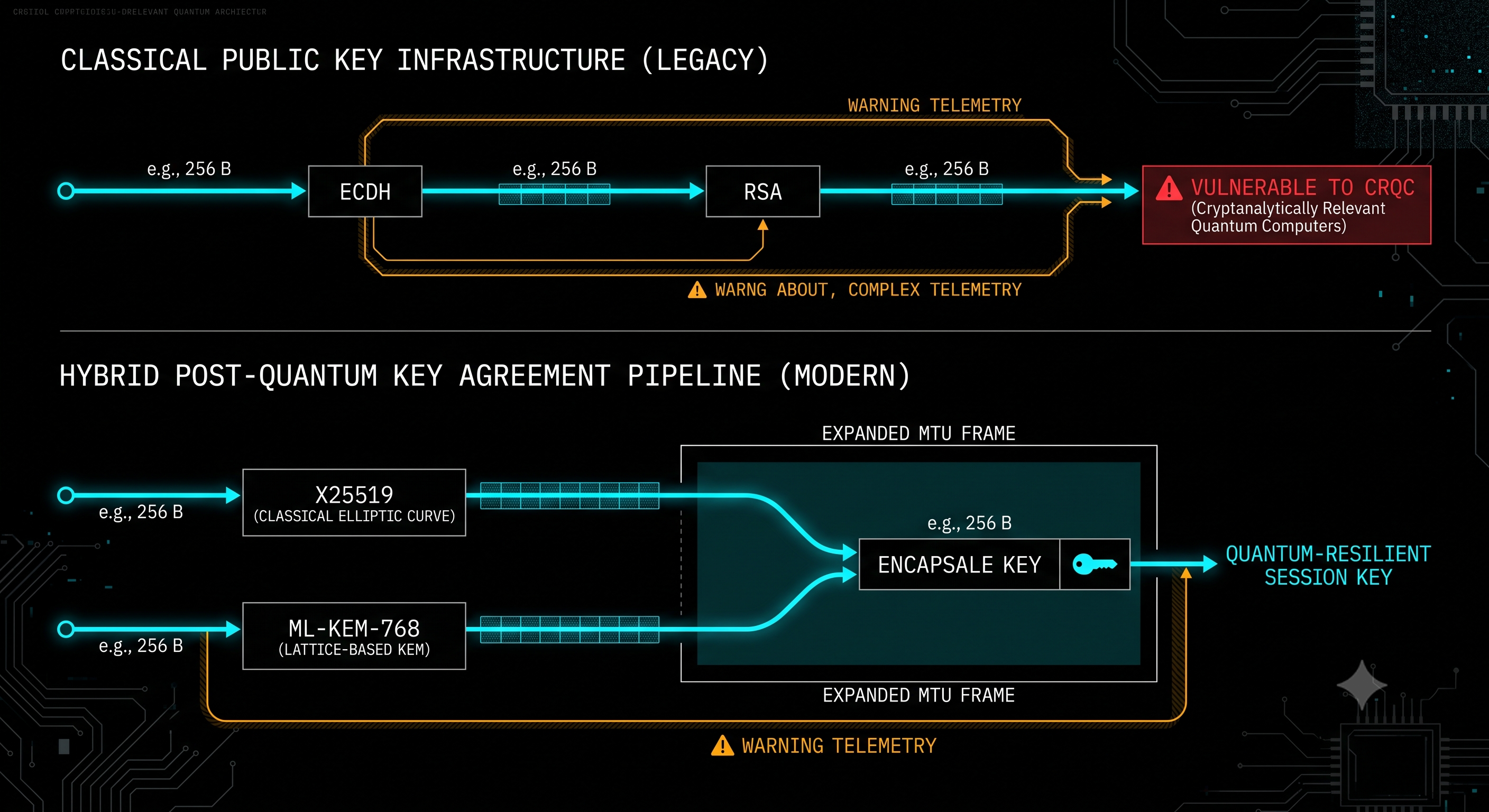
Deploy Hybrid Key Exchange First: Avoid ripping out classical crypto immediately. Configure your TLS termination (e.g., via Envoy or AWS CloudFront/ALB) to use hybrid post-quantum key agreement (X25519 + ML-KEM-768). This binds classical ECDH security with quantum resistance—ensuring that if an unknown flaw is found in the new math, legacy defenses hold.
Generate a Cryptographic Bill of Materials (CBOM): You cannot defend what you cannot observe. Audit automated CI/CD pipelines, container images, and service meshes to catalog where hardcoded TLS parameters, JWT verification keys, and legacy PKI certificates reside.
Abstract Key Exchanges in Code: Isolate cryptographic routines behind modular service interfaces so algorithm rotation requires a configuration push rather than a codebase rewrite.
Discussion Question
How is your team handling cryptographic discovery across your microservices? Have you run benchmark tests on TLS handshakes using hybrid ML-KEM, or is legacy RSA/ECC still baked into your internal API gateways?
CTA (Join Techawks USA)
Join Techawks USA: Connect with top engineering leads, cloud architects, and security practitioners across the US ecosystem. Join the community to dive into architecture blueprints, benchmark discussions, and production-tested systems engineering.
The conversation around Post-Quantum Cryptography (PQC) has moved out of academic whitepapers and squarely into US enterprise architecture. Under federal zero-trust mandates and updated commercial cybersecurity frameworks, US tech stacks are moving to replace RSA and Elliptic Curve Cryptography (ECC).
The immediate threat is not that a cryptanalytically relevant quantum computer (CRQC) breaks your database tomorrow. The threat is SNDL (Store Now, Decrypt Later): state and sophisticated actors harvesting encrypted TLS traffic, long-term health records, intellectual property, and financial ledger data right now, waiting to run them through quantum hardware later.
For US software architects, DevOps leads, and security engineers, the transition is not a simple drop-in algorithm replacement.
What Changes Under NIST's Standards
NIST finalized the primary algorithms defining the next two decades of secure communications:
FIPS 203 (ML-KEM / formerly CRYSTALS-Kyber): Primary standard for Key Encapsulation Mechanisms (used for establishing shared keys over untrusted networks).
FIPS 204 (ML-DSA / formerly CRYSTALS-Dilithium): Primary lattice-based standard for digital signatures and authentication.
FIPS 205 (SLH-DSA / formerly SPHINCS+): Stateless hash-based digital signature standard acting as an algorithmic fallback.
The Systems Engineering Challenge: Payload Bloat & Latency
PQC algorithms rely on lattice-based math rather than integer factorization or discrete logarithms. This introduces fundamental architectural constraints:
Massive Key and Ciphertext Sizes:
An RSA-2048 public key is 256 bytes.
An ML-KEM-768 public key is 1,184 bytes, and the ciphertext is 1,088 bytes.
Digital signatures see an even steeper jump: Ed25519 signatures are 64 bytes; ML-DSA-65 signatures are 3,293 bytes.
Network Fragmentation: Larger signatures easily exceed single Maximum Transmission Units (MTUs) on standard networks (1500 bytes), causing TCP packet fragmentation and spikes in TLS handshake latency across distributed edge nodes.
The Tactical Playbook: Crypto-Agility & Hybrid KEMs
Do not hardcode new algorithms into your repos. Build for crypto-agility:
Deploy Hybrid Key Exchange First: Avoid ripping out classical crypto immediately. Configure your TLS termination (e.g., via Envoy or AWS CloudFront/ALB) to use hybrid post-quantum key agreement (X25519 + ML-KEM-768). This binds classical ECDH security with quantum resistance—ensuring that if an unknown flaw is found in the new math, legacy defenses hold.
Generate a Cryptographic Bill of Materials (CBOM): You cannot defend what you cannot observe. Audit automated CI/CD pipelines, container images, and service meshes to catalog where hardcoded TLS parameters, JWT verification keys, and legacy PKI certificates reside.
Abstract Key Exchanges in Code: Isolate cryptographic routines behind modular service interfaces so algorithm rotation requires a configuration push rather than a codebase rewrite.
Discussion Question
How is your team handling cryptographic discovery across your microservices? Have you run benchmark tests on TLS handshakes using hybrid ML-KEM, or is legacy RSA/ECC still baked into your internal API gateways?
CTA (Join Techawks USA)
Join Techawks USA: Connect with top engineering leads, cloud architects, and security practitioners across the US ecosystem. Join the community to dive into architecture blueprints, benchmark discussions, and production-tested systems engineering.
Beyond "Harvest Now, Decrypt Later": Implementing NIST’s Post-Quantum Cryptography in Cloud Production
The conversation around Post-Quantum Cryptography (PQC) has moved out of academic whitepapers and squarely into US enterprise architecture. Under federal zero-trust mandates and updated commercial cybersecurity frameworks, US tech stacks are moving to replace RSA and Elliptic Curve Cryptography (ECC).
The immediate threat is not that a cryptanalytically relevant quantum computer (CRQC) breaks your database tomorrow. The threat is SNDL (Store Now, Decrypt Later): state and sophisticated actors harvesting encrypted TLS traffic, long-term health records, intellectual property, and financial ledger data right now, waiting to run them through quantum hardware later.
For US software architects, DevOps leads, and security engineers, the transition is not a simple drop-in algorithm replacement.
What Changes Under NIST's Standards
NIST finalized the primary algorithms defining the next two decades of secure communications:
FIPS 203 (ML-KEM / formerly CRYSTALS-Kyber): Primary standard for Key Encapsulation Mechanisms (used for establishing shared keys over untrusted networks).
FIPS 204 (ML-DSA / formerly CRYSTALS-Dilithium): Primary lattice-based standard for digital signatures and authentication.
FIPS 205 (SLH-DSA / formerly SPHINCS+): Stateless hash-based digital signature standard acting as an algorithmic fallback.
The Systems Engineering Challenge: Payload Bloat & Latency
PQC algorithms rely on lattice-based math rather than integer factorization or discrete logarithms. This introduces fundamental architectural constraints:
Massive Key and Ciphertext Sizes:
An RSA-2048 public key is 256 bytes.
An ML-KEM-768 public key is 1,184 bytes, and the ciphertext is 1,088 bytes.
Digital signatures see an even steeper jump: Ed25519 signatures are 64 bytes; ML-DSA-65 signatures are 3,293 bytes.
Network Fragmentation: Larger signatures easily exceed single Maximum Transmission Units (MTUs) on standard networks (1500 bytes), causing TCP packet fragmentation and spikes in TLS handshake latency across distributed edge nodes.
The Tactical Playbook: Crypto-Agility & Hybrid KEMs
Do not hardcode new algorithms into your repos. Build for crypto-agility:
Deploy Hybrid Key Exchange First: Avoid ripping out classical crypto immediately. Configure your TLS termination (e.g., via Envoy or AWS CloudFront/ALB) to use hybrid post-quantum key agreement (X25519 + ML-KEM-768). This binds classical ECDH security with quantum resistance—ensuring that if an unknown flaw is found in the new math, legacy defenses hold.
Generate a Cryptographic Bill of Materials (CBOM): You cannot defend what you cannot observe. Audit automated CI/CD pipelines, container images, and service meshes to catalog where hardcoded TLS parameters, JWT verification keys, and legacy PKI certificates reside.
Abstract Key Exchanges in Code: Isolate cryptographic routines behind modular service interfaces so algorithm rotation requires a configuration push rather than a codebase rewrite.
Discussion Question
How is your team handling cryptographic discovery across your microservices? Have you run benchmark tests on TLS handshakes using hybrid ML-KEM, or is legacy RSA/ECC still baked into your internal API gateways?
CTA (Join Techawks USA)
Join Techawks USA: Connect with top engineering leads, cloud architects, and security practitioners across the US ecosystem. Join the community to dive into architecture blueprints, benchmark discussions, and production-tested systems engineering.

 Arabic
 French
 Spanish
 Portuguese
 Deutsch
 Turkish
 Dutch
Dutch
 Italiano
 Russian
 Romaian
 Portuguese (Brazil)
 Greek
Greek