


Architecting for the UK’s Data (Use and Access) Act: Refactoring Automated Decision-Making (ADM) in Production AI Systems
For years, Article 22 of the UK GDPR acted as an outright prohibition: organizations could not subject individuals to decisions based solely on automated processing that produced legal or similarly significant effects, unless falling into narrow carve-outs (contract necessity, statutory authorization, or explicit consent).
Under the Data (Use and Access) Act (DUAA), the UK has formally pivoted from a blanket ban to an enablement framework with mandatory technical safeguards.
For engineering teams across London, Cambridge, Edinburgh, and Manchester building algorithmic scoring, automated underwriting, fraud mitigation, or dynamic pricing engines, this unlocks major velocity—provided your systems architecture implements the required engineering controls.
What Actually Changed Under the Hood:
Rather than requiring prior consent or proving contract necessity for every automated inference, modern UK data law permits automated decision-making across a broader set of lawful bases (including legitimate interests).
However, this flexibility is strictly contingent on providing three concrete capabilities baked directly into your data and API layer:
Meaningful Explanability: The system must supply the data subject with intelligible information about the logic involved and the consequences of the decision.
Right to Contestability: The subject must be able to challenge the decision via accessible digital endpoints.
Deterministic Human-in-the-Loop (HITL) Intervention: The subject has the statutory right to demand human review by someone with the actual authority to overturn the algorithmic output.
Tactical Architecture: Building the "Contestable Pipeline"
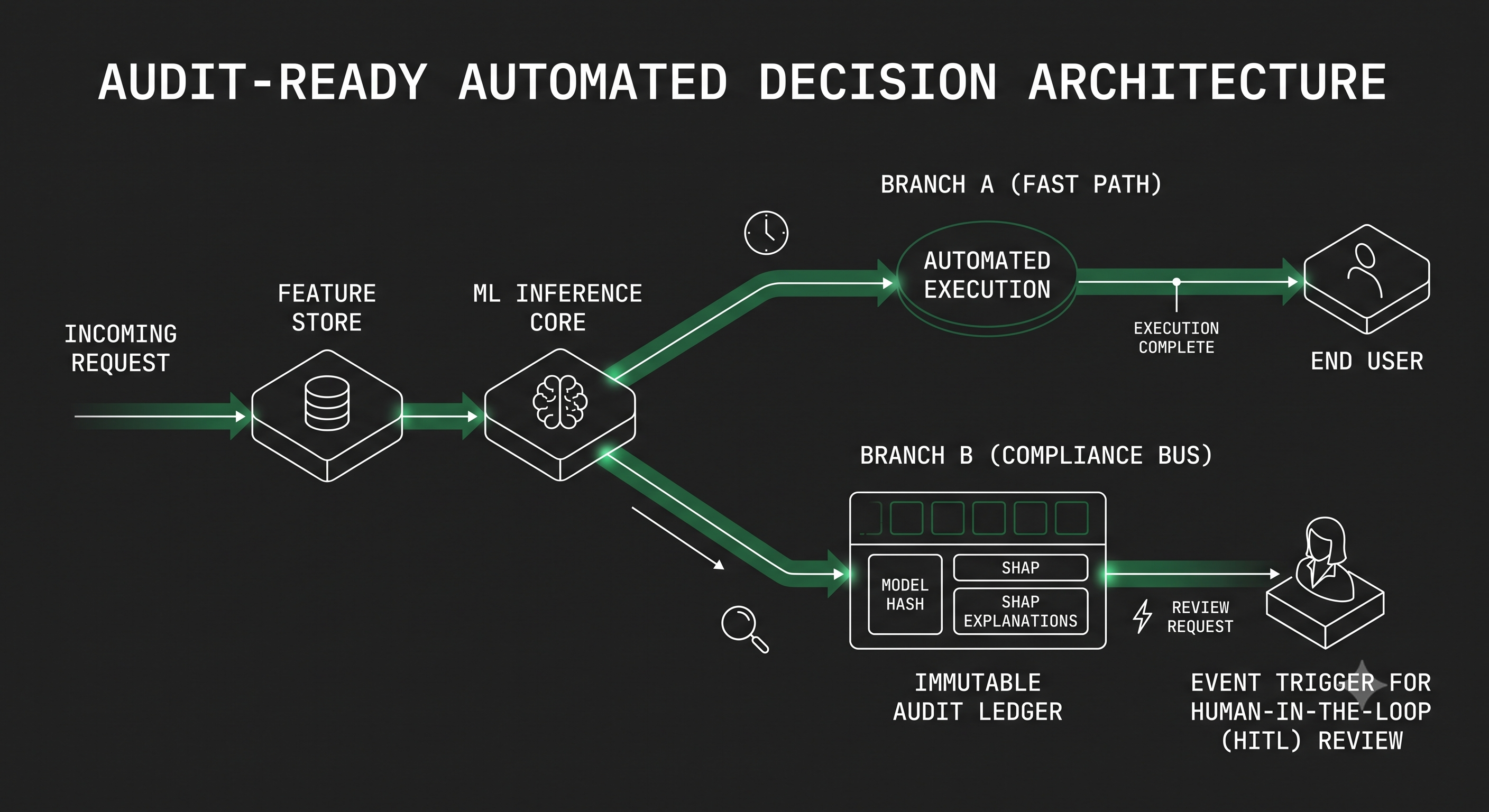
To satisfy these requirements without slowing down microservice performance, decouple your automated decision infrastructure into a repeatable, four-stage design pattern:
[ Ingestion / Feature Store ]
│
▼
[ Inference Engine (ML Model / Rules) ] ──▶ [ Decision Event Bus (Kafka/SQS) ]
│ │
▼ ▼
[ Immutable Audit Store ] [ HITL Review & Re-route Service ]
(Features, Model Version, SHAP weights) (State machine for human override)
Persist Decision Snapshots (Feature-Level Auditability):
Never rely on runtime re-inference. If a user challenges a credit limit decision 20 days later, your underlying feature store (e.g., Feast) and model weights may have drifted.
Write an immutable audit log payload containing: request_id, model_registry_hash, raw vector inputs, computed confidence score, and local feature importance outputs (e.g., generated via TreeSHAP or integrated gradients).
Implement Asynchronous Escalation State Machines:
Build a dedicated webhook/queue to consume contestability triggers.
If a customer submits a dispute via your /v1/decisions/{id}/contest endpoint, transition the entity state from PROCESSED_AUTOMATED to PENDING_HUMAN_REVIEW, locking further automated actions on the user's account until a qualified operator signs off.
Decouple "Model Output" from "Final Action Execution":
Keep your model purely as an advisory score generator. Isolate the business logic execution behind a rule engine that verifies whether special category data is touched (which still requires higher-threshold safeguards) and automatically flags borderline confidence scores for manual review before any action is executed.
Discussion Question
How is your team handling automated decision audit trails today? Are you snapshotting model inputs and explainability vectors directly to cold storage, or is human contestability still a manual, ad-hoc process handled across disparate database logs?
CTA (Join Techawks UK)
Join Techawks UK: Connect with CTOs, principal systems architects, and engineering leads shaping the future of British deep tech, fintech, and sovereign infrastructure. Join our discussions, benchmark your systems against UK regulatory standards, and build resilient software with the community.
For years, Article 22 of the UK GDPR acted as an outright prohibition: organizations could not subject individuals to decisions based solely on automated processing that produced legal or similarly significant effects, unless falling into narrow carve-outs (contract necessity, statutory authorization, or explicit consent).
Under the Data (Use and Access) Act (DUAA), the UK has formally pivoted from a blanket ban to an enablement framework with mandatory technical safeguards.
For engineering teams across London, Cambridge, Edinburgh, and Manchester building algorithmic scoring, automated underwriting, fraud mitigation, or dynamic pricing engines, this unlocks major velocity—provided your systems architecture implements the required engineering controls.
What Actually Changed Under the Hood:
Rather than requiring prior consent or proving contract necessity for every automated inference, modern UK data law permits automated decision-making across a broader set of lawful bases (including legitimate interests).
However, this flexibility is strictly contingent on providing three concrete capabilities baked directly into your data and API layer:
Meaningful Explanability: The system must supply the data subject with intelligible information about the logic involved and the consequences of the decision.
Right to Contestability: The subject must be able to challenge the decision via accessible digital endpoints.
Deterministic Human-in-the-Loop (HITL) Intervention: The subject has the statutory right to demand human review by someone with the actual authority to overturn the algorithmic output.
Tactical Architecture: Building the "Contestable Pipeline"
To satisfy these requirements without slowing down microservice performance, decouple your automated decision infrastructure into a repeatable, four-stage design pattern:
[ Ingestion / Feature Store ]
│
▼
[ Inference Engine (ML Model / Rules) ] ──▶ [ Decision Event Bus (Kafka/SQS) ]
│ │
▼ ▼
[ Immutable Audit Store ] [ HITL Review & Re-route Service ]
(Features, Model Version, SHAP weights) (State machine for human override)
Persist Decision Snapshots (Feature-Level Auditability):
Never rely on runtime re-inference. If a user challenges a credit limit decision 20 days later, your underlying feature store (e.g., Feast) and model weights may have drifted.
Write an immutable audit log payload containing: request_id, model_registry_hash, raw vector inputs, computed confidence score, and local feature importance outputs (e.g., generated via TreeSHAP or integrated gradients).
Implement Asynchronous Escalation State Machines:
Build a dedicated webhook/queue to consume contestability triggers.
If a customer submits a dispute via your /v1/decisions/{id}/contest endpoint, transition the entity state from PROCESSED_AUTOMATED to PENDING_HUMAN_REVIEW, locking further automated actions on the user's account until a qualified operator signs off.
Decouple "Model Output" from "Final Action Execution":
Keep your model purely as an advisory score generator. Isolate the business logic execution behind a rule engine that verifies whether special category data is touched (which still requires higher-threshold safeguards) and automatically flags borderline confidence scores for manual review before any action is executed.
Discussion Question
How is your team handling automated decision audit trails today? Are you snapshotting model inputs and explainability vectors directly to cold storage, or is human contestability still a manual, ad-hoc process handled across disparate database logs?
CTA (Join Techawks UK)
Join Techawks UK: Connect with CTOs, principal systems architects, and engineering leads shaping the future of British deep tech, fintech, and sovereign infrastructure. Join our discussions, benchmark your systems against UK regulatory standards, and build resilient software with the community.
Architecting for the UK’s Data (Use and Access) Act: Refactoring Automated Decision-Making (ADM) in Production AI Systems
For years, Article 22 of the UK GDPR acted as an outright prohibition: organizations could not subject individuals to decisions based solely on automated processing that produced legal or similarly significant effects, unless falling into narrow carve-outs (contract necessity, statutory authorization, or explicit consent).
Under the Data (Use and Access) Act (DUAA), the UK has formally pivoted from a blanket ban to an enablement framework with mandatory technical safeguards.
For engineering teams across London, Cambridge, Edinburgh, and Manchester building algorithmic scoring, automated underwriting, fraud mitigation, or dynamic pricing engines, this unlocks major velocity—provided your systems architecture implements the required engineering controls.
What Actually Changed Under the Hood:
Rather than requiring prior consent or proving contract necessity for every automated inference, modern UK data law permits automated decision-making across a broader set of lawful bases (including legitimate interests).
However, this flexibility is strictly contingent on providing three concrete capabilities baked directly into your data and API layer:
Meaningful Explanability: The system must supply the data subject with intelligible information about the logic involved and the consequences of the decision.
Right to Contestability: The subject must be able to challenge the decision via accessible digital endpoints.
Deterministic Human-in-the-Loop (HITL) Intervention: The subject has the statutory right to demand human review by someone with the actual authority to overturn the algorithmic output.
Tactical Architecture: Building the "Contestable Pipeline"
To satisfy these requirements without slowing down microservice performance, decouple your automated decision infrastructure into a repeatable, four-stage design pattern:
[ Ingestion / Feature Store ]
│
▼
[ Inference Engine (ML Model / Rules) ] ──▶ [ Decision Event Bus (Kafka/SQS) ]
│ │
▼ ▼
[ Immutable Audit Store ] [ HITL Review & Re-route Service ]
(Features, Model Version, SHAP weights) (State machine for human override)
Persist Decision Snapshots (Feature-Level Auditability):
Never rely on runtime re-inference. If a user challenges a credit limit decision 20 days later, your underlying feature store (e.g., Feast) and model weights may have drifted.
Write an immutable audit log payload containing: request_id, model_registry_hash, raw vector inputs, computed confidence score, and local feature importance outputs (e.g., generated via TreeSHAP or integrated gradients).
Implement Asynchronous Escalation State Machines:
Build a dedicated webhook/queue to consume contestability triggers.
If a customer submits a dispute via your /v1/decisions/{id}/contest endpoint, transition the entity state from PROCESSED_AUTOMATED to PENDING_HUMAN_REVIEW, locking further automated actions on the user's account until a qualified operator signs off.
Decouple "Model Output" from "Final Action Execution":
Keep your model purely as an advisory score generator. Isolate the business logic execution behind a rule engine that verifies whether special category data is touched (which still requires higher-threshold safeguards) and automatically flags borderline confidence scores for manual review before any action is executed.
Discussion Question
How is your team handling automated decision audit trails today? Are you snapshotting model inputs and explainability vectors directly to cold storage, or is human contestability still a manual, ad-hoc process handled across disparate database logs?
CTA (Join Techawks UK)
Join Techawks UK: Connect with CTOs, principal systems architects, and engineering leads shaping the future of British deep tech, fintech, and sovereign infrastructure. Join our discussions, benchmark your systems against UK regulatory standards, and build resilient software with the community.

 English
 Arabic
 French
 Spanish
 Portuguese
 Deutsch
 Turkish
 Dutch
Dutch
 Italiano
 Russian
 Romaian
 Portuguese (Brazil)