


Architecting Sovereign AI in the UAE: Moving Beyond Public APIs to In-Country Hybrid Runtimes
The UAE’s digital economy is executing a world-leading AI buildout, but the engineering conversation has shifted from "Which API is smartest?" to "Where does the inference actually execute, and who holds the keys?"
Under the UAE Personal Data Protection Law (PDPL) and regulatory frameworks across the CBUAE, DIFC, and ADGM, processing sensitive, health, or financial data requires verifiable data sovereignty. Relying on foreign cloud API gateways exposes organizations to cross-border transfer restrictions, sub-processor data leakage, and regulatory non-compliance penalties that can reach up to AED 5,000,000.
Sovereignty does not mean running your own datacenter from scratch. It means designing a Sovereign-First Hybrid Inference Pipeline that keeps sensitive data under local legal and physical jurisdiction.
The Core Technical Trade-Off: Residency vs. Sovereignty
Data Residency: Storing raw vectors or transactional databases physically inside UAE borders (e.g., local UAE cloud availability zones).
Data Sovereignty: Ensuring that every step of the compute lifecycle—tokenization, embedding generation, context window hydration, and model inference—is governed strictly under UAE jurisdiction without unvetted third-party cross-border exposure.
Architectural Blueprint: Deploying Sovereign Inference
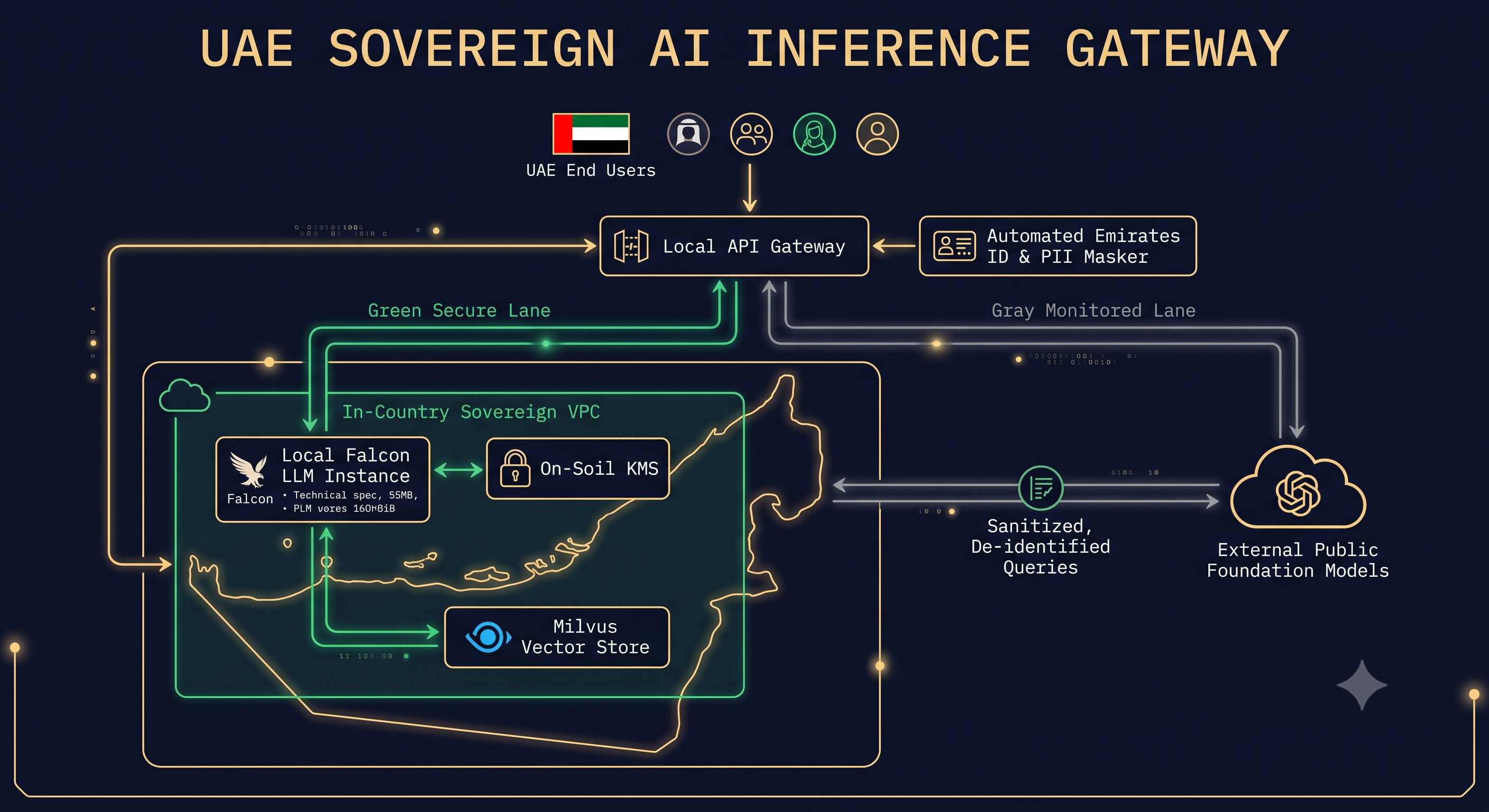
To deploy production AI workloads without triggering cross-border non-compliance, implement a three-tier sovereign abstraction:
[ Client Request (UAE Mobile/Web) ]
│
▼
[ In-Country API Gateway & PII Redactor ]
(Local VPC: Presidio / Regex / Token Masking)
│ │
│ (Sensitive/Regulated Data) │ (Non-sensitive / General Data)
▼ ▼
[ Sovereign Model Tier ] [ Global Foundation APIs ]
- Local Falcon Engine (Sanitized Prompt Only)
- Dedicated In-Country Cluster
- In-VPC Vector DB (Qdrant/Milvus)
Deploy In-Region Open Weights (Falcon / Hybrid Architectures):
Instead of depending exclusively on closed US-hosted APIs, self-host optimized open-weight foundation models—such as the UAE’s open-source Falcon series (developed by TII) or fine-tuned compact architectures—within local cloud VPCs (such as Core42 Sovereign Cloud or in-region AWS/Azure instances).
Quantize models down to FP8 or INT4 (using AWQ or vLLM) to achieve sub-20ms first-token latency on localized GPU nodes without degrading Arabic language nuances.
Context-Aware Semantic PII Scrubbing:
Implement an upstream proxy layer before routing to any external endpoint. Use lightweight local transformer models or spaCy-based NER pipelines tuned for regional formats (Emirates ID numbers, UAE phone prefixes, IBANs, and Arabic naming patterns).
Dynamically pseudonymize entities: store mapping tables in an in-memory Redis cluster isolated within the local jurisdiction, reinjecting actual values only after the sanitized response returns.
Bring Your Own Key (BYOK) with In-Country KMS:
Enforce client-side envelope encryption on all vector database entries and RAG document embeddings. The root cryptographic keys must reside in an on-soil Hardware Security Module (HSM) compliant with UAE Cyber Security Council standards, ensuring that cloud infrastructure providers cannot inspect plaintext context windows.
Discussion Question
How is your engineering team solving data sovereignty for production RAG pipelines in the UAE? Are you deploying localized models like Falcon within local VPCs, or relying on sanitized proxies to query external foundation models?
CTA (Join Techawks UAE)
Join Techawks UAE: Connect with leading CTOs, cloud architects, and systems engineers building the UAE’s sovereign tech future across Dubai, Abu Dhabi, and beyond. Join our technical sessions, dissect architecture patterns, and scale your stack with the region’s top builders.
The UAE’s digital economy is executing a world-leading AI buildout, but the engineering conversation has shifted from "Which API is smartest?" to "Where does the inference actually execute, and who holds the keys?"
Under the UAE Personal Data Protection Law (PDPL) and regulatory frameworks across the CBUAE, DIFC, and ADGM, processing sensitive, health, or financial data requires verifiable data sovereignty. Relying on foreign cloud API gateways exposes organizations to cross-border transfer restrictions, sub-processor data leakage, and regulatory non-compliance penalties that can reach up to AED 5,000,000.
Sovereignty does not mean running your own datacenter from scratch. It means designing a Sovereign-First Hybrid Inference Pipeline that keeps sensitive data under local legal and physical jurisdiction.
The Core Technical Trade-Off: Residency vs. Sovereignty
Data Residency: Storing raw vectors or transactional databases physically inside UAE borders (e.g., local UAE cloud availability zones).
Data Sovereignty: Ensuring that every step of the compute lifecycle—tokenization, embedding generation, context window hydration, and model inference—is governed strictly under UAE jurisdiction without unvetted third-party cross-border exposure.
Architectural Blueprint: Deploying Sovereign Inference
To deploy production AI workloads without triggering cross-border non-compliance, implement a three-tier sovereign abstraction:
[ Client Request (UAE Mobile/Web) ]
│
▼
[ In-Country API Gateway & PII Redactor ]
(Local VPC: Presidio / Regex / Token Masking)
│ │
│ (Sensitive/Regulated Data) │ (Non-sensitive / General Data)
▼ ▼
[ Sovereign Model Tier ] [ Global Foundation APIs ]
- Local Falcon Engine (Sanitized Prompt Only)
- Dedicated In-Country Cluster
- In-VPC Vector DB (Qdrant/Milvus)
Deploy In-Region Open Weights (Falcon / Hybrid Architectures):
Instead of depending exclusively on closed US-hosted APIs, self-host optimized open-weight foundation models—such as the UAE’s open-source Falcon series (developed by TII) or fine-tuned compact architectures—within local cloud VPCs (such as Core42 Sovereign Cloud or in-region AWS/Azure instances).
Quantize models down to FP8 or INT4 (using AWQ or vLLM) to achieve sub-20ms first-token latency on localized GPU nodes without degrading Arabic language nuances.
Context-Aware Semantic PII Scrubbing:
Implement an upstream proxy layer before routing to any external endpoint. Use lightweight local transformer models or spaCy-based NER pipelines tuned for regional formats (Emirates ID numbers, UAE phone prefixes, IBANs, and Arabic naming patterns).
Dynamically pseudonymize entities: store mapping tables in an in-memory Redis cluster isolated within the local jurisdiction, reinjecting actual values only after the sanitized response returns.
Bring Your Own Key (BYOK) with In-Country KMS:
Enforce client-side envelope encryption on all vector database entries and RAG document embeddings. The root cryptographic keys must reside in an on-soil Hardware Security Module (HSM) compliant with UAE Cyber Security Council standards, ensuring that cloud infrastructure providers cannot inspect plaintext context windows.
Discussion Question
How is your engineering team solving data sovereignty for production RAG pipelines in the UAE? Are you deploying localized models like Falcon within local VPCs, or relying on sanitized proxies to query external foundation models?
CTA (Join Techawks UAE)
Join Techawks UAE: Connect with leading CTOs, cloud architects, and systems engineers building the UAE’s sovereign tech future across Dubai, Abu Dhabi, and beyond. Join our technical sessions, dissect architecture patterns, and scale your stack with the region’s top builders.
Architecting Sovereign AI in the UAE: Moving Beyond Public APIs to In-Country Hybrid Runtimes
The UAE’s digital economy is executing a world-leading AI buildout, but the engineering conversation has shifted from "Which API is smartest?" to "Where does the inference actually execute, and who holds the keys?"
Under the UAE Personal Data Protection Law (PDPL) and regulatory frameworks across the CBUAE, DIFC, and ADGM, processing sensitive, health, or financial data requires verifiable data sovereignty. Relying on foreign cloud API gateways exposes organizations to cross-border transfer restrictions, sub-processor data leakage, and regulatory non-compliance penalties that can reach up to AED 5,000,000.
Sovereignty does not mean running your own datacenter from scratch. It means designing a Sovereign-First Hybrid Inference Pipeline that keeps sensitive data under local legal and physical jurisdiction.
The Core Technical Trade-Off: Residency vs. Sovereignty
Data Residency: Storing raw vectors or transactional databases physically inside UAE borders (e.g., local UAE cloud availability zones).
Data Sovereignty: Ensuring that every step of the compute lifecycle—tokenization, embedding generation, context window hydration, and model inference—is governed strictly under UAE jurisdiction without unvetted third-party cross-border exposure.
Architectural Blueprint: Deploying Sovereign Inference
To deploy production AI workloads without triggering cross-border non-compliance, implement a three-tier sovereign abstraction:
[ Client Request (UAE Mobile/Web) ]
│
▼
[ In-Country API Gateway & PII Redactor ]
(Local VPC: Presidio / Regex / Token Masking)
│ │
│ (Sensitive/Regulated Data) │ (Non-sensitive / General Data)
▼ ▼
[ Sovereign Model Tier ] [ Global Foundation APIs ]
- Local Falcon Engine (Sanitized Prompt Only)
- Dedicated In-Country Cluster
- In-VPC Vector DB (Qdrant/Milvus)
Deploy In-Region Open Weights (Falcon / Hybrid Architectures):
Instead of depending exclusively on closed US-hosted APIs, self-host optimized open-weight foundation models—such as the UAE’s open-source Falcon series (developed by TII) or fine-tuned compact architectures—within local cloud VPCs (such as Core42 Sovereign Cloud or in-region AWS/Azure instances).
Quantize models down to FP8 or INT4 (using AWQ or vLLM) to achieve sub-20ms first-token latency on localized GPU nodes without degrading Arabic language nuances.
Context-Aware Semantic PII Scrubbing:
Implement an upstream proxy layer before routing to any external endpoint. Use lightweight local transformer models or spaCy-based NER pipelines tuned for regional formats (Emirates ID numbers, UAE phone prefixes, IBANs, and Arabic naming patterns).
Dynamically pseudonymize entities: store mapping tables in an in-memory Redis cluster isolated within the local jurisdiction, reinjecting actual values only after the sanitized response returns.
Bring Your Own Key (BYOK) with In-Country KMS:
Enforce client-side envelope encryption on all vector database entries and RAG document embeddings. The root cryptographic keys must reside in an on-soil Hardware Security Module (HSM) compliant with UAE Cyber Security Council standards, ensuring that cloud infrastructure providers cannot inspect plaintext context windows.
Discussion Question
How is your engineering team solving data sovereignty for production RAG pipelines in the UAE? Are you deploying localized models like Falcon within local VPCs, or relying on sanitized proxies to query external foundation models?
CTA (Join Techawks UAE)
Join Techawks UAE: Connect with leading CTOs, cloud architects, and systems engineers building the UAE’s sovereign tech future across Dubai, Abu Dhabi, and beyond. Join our technical sessions, dissect architecture patterns, and scale your stack with the region’s top builders.

 English
 French
 Spanish
 Portuguese
 Deutsch
 Turkish
 Dutch
Dutch
 Italiano
 Russian
 Romaian
 Portuguese (Brazil)
 Greek
Greek