


The Canadian Sovereign Compute Pivot: Architecting ML Workloads for Clean-Grid Infrastructure and In-Country Governance
Canada has long been an AI intellectual powerhouse, but Canadian founders and engineering teams have historically faced a harsh reality: building models locally meant shipping data and IP across the border to US-hosted compute clusters.
That paradigm is breaking. With federal mandates expanding domestic compute capacity (via the Compute Access Fund and commercial AI data-centre initiatives) and provincial privacy commissioners scrutinizing cross-border personal data flows, Canadian tech stacks are undergoing a sovereignty refactoring.
Why This Matters to Canadian Engineering Leads:
The Sovereignty vs. Residency Gap: Storing cold data in an AWS ca-central-1 or Azure Canada East bucket satisfies baseline data residency, but not necessarily operational data sovereignty. If your inference clusters, telemetry pipelines, or control planes depend on foreign parent entities subject to extraterritorial subpoena, enterprise and public-sector clients in healthcare, banking, and government will red-flag your procurement pipeline.
Clean-Grid Arbitrage: Canada’s cold climates and hydro/clean power grids (Quebec, BC, Manitoba, and expanding infrastructure in Saskatchewan) offer up to a 60–75% lower carbon footprint per Teraflop compared to traditional fossil-fueled US data center corridors. Enterprise ESG reporting now demands hardware-level emissions transparency in AI operations.
Tactical Architecture: Implementing Green, Sovereign ML Pipelines
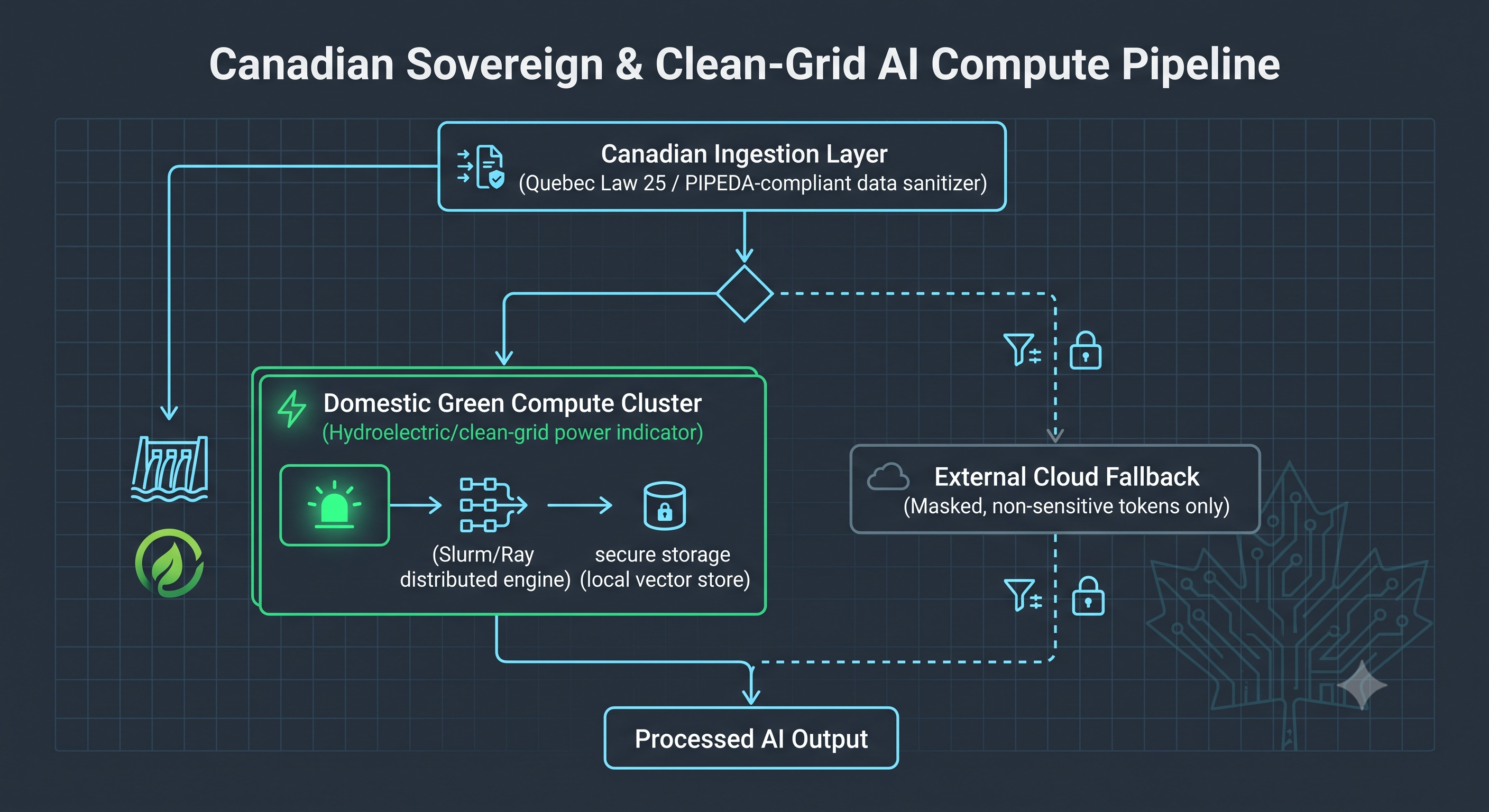
To leverage Canadian domestic compute without getting locked into isolated bare-metal setups, structure your AI orchestration using a hybrid sovereign cluster pattern:
[ In-Country Traffic (Canadian Client Requests) ]
│
▼
[ Sovereign Control Plane (Local VPC) ]
(PIPEDA/Law 25 Audit Logger & Tokenizer)
│
┌───────────┴───────────┐
▼ ▼
[ Low-Carbon Compute ] [ Public Foundation Fallback ]
- Hydro-powered node - Sanitized queries only
- Ray / Slurm cluster - PII-stripped via regex/NER
- In-country embeddings
Carbon-Aware Workload Scheduling:
Integrate grid intensity telemetry (e.g., using open-source tools like CodeCarbon or Kepler via Prometheus) directly into your Kubernetes or Slurm scheduler.
Configure non-latency-sensitive workloads (such as batch fine-tuning, synthetic data generation, and offline embedding re-indexing) to trigger dynamically when clean power output peaks, routing jobs to low-emission domestic regions.
Containerized Portability with Slurm & Ray:
Avoid hardcoding proprietary cloud SDKs into your training code. Abstract your compute layer using Ray Core or containerized jobs running on Singularity/Apptainer over Slurm.
This allows immediate portability between public Canadian research supercomputing infrastructure (like the Digital Research Alliance of Canada nodes) and commercial domestic sovereign clusters without altering your PyTorch training loops.
Provincial Compliance Guards (Quebec Law 25 & PIPEDA Modernization):
Embed automated privacy guards in your ingestion pre-processors. Ensure that any inference request originating from Canadian users anonymizes or tokenizes identifiers locally before features hit shared memory pools in distributed training setups.
Discussion Question
Is your organization running model training and inference on dedicated Canadian compute clusters, or are you still relying entirely on US-based cloud infrastructure? What has been your biggest friction point when trying to keep your ML stack 100% sovereign?
CTA (Join Techawks Canada)
Join Techawks Canada: Connect with Canadian CTOs, ML architects, and deep-tech founders building the future of sovereign computing, quantum systems, and AI infrastructure from Vancouver to Montreal. Join our discussions, share architecture playbooks, and build sustainable tech with the community.
Canada has long been an AI intellectual powerhouse, but Canadian founders and engineering teams have historically faced a harsh reality: building models locally meant shipping data and IP across the border to US-hosted compute clusters.
That paradigm is breaking. With federal mandates expanding domestic compute capacity (via the Compute Access Fund and commercial AI data-centre initiatives) and provincial privacy commissioners scrutinizing cross-border personal data flows, Canadian tech stacks are undergoing a sovereignty refactoring.
Why This Matters to Canadian Engineering Leads:
The Sovereignty vs. Residency Gap: Storing cold data in an AWS ca-central-1 or Azure Canada East bucket satisfies baseline data residency, but not necessarily operational data sovereignty. If your inference clusters, telemetry pipelines, or control planes depend on foreign parent entities subject to extraterritorial subpoena, enterprise and public-sector clients in healthcare, banking, and government will red-flag your procurement pipeline.
Clean-Grid Arbitrage: Canada’s cold climates and hydro/clean power grids (Quebec, BC, Manitoba, and expanding infrastructure in Saskatchewan) offer up to a 60–75% lower carbon footprint per Teraflop compared to traditional fossil-fueled US data center corridors. Enterprise ESG reporting now demands hardware-level emissions transparency in AI operations.
Tactical Architecture: Implementing Green, Sovereign ML Pipelines
To leverage Canadian domestic compute without getting locked into isolated bare-metal setups, structure your AI orchestration using a hybrid sovereign cluster pattern:
[ In-Country Traffic (Canadian Client Requests) ]
│
▼
[ Sovereign Control Plane (Local VPC) ]
(PIPEDA/Law 25 Audit Logger & Tokenizer)
│
┌───────────┴───────────┐
▼ ▼
[ Low-Carbon Compute ] [ Public Foundation Fallback ]
- Hydro-powered node - Sanitized queries only
- Ray / Slurm cluster - PII-stripped via regex/NER
- In-country embeddings
Carbon-Aware Workload Scheduling:
Integrate grid intensity telemetry (e.g., using open-source tools like CodeCarbon or Kepler via Prometheus) directly into your Kubernetes or Slurm scheduler.
Configure non-latency-sensitive workloads (such as batch fine-tuning, synthetic data generation, and offline embedding re-indexing) to trigger dynamically when clean power output peaks, routing jobs to low-emission domestic regions.
Containerized Portability with Slurm & Ray:
Avoid hardcoding proprietary cloud SDKs into your training code. Abstract your compute layer using Ray Core or containerized jobs running on Singularity/Apptainer over Slurm.
This allows immediate portability between public Canadian research supercomputing infrastructure (like the Digital Research Alliance of Canada nodes) and commercial domestic sovereign clusters without altering your PyTorch training loops.
Provincial Compliance Guards (Quebec Law 25 & PIPEDA Modernization):
Embed automated privacy guards in your ingestion pre-processors. Ensure that any inference request originating from Canadian users anonymizes or tokenizes identifiers locally before features hit shared memory pools in distributed training setups.
Discussion Question
Is your organization running model training and inference on dedicated Canadian compute clusters, or are you still relying entirely on US-based cloud infrastructure? What has been your biggest friction point when trying to keep your ML stack 100% sovereign?
CTA (Join Techawks Canada)
Join Techawks Canada: Connect with Canadian CTOs, ML architects, and deep-tech founders building the future of sovereign computing, quantum systems, and AI infrastructure from Vancouver to Montreal. Join our discussions, share architecture playbooks, and build sustainable tech with the community.
The Canadian Sovereign Compute Pivot: Architecting ML Workloads for Clean-Grid Infrastructure and In-Country Governance
Canada has long been an AI intellectual powerhouse, but Canadian founders and engineering teams have historically faced a harsh reality: building models locally meant shipping data and IP across the border to US-hosted compute clusters.
That paradigm is breaking. With federal mandates expanding domestic compute capacity (via the Compute Access Fund and commercial AI data-centre initiatives) and provincial privacy commissioners scrutinizing cross-border personal data flows, Canadian tech stacks are undergoing a sovereignty refactoring.
Why This Matters to Canadian Engineering Leads:
The Sovereignty vs. Residency Gap: Storing cold data in an AWS ca-central-1 or Azure Canada East bucket satisfies baseline data residency, but not necessarily operational data sovereignty. If your inference clusters, telemetry pipelines, or control planes depend on foreign parent entities subject to extraterritorial subpoena, enterprise and public-sector clients in healthcare, banking, and government will red-flag your procurement pipeline.
Clean-Grid Arbitrage: Canada’s cold climates and hydro/clean power grids (Quebec, BC, Manitoba, and expanding infrastructure in Saskatchewan) offer up to a 60–75% lower carbon footprint per Teraflop compared to traditional fossil-fueled US data center corridors. Enterprise ESG reporting now demands hardware-level emissions transparency in AI operations.
Tactical Architecture: Implementing Green, Sovereign ML Pipelines
To leverage Canadian domestic compute without getting locked into isolated bare-metal setups, structure your AI orchestration using a hybrid sovereign cluster pattern:
[ In-Country Traffic (Canadian Client Requests) ]
│
▼
[ Sovereign Control Plane (Local VPC) ]
(PIPEDA/Law 25 Audit Logger & Tokenizer)
│
┌───────────┴───────────┐
▼ ▼
[ Low-Carbon Compute ] [ Public Foundation Fallback ]
- Hydro-powered node - Sanitized queries only
- Ray / Slurm cluster - PII-stripped via regex/NER
- In-country embeddings
Carbon-Aware Workload Scheduling:
Integrate grid intensity telemetry (e.g., using open-source tools like CodeCarbon or Kepler via Prometheus) directly into your Kubernetes or Slurm scheduler.
Configure non-latency-sensitive workloads (such as batch fine-tuning, synthetic data generation, and offline embedding re-indexing) to trigger dynamically when clean power output peaks, routing jobs to low-emission domestic regions.
Containerized Portability with Slurm & Ray:
Avoid hardcoding proprietary cloud SDKs into your training code. Abstract your compute layer using Ray Core or containerized jobs running on Singularity/Apptainer over Slurm.
This allows immediate portability between public Canadian research supercomputing infrastructure (like the Digital Research Alliance of Canada nodes) and commercial domestic sovereign clusters without altering your PyTorch training loops.
Provincial Compliance Guards (Quebec Law 25 & PIPEDA Modernization):
Embed automated privacy guards in your ingestion pre-processors. Ensure that any inference request originating from Canadian users anonymizes or tokenizes identifiers locally before features hit shared memory pools in distributed training setups.
Discussion Question
Is your organization running model training and inference on dedicated Canadian compute clusters, or are you still relying entirely on US-based cloud infrastructure? What has been your biggest friction point when trying to keep your ML stack 100% sovereign?
CTA (Join Techawks Canada)
Join Techawks Canada: Connect with Canadian CTOs, ML architects, and deep-tech founders building the future of sovereign computing, quantum systems, and AI infrastructure from Vancouver to Montreal. Join our discussions, share architecture playbooks, and build sustainable tech with the community.

 Arabic
 French
 Spanish
 Portuguese
 Deutsch
 Turkish
 Dutch
Dutch
 Italiano
 Russian
 Romaian
 Portuguese (Brazil)
 Greek
Greek