


Designing for Trust: Why Explainability Is the New North Star in Agentic UX
In modern product development, the shift toward autonomous and AI-driven interfaces means product managers and UX designers are no longer just designing layouts—they are designing probability distributions and decision systems.
When an AI agent makes decisions, modifies workflows, or fetches data autonomously before a user even asks, traditional usability metrics fail. Users don't just want speed; they demand provenance, control, and visibility.
Why This Matters
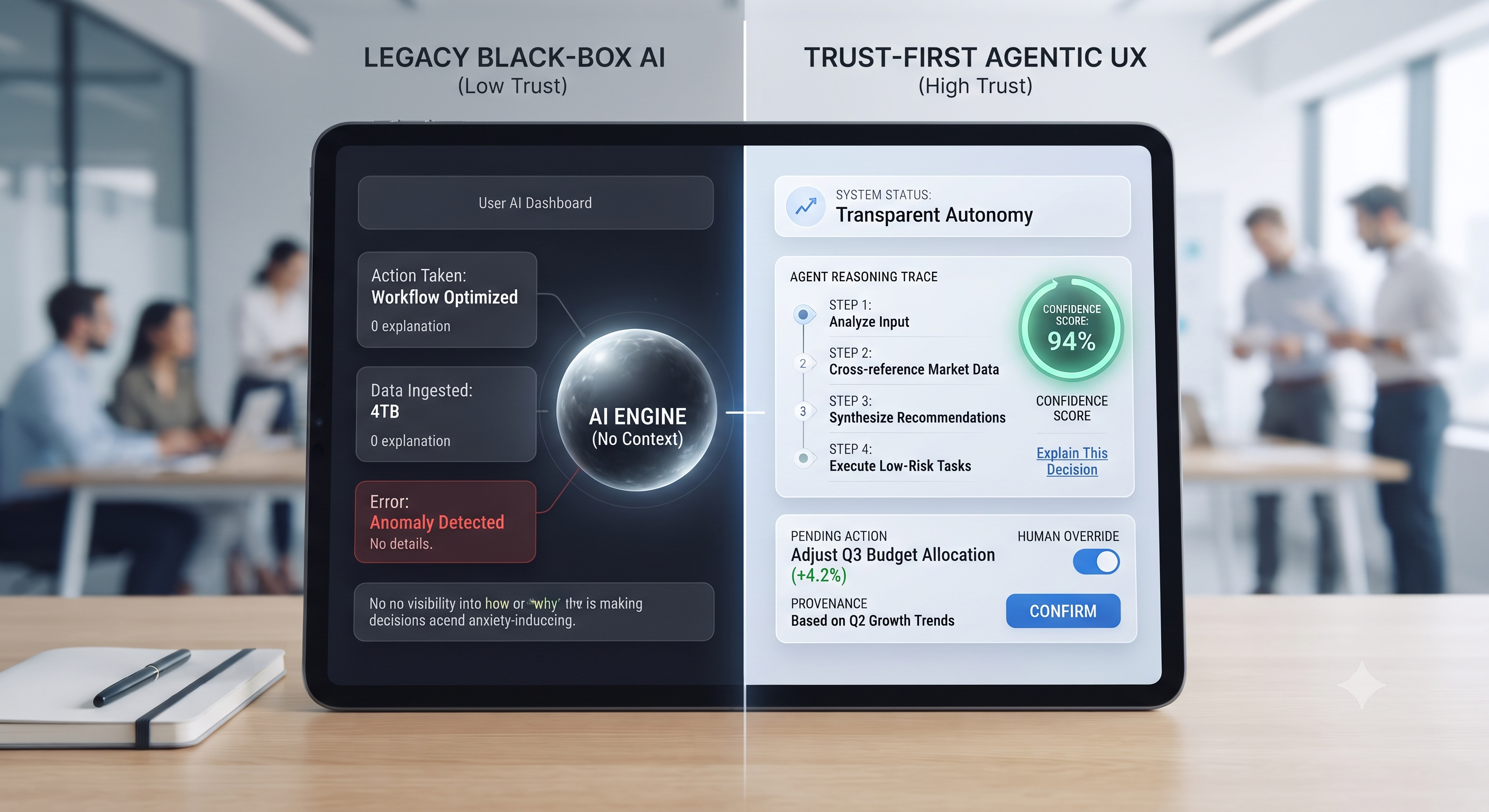
The Black Box Problem: If an automated workflow fails or takes an unexpected action without showing its work, user trust evaporates instantly. Regaining that confidence is nearly impossible.
Control vs. Autonomy: Over-automating without an intuitive escape hatch or "undo" mechanism leaves users feeling helpless and anxious rather than empowered.
The Translation Gap: Translating complex, probabilistic backend reasoning into clean, comprehensible UI micro-interactions is the defining UX challenge of 2026.
What You Can Learn: Frameworks for Trust-First UX
To design resilient, human-centered AI products, product teams are adopting three core design rules:
Show the Reasoning (Provenance): Design lightweight provenance layers—such as collapsible "thought process" drawers or inline badges—that explain why an AI agent made a specific recommendation.
Build Meaningful Guardrails: Never let an autonomous agent take irreversible actions without a clear, high-friction confirmation step paired with an immediate, one-click override.
Design for Graceful Failure: When an agent stalls or hallucinates, the interface must clearly communicate the limitation and provide an instant fallback path to human-driven workflows.
Discussion Question
How is your team balancing user autonomy with AI automation in your current product flows? Are you finding that users prefer total control or quiet background execution? Let’s design the future in the comments!
CTA (Join Product, UX & Design)
Want to swap frameworks on agentic UX, outcome-driven roadmaps, and modern product strategy? Join Product, UX & Design today to connect with global product leaders and designers
In modern product development, the shift toward autonomous and AI-driven interfaces means product managers and UX designers are no longer just designing layouts—they are designing probability distributions and decision systems.
When an AI agent makes decisions, modifies workflows, or fetches data autonomously before a user even asks, traditional usability metrics fail. Users don't just want speed; they demand provenance, control, and visibility.
Why This Matters
The Black Box Problem: If an automated workflow fails or takes an unexpected action without showing its work, user trust evaporates instantly. Regaining that confidence is nearly impossible.
Control vs. Autonomy: Over-automating without an intuitive escape hatch or "undo" mechanism leaves users feeling helpless and anxious rather than empowered.
The Translation Gap: Translating complex, probabilistic backend reasoning into clean, comprehensible UI micro-interactions is the defining UX challenge of 2026.
What You Can Learn: Frameworks for Trust-First UX
To design resilient, human-centered AI products, product teams are adopting three core design rules:
Show the Reasoning (Provenance): Design lightweight provenance layers—such as collapsible "thought process" drawers or inline badges—that explain why an AI agent made a specific recommendation.
Build Meaningful Guardrails: Never let an autonomous agent take irreversible actions without a clear, high-friction confirmation step paired with an immediate, one-click override.
Design for Graceful Failure: When an agent stalls or hallucinates, the interface must clearly communicate the limitation and provide an instant fallback path to human-driven workflows.
Discussion Question
How is your team balancing user autonomy with AI automation in your current product flows? Are you finding that users prefer total control or quiet background execution? Let’s design the future in the comments!
CTA (Join Product, UX & Design)
Want to swap frameworks on agentic UX, outcome-driven roadmaps, and modern product strategy? Join Product, UX & Design today to connect with global product leaders and designers
Designing for Trust: Why Explainability Is the New North Star in Agentic UX
In modern product development, the shift toward autonomous and AI-driven interfaces means product managers and UX designers are no longer just designing layouts—they are designing probability distributions and decision systems.
When an AI agent makes decisions, modifies workflows, or fetches data autonomously before a user even asks, traditional usability metrics fail. Users don't just want speed; they demand provenance, control, and visibility.
Why This Matters
The Black Box Problem: If an automated workflow fails or takes an unexpected action without showing its work, user trust evaporates instantly. Regaining that confidence is nearly impossible.
Control vs. Autonomy: Over-automating without an intuitive escape hatch or "undo" mechanism leaves users feeling helpless and anxious rather than empowered.
The Translation Gap: Translating complex, probabilistic backend reasoning into clean, comprehensible UI micro-interactions is the defining UX challenge of 2026.
What You Can Learn: Frameworks for Trust-First UX
To design resilient, human-centered AI products, product teams are adopting three core design rules:
Show the Reasoning (Provenance): Design lightweight provenance layers—such as collapsible "thought process" drawers or inline badges—that explain why an AI agent made a specific recommendation.
Build Meaningful Guardrails: Never let an autonomous agent take irreversible actions without a clear, high-friction confirmation step paired with an immediate, one-click override.
Design for Graceful Failure: When an agent stalls or hallucinates, the interface must clearly communicate the limitation and provide an instant fallback path to human-driven workflows.
Discussion Question
How is your team balancing user autonomy with AI automation in your current product flows? Are you finding that users prefer total control or quiet background execution? Let’s design the future in the comments!
CTA (Join Product, UX & Design)
Want to swap frameworks on agentic UX, outcome-driven roadmaps, and modern product strategy? Join Product, UX & Design today to connect with global product leaders and designers

 English
 Arabic
 French
 Spanish
 Portuguese
 Turkish
 Dutch
Dutch
 Italiano
 Russian
 Romaian
 Portuguese (Brazil)
 Greek
Greek