


Beyond Population Scale: Why India’s Shift to Sovereign AI and Compute Infrastructure Changes the Rules for Local Builders
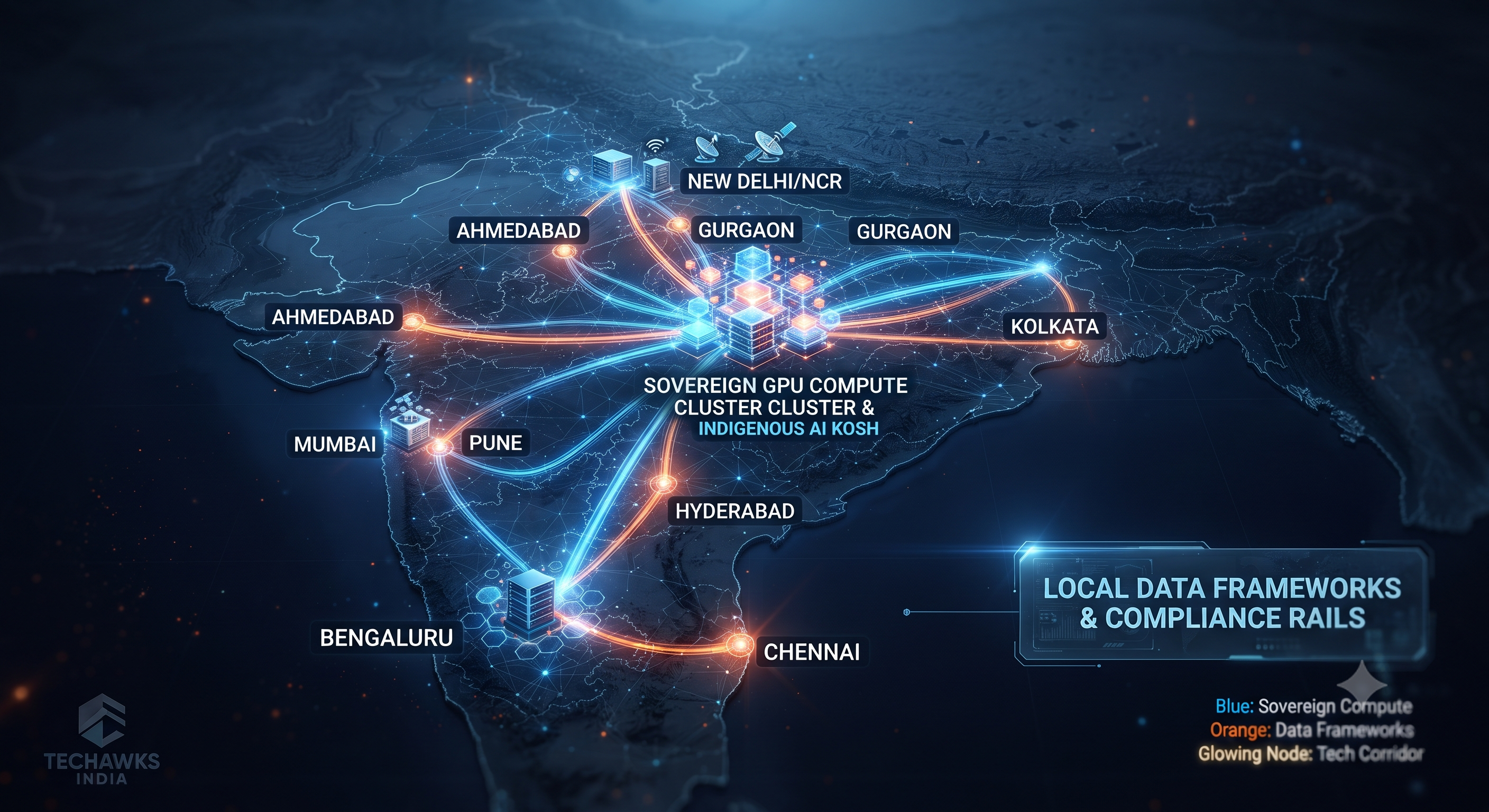
India’s tech landscape has reached a defining inflection point. With population-scale digital rails already mature, attention has shifted decisively toward deep tech infrastructure—ranging from multi-tenant GPU compute grids and indigenous foundation models to specialized regulatory frameworks for data localization.
For the Indian tech community—spanning Global Capability Centers (GCCs), bustling product startups in Tier-I and Tier-II tech hubs, and independent builders—this structural shift redefines how software is architected, tested, and scaled.
Why This Matters
Infrastructure Independence: Relying purely on foreign cloud black boxes and closed models introduces cost and regulatory bottlenecks. Sovereign infrastructure gives local builders direct access to indigenous AI Kosh datasets, specialized compute, and lower inference overheads.
Middle-Office Automation at Scale: Indian enterprises and GCCs are moving past flashy frontend AI demos, focusing instead on complex middle-office workflows where multi-agent systems can handle high-volume compliance, logistics, and localized service delivery.
The Rise of Tier-II/III Engineering: With digital talent and labs expanding beyond traditional metros, building resilient, low-latency applications that function smoothly across diverse connectivity networks is an engineering superpower.
What You Can Learn: Architecting for Sovereign & Distributed Scale
To align your projects with India's next technological chapter, focus on these core engineering shifts:
Design for Hybrid and Sovereign Constraints: Build your cloud and data pipelines keeping data sovereignty and compliance mandates baked into your core architecture from day one.
Optimize for Inference Economics: With inference costs dropping, structure your applications to leverage modular Small Language Models (SLMs) fine-tuned for regional contexts rather than burning budgets on monolithic external APIs.
Focus on Deterministic Guardrails: When deploying agentic workflows across complex enterprise environments, pair probabilistic models with rigid deterministic assertion checks to prevent silent automation failures.
Discussion Question
How is your team or startup leveraging local compute resources, open datasets, or sovereign cloud frameworks in India? Are you seeing a shift toward custom-built domain models over off-the-shelf APIs? Let's discuss below!
CTA (Join Techawks India)
Want to connect with India's sharpest engineers, founders, and tech builders navigating the future of AI, cloud, and digital infrastructure? Join Techawks India today to collaborate and grow your craft.
India’s tech landscape has reached a defining inflection point. With population-scale digital rails already mature, attention has shifted decisively toward deep tech infrastructure—ranging from multi-tenant GPU compute grids and indigenous foundation models to specialized regulatory frameworks for data localization.
For the Indian tech community—spanning Global Capability Centers (GCCs), bustling product startups in Tier-I and Tier-II tech hubs, and independent builders—this structural shift redefines how software is architected, tested, and scaled.
Why This Matters
Infrastructure Independence: Relying purely on foreign cloud black boxes and closed models introduces cost and regulatory bottlenecks. Sovereign infrastructure gives local builders direct access to indigenous AI Kosh datasets, specialized compute, and lower inference overheads.
Middle-Office Automation at Scale: Indian enterprises and GCCs are moving past flashy frontend AI demos, focusing instead on complex middle-office workflows where multi-agent systems can handle high-volume compliance, logistics, and localized service delivery.
The Rise of Tier-II/III Engineering: With digital talent and labs expanding beyond traditional metros, building resilient, low-latency applications that function smoothly across diverse connectivity networks is an engineering superpower.
What You Can Learn: Architecting for Sovereign & Distributed Scale
To align your projects with India's next technological chapter, focus on these core engineering shifts:
Design for Hybrid and Sovereign Constraints: Build your cloud and data pipelines keeping data sovereignty and compliance mandates baked into your core architecture from day one.
Optimize for Inference Economics: With inference costs dropping, structure your applications to leverage modular Small Language Models (SLMs) fine-tuned for regional contexts rather than burning budgets on monolithic external APIs.
Focus on Deterministic Guardrails: When deploying agentic workflows across complex enterprise environments, pair probabilistic models with rigid deterministic assertion checks to prevent silent automation failures.
Discussion Question
How is your team or startup leveraging local compute resources, open datasets, or sovereign cloud frameworks in India? Are you seeing a shift toward custom-built domain models over off-the-shelf APIs? Let's discuss below!
CTA (Join Techawks India)
Want to connect with India's sharpest engineers, founders, and tech builders navigating the future of AI, cloud, and digital infrastructure? Join Techawks India today to collaborate and grow your craft.
Beyond Population Scale: Why India’s Shift to Sovereign AI and Compute Infrastructure Changes the Rules for Local Builders
India’s tech landscape has reached a defining inflection point. With population-scale digital rails already mature, attention has shifted decisively toward deep tech infrastructure—ranging from multi-tenant GPU compute grids and indigenous foundation models to specialized regulatory frameworks for data localization.
For the Indian tech community—spanning Global Capability Centers (GCCs), bustling product startups in Tier-I and Tier-II tech hubs, and independent builders—this structural shift redefines how software is architected, tested, and scaled.
Why This Matters
Infrastructure Independence: Relying purely on foreign cloud black boxes and closed models introduces cost and regulatory bottlenecks. Sovereign infrastructure gives local builders direct access to indigenous AI Kosh datasets, specialized compute, and lower inference overheads.
Middle-Office Automation at Scale: Indian enterprises and GCCs are moving past flashy frontend AI demos, focusing instead on complex middle-office workflows where multi-agent systems can handle high-volume compliance, logistics, and localized service delivery.
The Rise of Tier-II/III Engineering: With digital talent and labs expanding beyond traditional metros, building resilient, low-latency applications that function smoothly across diverse connectivity networks is an engineering superpower.
What You Can Learn: Architecting for Sovereign & Distributed Scale
To align your projects with India's next technological chapter, focus on these core engineering shifts:
Design for Hybrid and Sovereign Constraints: Build your cloud and data pipelines keeping data sovereignty and compliance mandates baked into your core architecture from day one.
Optimize for Inference Economics: With inference costs dropping, structure your applications to leverage modular Small Language Models (SLMs) fine-tuned for regional contexts rather than burning budgets on monolithic external APIs.
Focus on Deterministic Guardrails: When deploying agentic workflows across complex enterprise environments, pair probabilistic models with rigid deterministic assertion checks to prevent silent automation failures.
Discussion Question
How is your team or startup leveraging local compute resources, open datasets, or sovereign cloud frameworks in India? Are you seeing a shift toward custom-built domain models over off-the-shelf APIs? Let's discuss below!
CTA (Join Techawks India)
Want to connect with India's sharpest engineers, founders, and tech builders navigating the future of AI, cloud, and digital infrastructure? Join Techawks India today to collaborate and grow your craft.

 English
 Arabic
 French
 Spanish
 Portuguese
 Deutsch
 Turkish
 Dutch
Dutch
 Russian
 Romaian
 Portuguese (Brazil)
 Greek
Greek