


From Silicon to Megawatt Campuses: Why the AI Infrastructure Bottleneck Has Changed the Game for US Tech
The US technology ecosystem is experiencing a massive systemic redesign. We are moving past the era of isolated model training experiments into full-scale enterprise integration.
As AI factories evolve into massive, unified computing nodes, hardware-software co-optimization is rewriting how engineers approach system design:
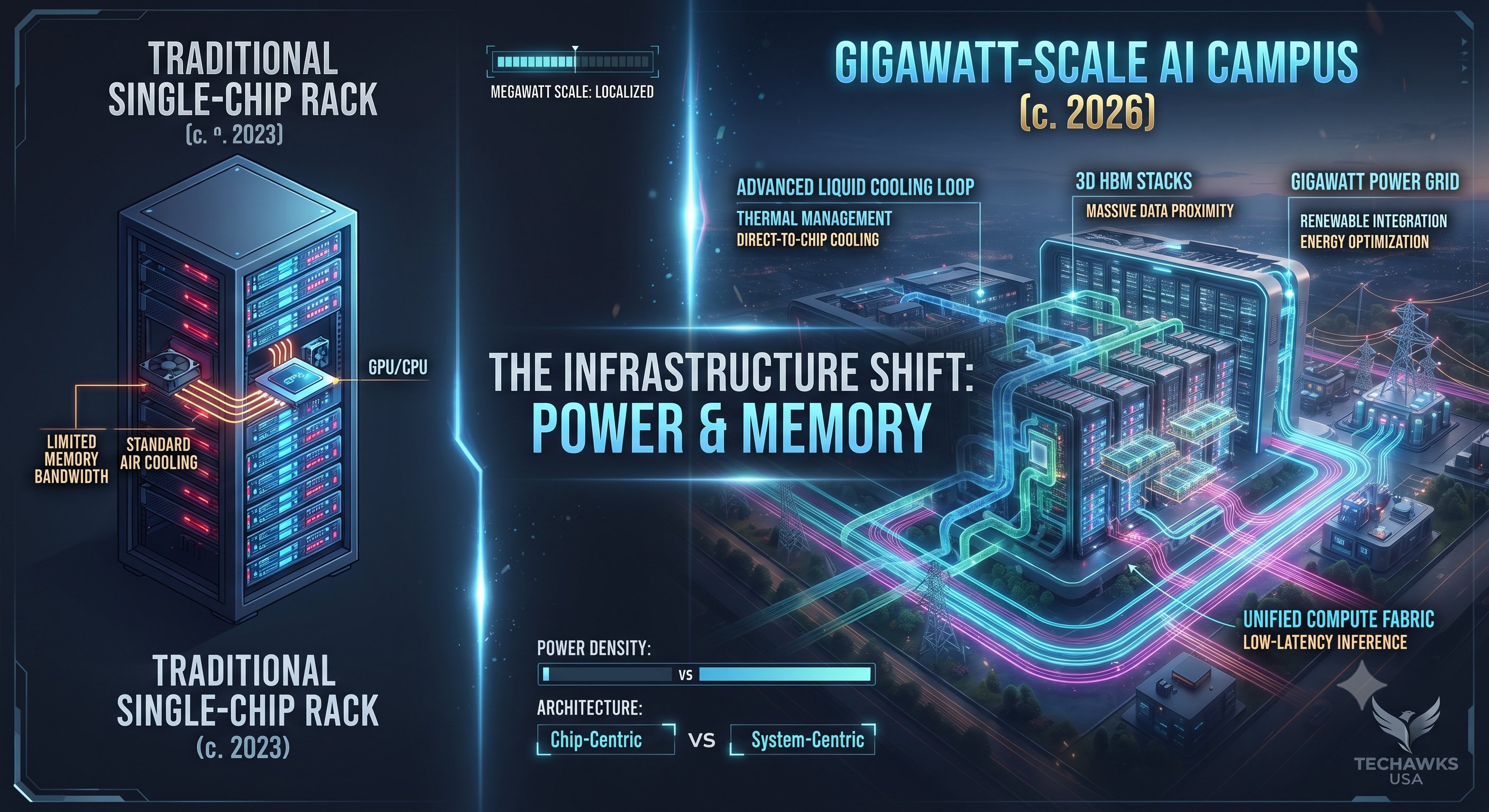
Memory Becomes the Design Center: Traditionally, compute systems were built first and memory was attached afterward. AI workloads have flipped this entirely; data movement and high-bandwidth memory (HBM) constraints now dictate core architecture.
The Power Wall: With data centers expanding toward gigawatt-scale campus requirements, energy efficiency, advanced thermal management, and 3D packaging are no longer just facility problems—they are software and hardware architecture problems.
From Model Training to Production Inference: The dominant enterprise cost driver has shifted from initial training to continuous, low-latency inference at scale.
What You Can Learn: Optimizing for System-Level Constraints
To build resilient applications in today's landscape, modern engineers must look beyond high-level code and understand the underlying hardware realities:
Design for Data Proximity: Minimize data movement across network boundaries to reduce both latency and energy overhead in production.
Embrace Hardware-Software Co-Design: Understand how your application logic interacts with memory limits and specialized accelerators (XPUs, GPUs, custom ASICs).
Factor Sustainability into Architecture: Optimize query frequency, payload sizes, and caching strategies to lower compute resource footprints.
Discussion Question
How is your team adapting to the shifting constraints of AI compute, memory, and energy costs? Are you seeing infrastructure limitations impact your deployment timelines? Let’s discuss below!
CTA (Join Techawks USA)
Want to connect with top engineers, architects, and leaders navigating the forefront of US technology and infrastructure? Join Techawks USA today to collaborate and stay ahead of the curve.
The US technology ecosystem is experiencing a massive systemic redesign. We are moving past the era of isolated model training experiments into full-scale enterprise integration.
As AI factories evolve into massive, unified computing nodes, hardware-software co-optimization is rewriting how engineers approach system design:
Memory Becomes the Design Center: Traditionally, compute systems were built first and memory was attached afterward. AI workloads have flipped this entirely; data movement and high-bandwidth memory (HBM) constraints now dictate core architecture.
The Power Wall: With data centers expanding toward gigawatt-scale campus requirements, energy efficiency, advanced thermal management, and 3D packaging are no longer just facility problems—they are software and hardware architecture problems.
From Model Training to Production Inference: The dominant enterprise cost driver has shifted from initial training to continuous, low-latency inference at scale.
What You Can Learn: Optimizing for System-Level Constraints
To build resilient applications in today's landscape, modern engineers must look beyond high-level code and understand the underlying hardware realities:
Design for Data Proximity: Minimize data movement across network boundaries to reduce both latency and energy overhead in production.
Embrace Hardware-Software Co-Design: Understand how your application logic interacts with memory limits and specialized accelerators (XPUs, GPUs, custom ASICs).
Factor Sustainability into Architecture: Optimize query frequency, payload sizes, and caching strategies to lower compute resource footprints.
Discussion Question
How is your team adapting to the shifting constraints of AI compute, memory, and energy costs? Are you seeing infrastructure limitations impact your deployment timelines? Let’s discuss below!
CTA (Join Techawks USA)
Want to connect with top engineers, architects, and leaders navigating the forefront of US technology and infrastructure? Join Techawks USA today to collaborate and stay ahead of the curve.
From Silicon to Megawatt Campuses: Why the AI Infrastructure Bottleneck Has Changed the Game for US Tech
The US technology ecosystem is experiencing a massive systemic redesign. We are moving past the era of isolated model training experiments into full-scale enterprise integration.
As AI factories evolve into massive, unified computing nodes, hardware-software co-optimization is rewriting how engineers approach system design:
Memory Becomes the Design Center: Traditionally, compute systems were built first and memory was attached afterward. AI workloads have flipped this entirely; data movement and high-bandwidth memory (HBM) constraints now dictate core architecture.
The Power Wall: With data centers expanding toward gigawatt-scale campus requirements, energy efficiency, advanced thermal management, and 3D packaging are no longer just facility problems—they are software and hardware architecture problems.
From Model Training to Production Inference: The dominant enterprise cost driver has shifted from initial training to continuous, low-latency inference at scale.
What You Can Learn: Optimizing for System-Level Constraints
To build resilient applications in today's landscape, modern engineers must look beyond high-level code and understand the underlying hardware realities:
Design for Data Proximity: Minimize data movement across network boundaries to reduce both latency and energy overhead in production.
Embrace Hardware-Software Co-Design: Understand how your application logic interacts with memory limits and specialized accelerators (XPUs, GPUs, custom ASICs).
Factor Sustainability into Architecture: Optimize query frequency, payload sizes, and caching strategies to lower compute resource footprints.
Discussion Question
How is your team adapting to the shifting constraints of AI compute, memory, and energy costs? Are you seeing infrastructure limitations impact your deployment timelines? Let’s discuss below!
CTA (Join Techawks USA)
Want to connect with top engineers, architects, and leaders navigating the forefront of US technology and infrastructure? Join Techawks USA today to collaborate and stay ahead of the curve.

 English
 Arabic
 French
 Spanish
 Portuguese
 Deutsch
 Turkish
 Dutch
Dutch
 Russian
 Romaian
 Portuguese (Brazil)
 Greek
Greek