


From Service Delivery to Product Engineering: Scaling India's Tech Ecosystem Through AI-Native Architecture
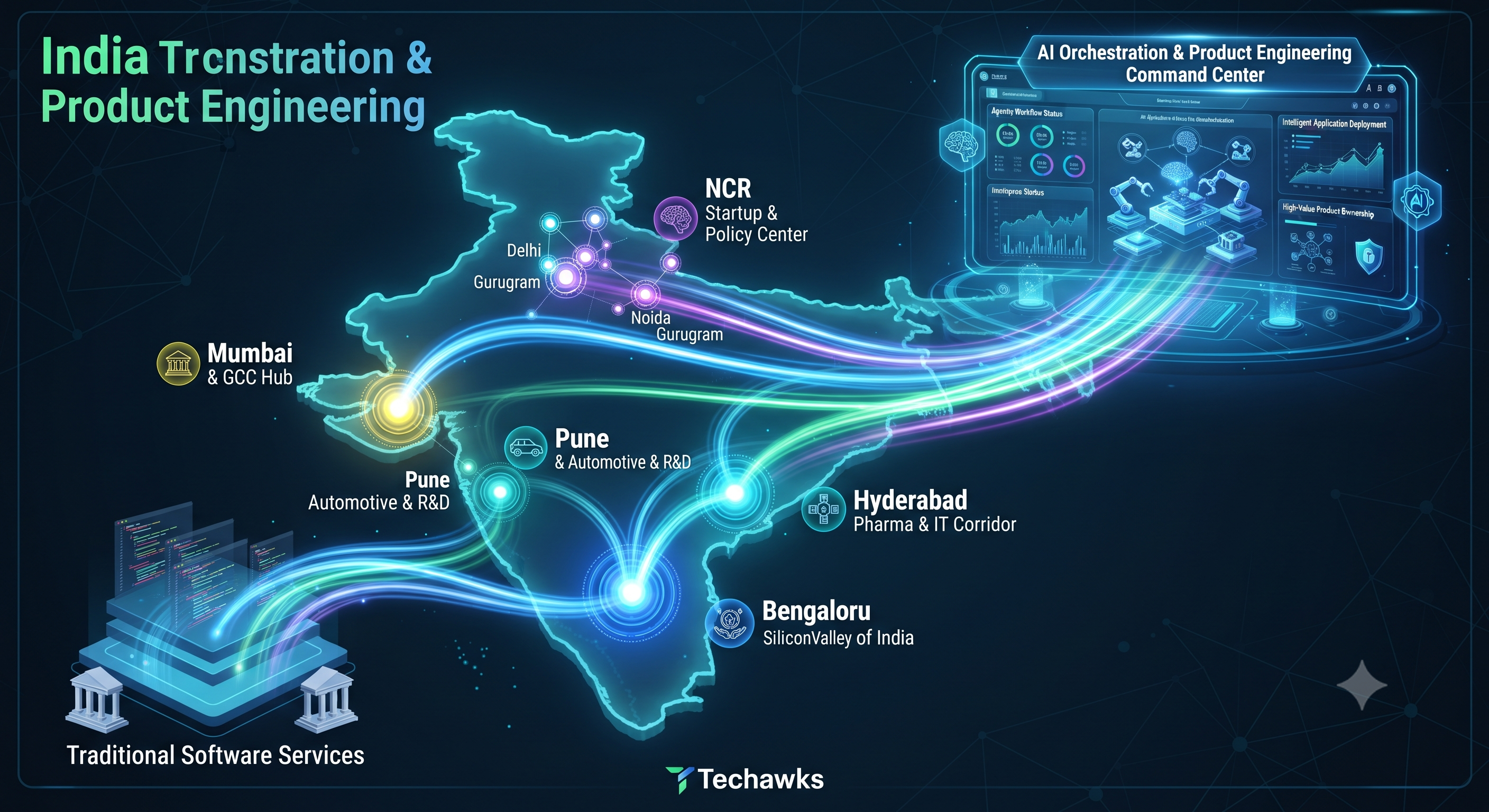
Across Bengaluru, Hyderabad, Pune, and major tech hubs across India, Global Capability Centers (GCCs) and product startups are experiencing a profound evolution. With enterprise funding concentrating heavily on scalable infrastructure and intelligent applications, the traditional advantage of raw coding volume is giving way to architectural ownership and system orchestration.
As autonomous coding tools and agentic workflows handle routine code generation, engineering teams across India are uniquely positioned to transition from executing repetitive software tasks to building deep, proprietary enterprise intelligence.
Why This Matters
When the cost of writing syntax drops to near zero, competitive advantage shifts entirely to problem framing, security governance, and domain-specific execution. For Indian developers, architects, and tech leaders, mastering AI-native systems and robust data foundations is the key to capturing high-value product ownership rather than competing on commodity development cycles.
Mini-Tutorial: Transitioning Your Engineering Workflow to AI-Native Product Thinking
Elevate your technical impact and build more resilient applications by adopting these three strategies:
Step 1: Target Middle-Office Workflow Gaps. Instead of trying to automate entire front-office or generic processes, focus on complex middle-office workflows where deterministic code handles standard logic and AI agents bridge human judgment gaps safely.
Step 2: Factor Maintenance Into Build-vs-Buy Equations. When evaluating whether to build custom internal solutions using AI-assisted tools, explicitly budget for long-term maintenance, security patching, and automated testing overhead rather than just initial code generation speed.
Step 3: Enforce Strict Security and Guardrails. Protect your enterprise deployments by pairing autonomous agents with rigorous human-in-the-loop (HITL) approval gates and least-privilege API boundaries.
Discussion Question
How is your team or GCC balancing traditional service delivery with the push toward building custom AI-native products? Let’s discuss below! 👇
CTA (Join Techawks India)
Ready to connect with top engineers, leaders, and innovators driving India's tech future? Join Techawks India today to collaborate, share insights, and scale your career together!
Across Bengaluru, Hyderabad, Pune, and major tech hubs across India, Global Capability Centers (GCCs) and product startups are experiencing a profound evolution. With enterprise funding concentrating heavily on scalable infrastructure and intelligent applications, the traditional advantage of raw coding volume is giving way to architectural ownership and system orchestration.
As autonomous coding tools and agentic workflows handle routine code generation, engineering teams across India are uniquely positioned to transition from executing repetitive software tasks to building deep, proprietary enterprise intelligence.
Why This Matters
When the cost of writing syntax drops to near zero, competitive advantage shifts entirely to problem framing, security governance, and domain-specific execution. For Indian developers, architects, and tech leaders, mastering AI-native systems and robust data foundations is the key to capturing high-value product ownership rather than competing on commodity development cycles.
Mini-Tutorial: Transitioning Your Engineering Workflow to AI-Native Product Thinking
Elevate your technical impact and build more resilient applications by adopting these three strategies:
Step 1: Target Middle-Office Workflow Gaps. Instead of trying to automate entire front-office or generic processes, focus on complex middle-office workflows where deterministic code handles standard logic and AI agents bridge human judgment gaps safely.
Step 2: Factor Maintenance Into Build-vs-Buy Equations. When evaluating whether to build custom internal solutions using AI-assisted tools, explicitly budget for long-term maintenance, security patching, and automated testing overhead rather than just initial code generation speed.
Step 3: Enforce Strict Security and Guardrails. Protect your enterprise deployments by pairing autonomous agents with rigorous human-in-the-loop (HITL) approval gates and least-privilege API boundaries.
Discussion Question
How is your team or GCC balancing traditional service delivery with the push toward building custom AI-native products? Let’s discuss below! 👇
CTA (Join Techawks India)
Ready to connect with top engineers, leaders, and innovators driving India's tech future? Join Techawks India today to collaborate, share insights, and scale your career together!
From Service Delivery to Product Engineering: Scaling India's Tech Ecosystem Through AI-Native Architecture
Across Bengaluru, Hyderabad, Pune, and major tech hubs across India, Global Capability Centers (GCCs) and product startups are experiencing a profound evolution. With enterprise funding concentrating heavily on scalable infrastructure and intelligent applications, the traditional advantage of raw coding volume is giving way to architectural ownership and system orchestration.
As autonomous coding tools and agentic workflows handle routine code generation, engineering teams across India are uniquely positioned to transition from executing repetitive software tasks to building deep, proprietary enterprise intelligence.
Why This Matters
When the cost of writing syntax drops to near zero, competitive advantage shifts entirely to problem framing, security governance, and domain-specific execution. For Indian developers, architects, and tech leaders, mastering AI-native systems and robust data foundations is the key to capturing high-value product ownership rather than competing on commodity development cycles.
Mini-Tutorial: Transitioning Your Engineering Workflow to AI-Native Product Thinking
Elevate your technical impact and build more resilient applications by adopting these three strategies:
Step 1: Target Middle-Office Workflow Gaps. Instead of trying to automate entire front-office or generic processes, focus on complex middle-office workflows where deterministic code handles standard logic and AI agents bridge human judgment gaps safely.
Step 2: Factor Maintenance Into Build-vs-Buy Equations. When evaluating whether to build custom internal solutions using AI-assisted tools, explicitly budget for long-term maintenance, security patching, and automated testing overhead rather than just initial code generation speed.
Step 3: Enforce Strict Security and Guardrails. Protect your enterprise deployments by pairing autonomous agents with rigorous human-in-the-loop (HITL) approval gates and least-privilege API boundaries.
Discussion Question
How is your team or GCC balancing traditional service delivery with the push toward building custom AI-native products? Let’s discuss below! 👇
CTA (Join Techawks India)
Ready to connect with top engineers, leaders, and innovators driving India's tech future? Join Techawks India today to collaborate, share insights, and scale your career together!

 English
 Arabic
 French
 Spanish
 Portuguese
 Deutsch
 Turkish
 Dutch
Dutch
 Russian
 Romaian
 Portuguese (Brazil)
 Greek
Greek