


From Proof-of-Concept to Production: Governing the Enterprise AI Agentic Era
As US enterprises accelerate their shift from simple AI experimentation to large-scale agentic deployments, a critical operational reality is taking center stage: autonomous agents are only as reliable as their governance harness.
Industry surveys from major advisory and research groups reveal that while nearly 90% of organizations regularly utilize AI in various business functions, turning that adoption into sustainable financial and operational return remains a major challenge. The friction no longer stems from model capability; it comes from disconnected data foundations, lack of architectural context, and security blind spots. When autonomous agents are granted the power to execute multi-step workflows across cloud environments, databases, and APIs, naive prompt execution creates unacceptable security risks.
Why This Matters
To cross the chasm from experimental pilot to core enterprise infrastructure, tech organizations must implement robust oversight layers. Security and engineering leaders are discovering that an effective AI harness requires treating autonomy not as a single model call, but as a heavily governed, multi-layered system with strict operational boundaries.
Mini-Tutorial: Implementing an Enterprise AI Governance Harness
Strengthen your production AI deployment and eliminate silent agent failures by establishing these three architectural controls:
Step 1: Build a Context-Rich Semantic Data Layer. Ensure your agents query clean, structured, and version-controlled data models rather than messy, fragmented legacy tables that trigger hallucinations and inconsistent logic.
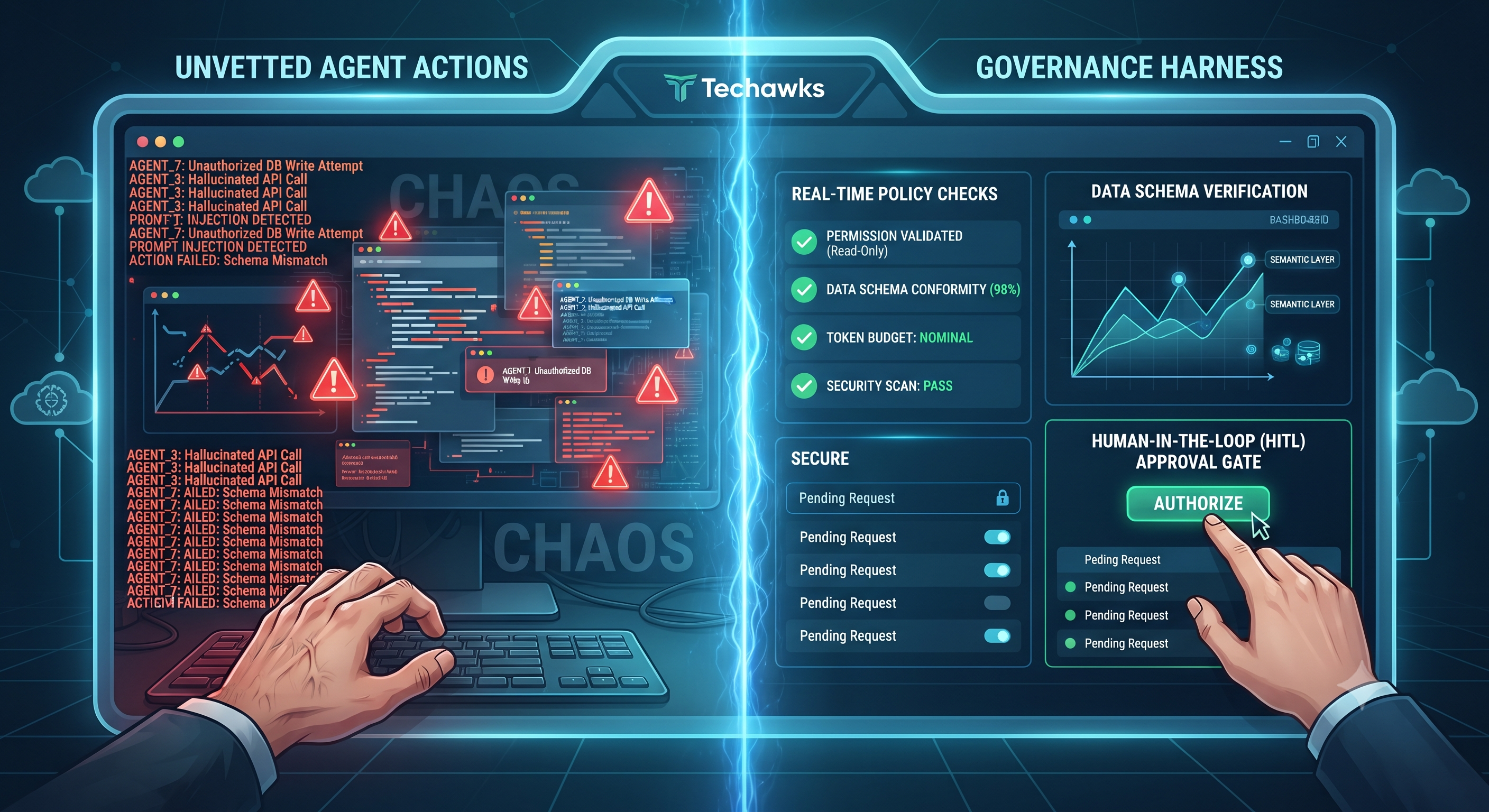
Step 2: Deploy Multi-Layer AI Guardrails. Integrate runtime security harnesses (such as policy engines and token-budget constraints) that actively intercept agent outputs, validate permissions, and block unauthorized data access or external transmissions.
Step 3: Mandate Human-in-the-Loop (HITL) Authorizations. Program explicit approval gates for high-impact actions—such as financial transactions, database writes, or production code deployments—so human operators maintain final operational control.
Discussion Question
How is your organization balancing the push for rapid agentic automation with enterprise security and governance requirements? Let’s talk strategy below! 👇
CTA (Join Techawks USA)
Ready to connect with top US tech leaders, engineers, and innovators navigating the frontier of enterprise AI? Join Techawks USA today to share architecture playbooks, scale your systems, and lead the future of technology!
As US enterprises accelerate their shift from simple AI experimentation to large-scale agentic deployments, a critical operational reality is taking center stage: autonomous agents are only as reliable as their governance harness.
Industry surveys from major advisory and research groups reveal that while nearly 90% of organizations regularly utilize AI in various business functions, turning that adoption into sustainable financial and operational return remains a major challenge. The friction no longer stems from model capability; it comes from disconnected data foundations, lack of architectural context, and security blind spots. When autonomous agents are granted the power to execute multi-step workflows across cloud environments, databases, and APIs, naive prompt execution creates unacceptable security risks.
Why This Matters
To cross the chasm from experimental pilot to core enterprise infrastructure, tech organizations must implement robust oversight layers. Security and engineering leaders are discovering that an effective AI harness requires treating autonomy not as a single model call, but as a heavily governed, multi-layered system with strict operational boundaries.
Mini-Tutorial: Implementing an Enterprise AI Governance Harness
Strengthen your production AI deployment and eliminate silent agent failures by establishing these three architectural controls:
Step 1: Build a Context-Rich Semantic Data Layer. Ensure your agents query clean, structured, and version-controlled data models rather than messy, fragmented legacy tables that trigger hallucinations and inconsistent logic.
Step 2: Deploy Multi-Layer AI Guardrails. Integrate runtime security harnesses (such as policy engines and token-budget constraints) that actively intercept agent outputs, validate permissions, and block unauthorized data access or external transmissions.
Step 3: Mandate Human-in-the-Loop (HITL) Authorizations. Program explicit approval gates for high-impact actions—such as financial transactions, database writes, or production code deployments—so human operators maintain final operational control.
Discussion Question
How is your organization balancing the push for rapid agentic automation with enterprise security and governance requirements? Let’s talk strategy below! 👇
CTA (Join Techawks USA)
Ready to connect with top US tech leaders, engineers, and innovators navigating the frontier of enterprise AI? Join Techawks USA today to share architecture playbooks, scale your systems, and lead the future of technology!
From Proof-of-Concept to Production: Governing the Enterprise AI Agentic Era
As US enterprises accelerate their shift from simple AI experimentation to large-scale agentic deployments, a critical operational reality is taking center stage: autonomous agents are only as reliable as their governance harness.
Industry surveys from major advisory and research groups reveal that while nearly 90% of organizations regularly utilize AI in various business functions, turning that adoption into sustainable financial and operational return remains a major challenge. The friction no longer stems from model capability; it comes from disconnected data foundations, lack of architectural context, and security blind spots. When autonomous agents are granted the power to execute multi-step workflows across cloud environments, databases, and APIs, naive prompt execution creates unacceptable security risks.
Why This Matters
To cross the chasm from experimental pilot to core enterprise infrastructure, tech organizations must implement robust oversight layers. Security and engineering leaders are discovering that an effective AI harness requires treating autonomy not as a single model call, but as a heavily governed, multi-layered system with strict operational boundaries.
Mini-Tutorial: Implementing an Enterprise AI Governance Harness
Strengthen your production AI deployment and eliminate silent agent failures by establishing these three architectural controls:
Step 1: Build a Context-Rich Semantic Data Layer. Ensure your agents query clean, structured, and version-controlled data models rather than messy, fragmented legacy tables that trigger hallucinations and inconsistent logic.
Step 2: Deploy Multi-Layer AI Guardrails. Integrate runtime security harnesses (such as policy engines and token-budget constraints) that actively intercept agent outputs, validate permissions, and block unauthorized data access or external transmissions.
Step 3: Mandate Human-in-the-Loop (HITL) Authorizations. Program explicit approval gates for high-impact actions—such as financial transactions, database writes, or production code deployments—so human operators maintain final operational control.
Discussion Question
How is your organization balancing the push for rapid agentic automation with enterprise security and governance requirements? Let’s talk strategy below! 👇
CTA (Join Techawks USA)
Ready to connect with top US tech leaders, engineers, and innovators navigating the frontier of enterprise AI? Join Techawks USA today to share architecture playbooks, scale your systems, and lead the future of technology!

 English
 Arabic
 French
 Spanish
 Portuguese
 Deutsch
 Turkish
 Dutch
Dutch
 Italiano
 Russian
 Portuguese (Brazil)
 Greek
Greek