


From Digital Government Pioneers to Autonomous Hubs: Scaling Smart City Architecture in the UAE
Across the Emirates, the tech landscape is moving at an unprecedented velocity. Backed by forward-thinking initiatives like the National AI Strategy, Abu Dhabi’s AI frameworks, and Dubai’s D33 economic agenda, local enterprises, free zones (like DIFC, ADGM, and Dubai Silicon Oasis), and government entities are deploying AI at scale.
Whether it's autonomous logistics in industrial corridors, predictive smart grid management in Masdar City, or real-time AI public services, the technical challenge has shifted. Traditional cloud architectures and basic script automation are no longer enough to support multi-agent ecosystems operating across ultra-low-latency 5G networks.
Why This Matters
When smart city infrastructure relies on real-time data from thousands of IoT sensors and autonomous control nodes, software engineering must be built for resilience and security. To maintain the UAE's position as a global digital leader, tech builders must design systems that combine high-performance edge computing with strict data governance and regulatory compliance.
Mini-Tutorial: Building an Edge-Ready, Compliant Smart City Pipeline
Optimize your regional applications for the UAE’s high-performance digital infrastructure with these three architectural steps:
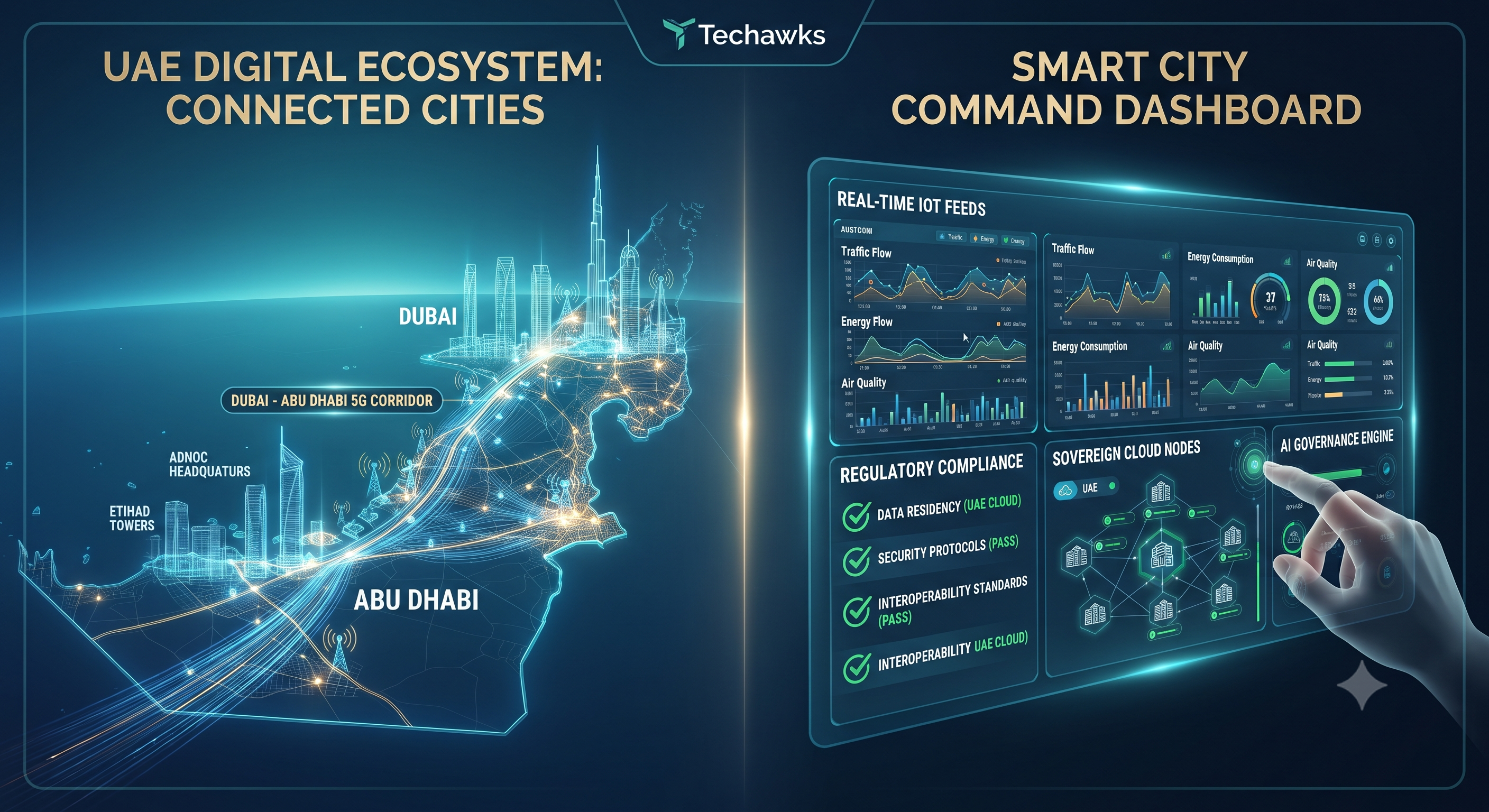
Step 1: Leverage Local Edge Computing & Sovereign Cloud. Route latency-sensitive data processing (such as IoT telemetry or video feeds) through local micro-servers and sovereign cloud nodes in Dubai and Abu Dhabi to eliminate cross-border lag and comply with data residency standards.
Step 2: Implement Proactive Regulatory Sandboxing. Design your AI pipelines to easily integrate with regulatory testing environments (such as Sandbox Dubai or ADGM sandboxes), allowing you to test autonomous models under real-world conditions with built-in audit logs.
Step 3: Design for Multi-Modal Interoperability. Ensure your APIs accept structured, clean payloads that can interface smoothly with government digital wallets, automated verification portals, and municipal data layers.
Discussion Question
How is your team utilizing the UAE's advanced digital infrastructure and sandbox environments to test and scale your latest AI applications? Let’s share local insights below! 👇
CTA (Join Techawks UAE)
Ready to connect with top engineers, founders, and innovators driving the UAE's digital economy? Join Techawks UAE today to collaborate, share regional architecture playbooks, and build the future together!
Across the Emirates, the tech landscape is moving at an unprecedented velocity. Backed by forward-thinking initiatives like the National AI Strategy, Abu Dhabi’s AI frameworks, and Dubai’s D33 economic agenda, local enterprises, free zones (like DIFC, ADGM, and Dubai Silicon Oasis), and government entities are deploying AI at scale.
Whether it's autonomous logistics in industrial corridors, predictive smart grid management in Masdar City, or real-time AI public services, the technical challenge has shifted. Traditional cloud architectures and basic script automation are no longer enough to support multi-agent ecosystems operating across ultra-low-latency 5G networks.
Why This Matters
When smart city infrastructure relies on real-time data from thousands of IoT sensors and autonomous control nodes, software engineering must be built for resilience and security. To maintain the UAE's position as a global digital leader, tech builders must design systems that combine high-performance edge computing with strict data governance and regulatory compliance.
Mini-Tutorial: Building an Edge-Ready, Compliant Smart City Pipeline
Optimize your regional applications for the UAE’s high-performance digital infrastructure with these three architectural steps:
Step 1: Leverage Local Edge Computing & Sovereign Cloud. Route latency-sensitive data processing (such as IoT telemetry or video feeds) through local micro-servers and sovereign cloud nodes in Dubai and Abu Dhabi to eliminate cross-border lag and comply with data residency standards.
Step 2: Implement Proactive Regulatory Sandboxing. Design your AI pipelines to easily integrate with regulatory testing environments (such as Sandbox Dubai or ADGM sandboxes), allowing you to test autonomous models under real-world conditions with built-in audit logs.
Step 3: Design for Multi-Modal Interoperability. Ensure your APIs accept structured, clean payloads that can interface smoothly with government digital wallets, automated verification portals, and municipal data layers.
Discussion Question
How is your team utilizing the UAE's advanced digital infrastructure and sandbox environments to test and scale your latest AI applications? Let’s share local insights below! 👇
CTA (Join Techawks UAE)
Ready to connect with top engineers, founders, and innovators driving the UAE's digital economy? Join Techawks UAE today to collaborate, share regional architecture playbooks, and build the future together!
From Digital Government Pioneers to Autonomous Hubs: Scaling Smart City Architecture in the UAE
Across the Emirates, the tech landscape is moving at an unprecedented velocity. Backed by forward-thinking initiatives like the National AI Strategy, Abu Dhabi’s AI frameworks, and Dubai’s D33 economic agenda, local enterprises, free zones (like DIFC, ADGM, and Dubai Silicon Oasis), and government entities are deploying AI at scale.
Whether it's autonomous logistics in industrial corridors, predictive smart grid management in Masdar City, or real-time AI public services, the technical challenge has shifted. Traditional cloud architectures and basic script automation are no longer enough to support multi-agent ecosystems operating across ultra-low-latency 5G networks.
Why This Matters
When smart city infrastructure relies on real-time data from thousands of IoT sensors and autonomous control nodes, software engineering must be built for resilience and security. To maintain the UAE's position as a global digital leader, tech builders must design systems that combine high-performance edge computing with strict data governance and regulatory compliance.
Mini-Tutorial: Building an Edge-Ready, Compliant Smart City Pipeline
Optimize your regional applications for the UAE’s high-performance digital infrastructure with these three architectural steps:
Step 1: Leverage Local Edge Computing & Sovereign Cloud. Route latency-sensitive data processing (such as IoT telemetry or video feeds) through local micro-servers and sovereign cloud nodes in Dubai and Abu Dhabi to eliminate cross-border lag and comply with data residency standards.
Step 2: Implement Proactive Regulatory Sandboxing. Design your AI pipelines to easily integrate with regulatory testing environments (such as Sandbox Dubai or ADGM sandboxes), allowing you to test autonomous models under real-world conditions with built-in audit logs.
Step 3: Design for Multi-Modal Interoperability. Ensure your APIs accept structured, clean payloads that can interface smoothly with government digital wallets, automated verification portals, and municipal data layers.
Discussion Question
How is your team utilizing the UAE's advanced digital infrastructure and sandbox environments to test and scale your latest AI applications? Let’s share local insights below! 👇
CTA (Join Techawks UAE)
Ready to connect with top engineers, founders, and innovators driving the UAE's digital economy? Join Techawks UAE today to collaborate, share regional architecture playbooks, and build the future together!

 English
 Arabic
 French
 Spanish
 Portuguese
 Deutsch
 Turkish
 Dutch
Dutch
 Italiano
 Russian
 Portuguese (Brazil)
 Greek
Greek