


From Silicon North to Autonomous Scale: Building Resilient AI Infrastructure in Canada
Canada's tech community has established global leadership in artificial intelligence research, talent development, and thriving startup hubs. However, as organizations across the country integrate autonomous AI agents and complex data pipelines into their core operations, a major architectural challenge is taking center stage: infrastructure resilience and data governance.
When autonomous systems execute multi-step workflows across cloud environments, basic script automation and unvetted prompt pipelines create significant operational vulnerabilities. Canadian tech leaders are discovering that scaling AI successfully requires treating autonomy not as a standalone feature, but as a heavily governed, multi-layered system.
Why This Matters
To maintain Canada's competitive edge in the global tech economy, engineering teams must bridge the gap between brilliant algorithmic research and robust production infrastructure. Without strict governance harnesses, automated guardrails, and clean data foundations, scaling agentic workflows leads to silent system failures and compliance friction.
Mini-Tutorial: Implementing a Resilient AI Engineering Framework
Elevate your technical deployments and ensure production-grade reliability with these three architectural practices:
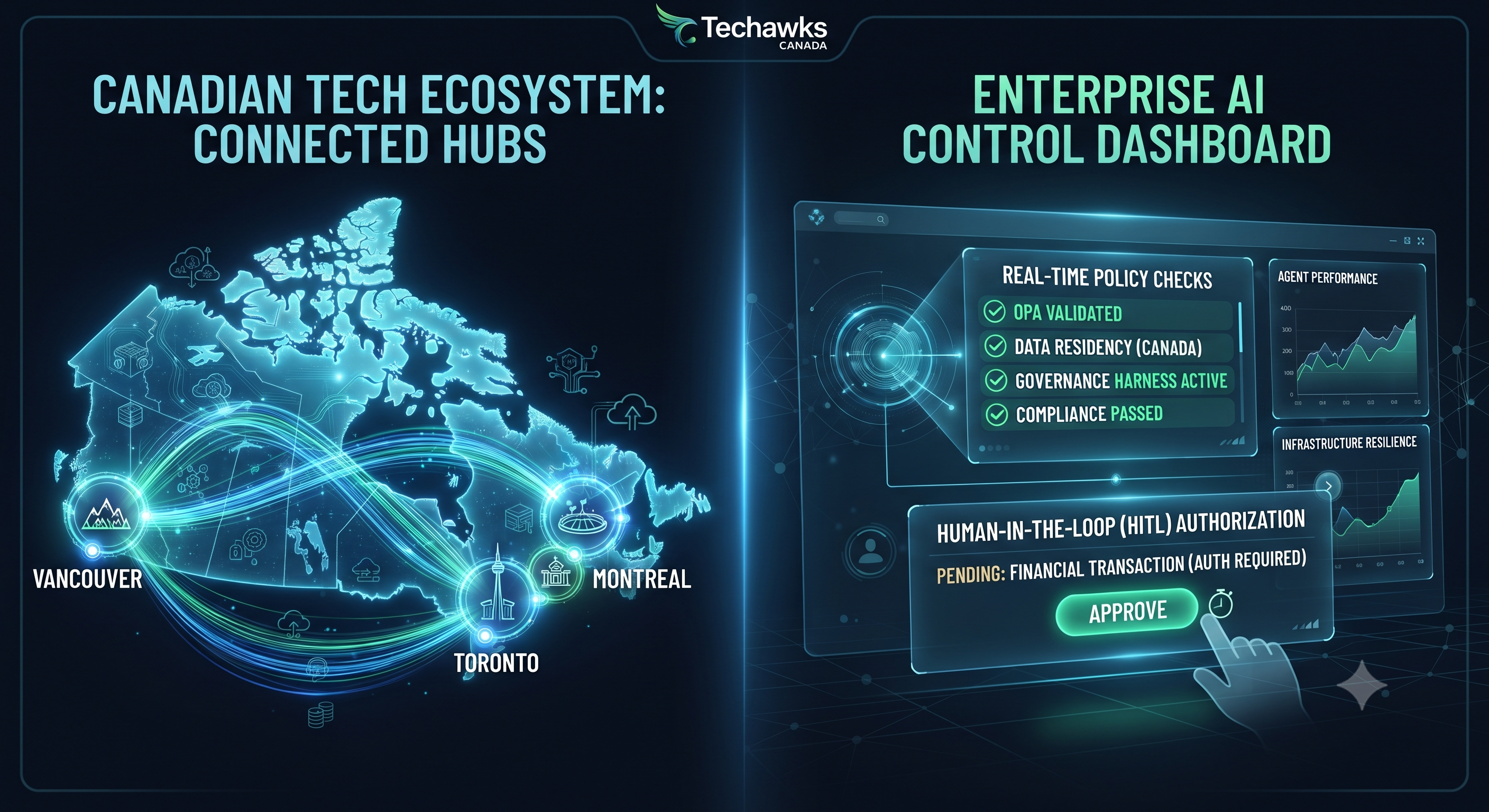
Step 1: Centralize on Sovereign Cloud and Regional Data Layers. Route sensitive data processing through secure, localized Canadian data centers to meet strict privacy expectations and data residency standards.
Step 2: Build Automated Policy-as-Code Guardrails. Integrate runtime security checks into your CI/CD pipelines using tools like Open Policy Agent (OPA) to intercept unvetted AI outputs before they impact production environments.
Step 3: Enforce Human-in-the-Loop (HITL) Authorizations. Program explicit approval gates for high-risk operations—such as financial transactions or database updates—ensuring human operators maintain ultimate operational control.
Discussion Question
How is your team balancing the rapid push for autonomous AI workflows with data governance and cloud infrastructure reliability? Let’s share engineering strategies below! 👇
CTA (Join Techawks Canada)
Ready to connect with top Canadian tech leaders, engineers, and innovators driving the digital economy? Join Techawks Canada today to share architecture playbooks, collaborate locally, and lead the future of technology!
Canada's tech community has established global leadership in artificial intelligence research, talent development, and thriving startup hubs. However, as organizations across the country integrate autonomous AI agents and complex data pipelines into their core operations, a major architectural challenge is taking center stage: infrastructure resilience and data governance.
When autonomous systems execute multi-step workflows across cloud environments, basic script automation and unvetted prompt pipelines create significant operational vulnerabilities. Canadian tech leaders are discovering that scaling AI successfully requires treating autonomy not as a standalone feature, but as a heavily governed, multi-layered system.
Why This Matters
To maintain Canada's competitive edge in the global tech economy, engineering teams must bridge the gap between brilliant algorithmic research and robust production infrastructure. Without strict governance harnesses, automated guardrails, and clean data foundations, scaling agentic workflows leads to silent system failures and compliance friction.
Mini-Tutorial: Implementing a Resilient AI Engineering Framework
Elevate your technical deployments and ensure production-grade reliability with these three architectural practices:
Step 1: Centralize on Sovereign Cloud and Regional Data Layers. Route sensitive data processing through secure, localized Canadian data centers to meet strict privacy expectations and data residency standards.
Step 2: Build Automated Policy-as-Code Guardrails. Integrate runtime security checks into your CI/CD pipelines using tools like Open Policy Agent (OPA) to intercept unvetted AI outputs before they impact production environments.
Step 3: Enforce Human-in-the-Loop (HITL) Authorizations. Program explicit approval gates for high-risk operations—such as financial transactions or database updates—ensuring human operators maintain ultimate operational control.
Discussion Question
How is your team balancing the rapid push for autonomous AI workflows with data governance and cloud infrastructure reliability? Let’s share engineering strategies below! 👇
CTA (Join Techawks Canada)
Ready to connect with top Canadian tech leaders, engineers, and innovators driving the digital economy? Join Techawks Canada today to share architecture playbooks, collaborate locally, and lead the future of technology!
From Silicon North to Autonomous Scale: Building Resilient AI Infrastructure in Canada
Canada's tech community has established global leadership in artificial intelligence research, talent development, and thriving startup hubs. However, as organizations across the country integrate autonomous AI agents and complex data pipelines into their core operations, a major architectural challenge is taking center stage: infrastructure resilience and data governance.
When autonomous systems execute multi-step workflows across cloud environments, basic script automation and unvetted prompt pipelines create significant operational vulnerabilities. Canadian tech leaders are discovering that scaling AI successfully requires treating autonomy not as a standalone feature, but as a heavily governed, multi-layered system.
Why This Matters
To maintain Canada's competitive edge in the global tech economy, engineering teams must bridge the gap between brilliant algorithmic research and robust production infrastructure. Without strict governance harnesses, automated guardrails, and clean data foundations, scaling agentic workflows leads to silent system failures and compliance friction.
Mini-Tutorial: Implementing a Resilient AI Engineering Framework
Elevate your technical deployments and ensure production-grade reliability with these three architectural practices:
Step 1: Centralize on Sovereign Cloud and Regional Data Layers. Route sensitive data processing through secure, localized Canadian data centers to meet strict privacy expectations and data residency standards.
Step 2: Build Automated Policy-as-Code Guardrails. Integrate runtime security checks into your CI/CD pipelines using tools like Open Policy Agent (OPA) to intercept unvetted AI outputs before they impact production environments.
Step 3: Enforce Human-in-the-Loop (HITL) Authorizations. Program explicit approval gates for high-risk operations—such as financial transactions or database updates—ensuring human operators maintain ultimate operational control.
Discussion Question
How is your team balancing the rapid push for autonomous AI workflows with data governance and cloud infrastructure reliability? Let’s share engineering strategies below! 👇
CTA (Join Techawks Canada)
Ready to connect with top Canadian tech leaders, engineers, and innovators driving the digital economy? Join Techawks Canada today to share architecture playbooks, collaborate locally, and lead the future of technology!

 Arabic
 French
 Spanish
 Portuguese
 Deutsch
 Turkish
 Dutch
Dutch
 Italiano
 Russian
 Romaian
 Portuguese (Brazil)
 Greek
Greek