


The AI Engineer’s Roadmap: Moving from API Consumer to System Architect
The barrier to entry for building with AI has never been lower, but the bar for building reliable, enterprise-ready AI applications keeps rising.
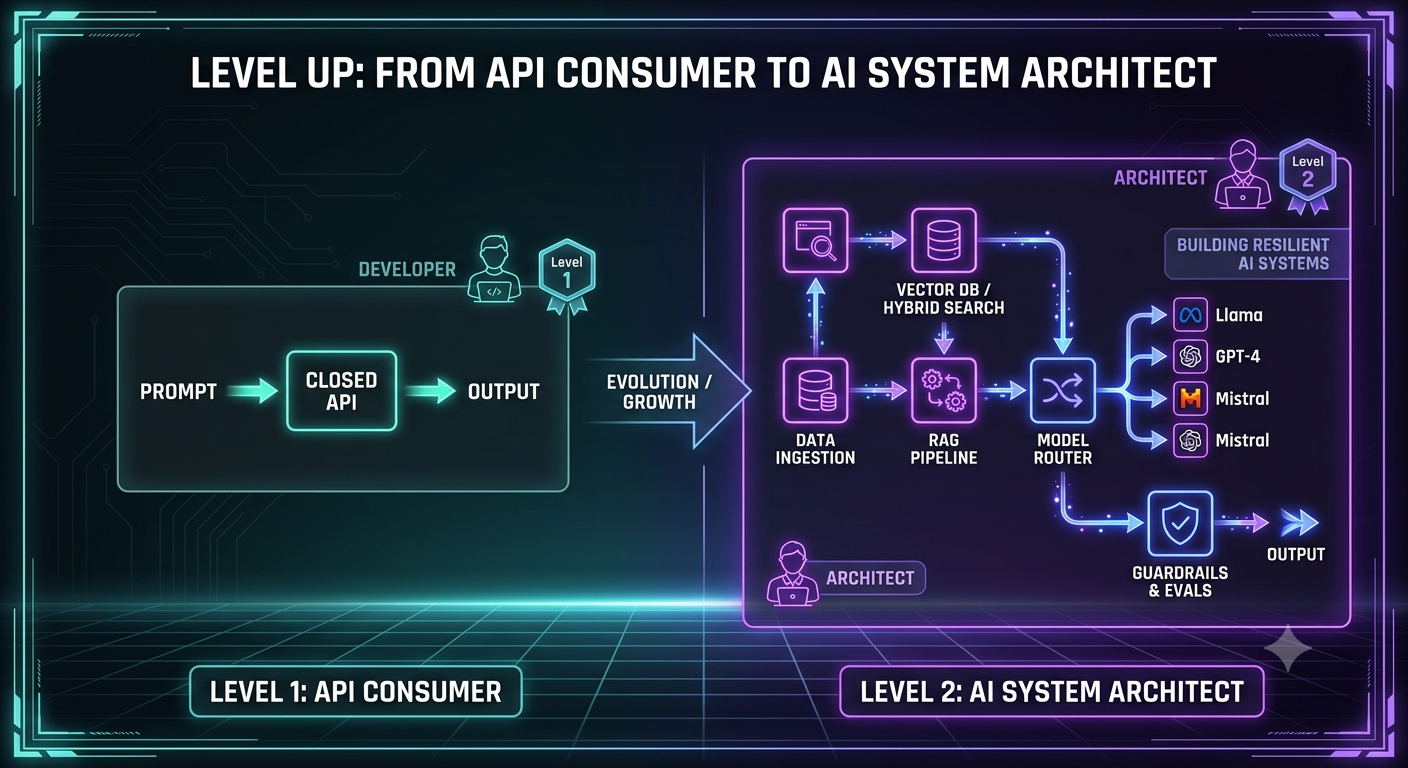
To future-proof your career in AI engineering, move up the value chain by mastering the 3 Pillars of Advanced AI Systems:
1. Data Pipeline & Retrieval Mastery (Context Engineering)
The Problem: Off-the-shelf LLMs don't know your domain data and suffer from hallucinations.
The Skill: Go beyond basic vector search. Master Advanced Retrieval-Augmented Generation (RAG)—including hybrid search (keyword + semantic), re-ranking algorithms, metadata filtering, and chunking strategies.
Action: Stop focusing only on the prompt. Invest time in learning how vector databases index data and how to clean unstructured context for optimal retrieval.
2. Evaluation & Guardrails (The Deterministic Layer)
The Problem: Non-deterministic outputs make traditional testing methods obsolete.
The Skill: Build automated evaluation suites (Eval pipelines). Learn to measure metric dimensions like faithfulness, answer relevance, and context recall using tools like Ragas or custom LLM-as-a-judge frameworks.
Action: Before deploying any feature, set up benchmark datasets to evaluate model output regressions whenever you update prompts or underlying models.
3. Latency, Cost, & Fine-Tuning (Optimization)
The Problem: SOTA closed models can be slow, expensive, and introduce vendor lock-in.
The Skill: Know when to use a frontier model versus fine-tuning smaller, open-weights models (e.g., Llama, Mistral) for specific, structured tasks. Master caching techniques and task routing.
Action: Learn parameter-efficient fine-tuning techniques like LoRA/QLoRA, and understand how to deploy local inference engines for low-latency workloads.
Key Takeaways
Context is king: The quality of an AI application depends more on data pipeline architecture than prompt engineering.
Evals over intuition: Reliable AI engineers build automated test suites to measure model performance programmatically.
Optimize for production: Knowing how to balance cost, latency, and accuracy using hybrid architectures makes you indispensable.
CTA
Ready to build production-ready AI alongside top engineers?
Join the AI Builders & Enthusiasts community today to trade architecture blueprints, get hands-on project feedback, and master the future of AI engineering.
The barrier to entry for building with AI has never been lower, but the bar for building reliable, enterprise-ready AI applications keeps rising.
To future-proof your career in AI engineering, move up the value chain by mastering the 3 Pillars of Advanced AI Systems:
1. Data Pipeline & Retrieval Mastery (Context Engineering)
The Problem: Off-the-shelf LLMs don't know your domain data and suffer from hallucinations.
The Skill: Go beyond basic vector search. Master Advanced Retrieval-Augmented Generation (RAG)—including hybrid search (keyword + semantic), re-ranking algorithms, metadata filtering, and chunking strategies.
Action: Stop focusing only on the prompt. Invest time in learning how vector databases index data and how to clean unstructured context for optimal retrieval.
2. Evaluation & Guardrails (The Deterministic Layer)
The Problem: Non-deterministic outputs make traditional testing methods obsolete.
The Skill: Build automated evaluation suites (Eval pipelines). Learn to measure metric dimensions like faithfulness, answer relevance, and context recall using tools like Ragas or custom LLM-as-a-judge frameworks.
Action: Before deploying any feature, set up benchmark datasets to evaluate model output regressions whenever you update prompts or underlying models.
3. Latency, Cost, & Fine-Tuning (Optimization)
The Problem: SOTA closed models can be slow, expensive, and introduce vendor lock-in.
The Skill: Know when to use a frontier model versus fine-tuning smaller, open-weights models (e.g., Llama, Mistral) for specific, structured tasks. Master caching techniques and task routing.
Action: Learn parameter-efficient fine-tuning techniques like LoRA/QLoRA, and understand how to deploy local inference engines for low-latency workloads.
Key Takeaways
Context is king: The quality of an AI application depends more on data pipeline architecture than prompt engineering.
Evals over intuition: Reliable AI engineers build automated test suites to measure model performance programmatically.
Optimize for production: Knowing how to balance cost, latency, and accuracy using hybrid architectures makes you indispensable.
CTA
Ready to build production-ready AI alongside top engineers?
Join the AI Builders & Enthusiasts community today to trade architecture blueprints, get hands-on project feedback, and master the future of AI engineering.
The AI Engineer’s Roadmap: Moving from API Consumer to System Architect
The barrier to entry for building with AI has never been lower, but the bar for building reliable, enterprise-ready AI applications keeps rising.
To future-proof your career in AI engineering, move up the value chain by mastering the 3 Pillars of Advanced AI Systems:
1. Data Pipeline & Retrieval Mastery (Context Engineering)
The Problem: Off-the-shelf LLMs don't know your domain data and suffer from hallucinations.
The Skill: Go beyond basic vector search. Master Advanced Retrieval-Augmented Generation (RAG)—including hybrid search (keyword + semantic), re-ranking algorithms, metadata filtering, and chunking strategies.
Action: Stop focusing only on the prompt. Invest time in learning how vector databases index data and how to clean unstructured context for optimal retrieval.
2. Evaluation & Guardrails (The Deterministic Layer)
The Problem: Non-deterministic outputs make traditional testing methods obsolete.
The Skill: Build automated evaluation suites (Eval pipelines). Learn to measure metric dimensions like faithfulness, answer relevance, and context recall using tools like Ragas or custom LLM-as-a-judge frameworks.
Action: Before deploying any feature, set up benchmark datasets to evaluate model output regressions whenever you update prompts or underlying models.
3. Latency, Cost, & Fine-Tuning (Optimization)
The Problem: SOTA closed models can be slow, expensive, and introduce vendor lock-in.
The Skill: Know when to use a frontier model versus fine-tuning smaller, open-weights models (e.g., Llama, Mistral) for specific, structured tasks. Master caching techniques and task routing.
Action: Learn parameter-efficient fine-tuning techniques like LoRA/QLoRA, and understand how to deploy local inference engines for low-latency workloads.
Key Takeaways
Context is king: The quality of an AI application depends more on data pipeline architecture than prompt engineering.
Evals over intuition: Reliable AI engineers build automated test suites to measure model performance programmatically.
Optimize for production: Knowing how to balance cost, latency, and accuracy using hybrid architectures makes you indispensable.
CTA
Ready to build production-ready AI alongside top engineers?
Join the AI Builders & Enthusiasts community today to trade architecture blueprints, get hands-on project feedback, and master the future of AI engineering.

 English
 Arabic
 French
 Portuguese
 Deutsch
 Turkish
 Dutch
Dutch
 Italiano
 Russian
 Romaian
 Portuguese (Brazil)
 Greek
Greek