


Where is Your LLM Pipeline Bottlenecking in Production?
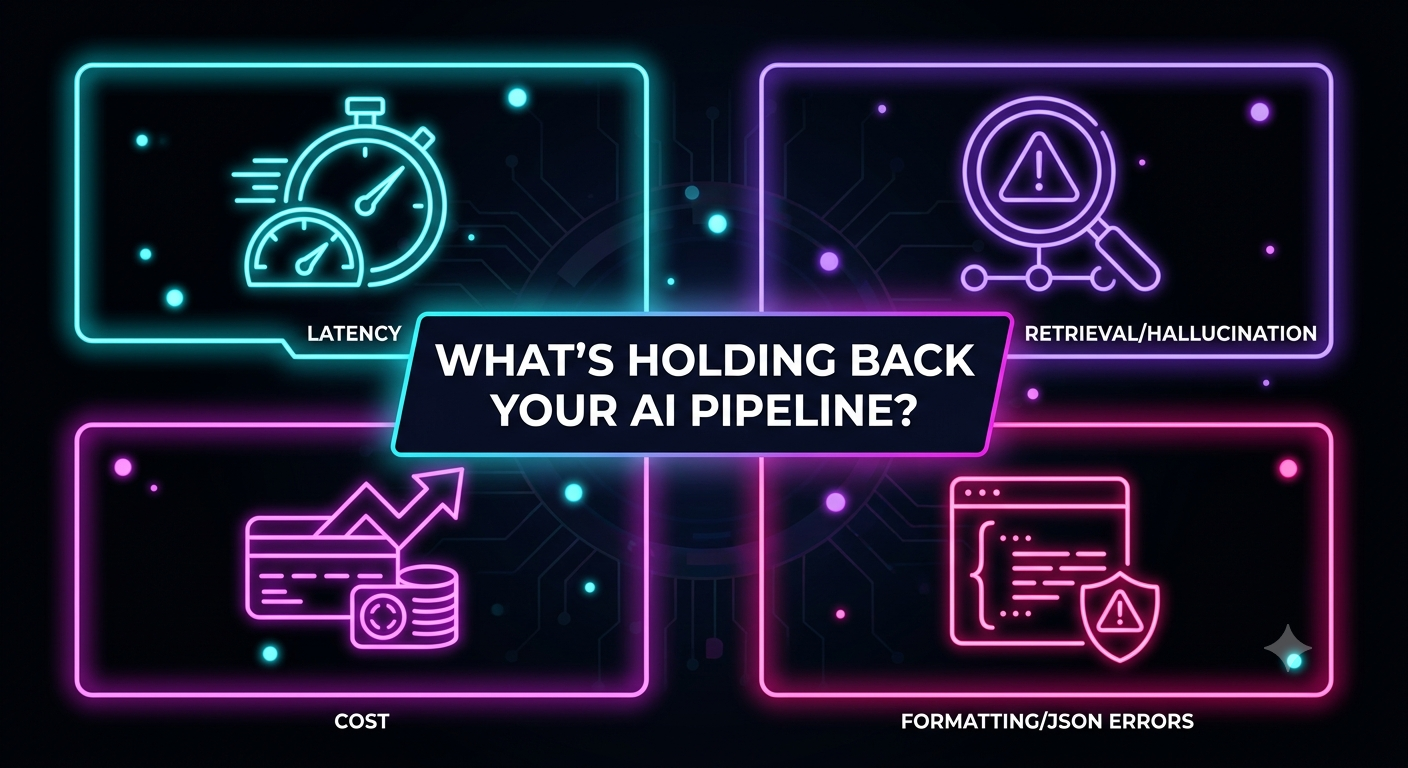
When scaling LLM-powered applications from demo to production, developers inevitably hit a performance wall. High-performing AI teams evaluate their architecture across 4 Critical Vectors:
Latency & Time-to-First-Token (TTFT): Streaming issues, slow model inference, or heavy sequential RAG operations making the UI feel sluggish.
Context Quality & Retrieval Accuracy: Vector DB noise, poor chunking strategies, or hallucinated details ruining user trust.
Inference Cost at Scale: Enterprise bills ballooning due to unnecessary calls to top-tier frontier models for simple tasks.
Output Determinism & Reliability: Model outputs breaking JSON schemas, ignoring prompt constraints, or failing silent safety checks.
🗳️ Community Poll:
If you could instantly solve ONE engineering bottleneck in your AI stack today, which would it be?
A) High Latency / Slow Response Times (TTFT, streaming bottlenecks)
B) Low Retrieval Accuracy / Hallucinations (RAG noise, chunking issues)
C) Unpredictable API Costs (High token usage, over-reliance on large models)
D) Unreliable Output Formatting (Broken JSON, schema failures)
(Vote in the poll above and drop your favorite workarounds in the comments!)
Key Takeaways
Profile early: Don't wait for production traffic to discover whether your latency is coming from vector search or LLM generation.
Tier your models: Save high-parameter models for complex reasoning; route structured or simple extraction tasks to smaller, faster models.
Enforce structured outputs: Use function calling or strict JSON schema enforcement layers to prevent downstream parsing failures.
CTA
Looking to benchmark your AI stack with developers building production-grade systems?
Join the AI Builders & Enthusiasts community today to trade optimization tips, debug RAG architectures, and build better AI together!
When scaling LLM-powered applications from demo to production, developers inevitably hit a performance wall. High-performing AI teams evaluate their architecture across 4 Critical Vectors:
Latency & Time-to-First-Token (TTFT): Streaming issues, slow model inference, or heavy sequential RAG operations making the UI feel sluggish.
Context Quality & Retrieval Accuracy: Vector DB noise, poor chunking strategies, or hallucinated details ruining user trust.
Inference Cost at Scale: Enterprise bills ballooning due to unnecessary calls to top-tier frontier models for simple tasks.
Output Determinism & Reliability: Model outputs breaking JSON schemas, ignoring prompt constraints, or failing silent safety checks.
🗳️ Community Poll:
If you could instantly solve ONE engineering bottleneck in your AI stack today, which would it be?
A) High Latency / Slow Response Times (TTFT, streaming bottlenecks)
B) Low Retrieval Accuracy / Hallucinations (RAG noise, chunking issues)
C) Unpredictable API Costs (High token usage, over-reliance on large models)
D) Unreliable Output Formatting (Broken JSON, schema failures)
(Vote in the poll above and drop your favorite workarounds in the comments!)
Key Takeaways
Profile early: Don't wait for production traffic to discover whether your latency is coming from vector search or LLM generation.
Tier your models: Save high-parameter models for complex reasoning; route structured or simple extraction tasks to smaller, faster models.
Enforce structured outputs: Use function calling or strict JSON schema enforcement layers to prevent downstream parsing failures.
CTA
Looking to benchmark your AI stack with developers building production-grade systems?
Join the AI Builders & Enthusiasts community today to trade optimization tips, debug RAG architectures, and build better AI together!
Where is Your LLM Pipeline Bottlenecking in Production?
When scaling LLM-powered applications from demo to production, developers inevitably hit a performance wall. High-performing AI teams evaluate their architecture across 4 Critical Vectors:
Latency & Time-to-First-Token (TTFT): Streaming issues, slow model inference, or heavy sequential RAG operations making the UI feel sluggish.
Context Quality & Retrieval Accuracy: Vector DB noise, poor chunking strategies, or hallucinated details ruining user trust.
Inference Cost at Scale: Enterprise bills ballooning due to unnecessary calls to top-tier frontier models for simple tasks.
Output Determinism & Reliability: Model outputs breaking JSON schemas, ignoring prompt constraints, or failing silent safety checks.
🗳️ Community Poll:
If you could instantly solve ONE engineering bottleneck in your AI stack today, which would it be?
A) High Latency / Slow Response Times (TTFT, streaming bottlenecks)
B) Low Retrieval Accuracy / Hallucinations (RAG noise, chunking issues)
C) Unpredictable API Costs (High token usage, over-reliance on large models)
D) Unreliable Output Formatting (Broken JSON, schema failures)
(Vote in the poll above and drop your favorite workarounds in the comments!)
Key Takeaways
Profile early: Don't wait for production traffic to discover whether your latency is coming from vector search or LLM generation.
Tier your models: Save high-parameter models for complex reasoning; route structured or simple extraction tasks to smaller, faster models.
Enforce structured outputs: Use function calling or strict JSON schema enforcement layers to prevent downstream parsing failures.
CTA
Looking to benchmark your AI stack with developers building production-grade systems?
Join the AI Builders & Enthusiasts community today to trade optimization tips, debug RAG architectures, and build better AI together!

 English
 Arabic
 French
 Spanish
 Portuguese
 Deutsch
 Turkish
 Dutch
Dutch
 Italiano
 Romaian
 Portuguese (Brazil)
 Greek
Greek