


The AI Agent Architecture Blueprint: 4 Components for Autonomous Workflows
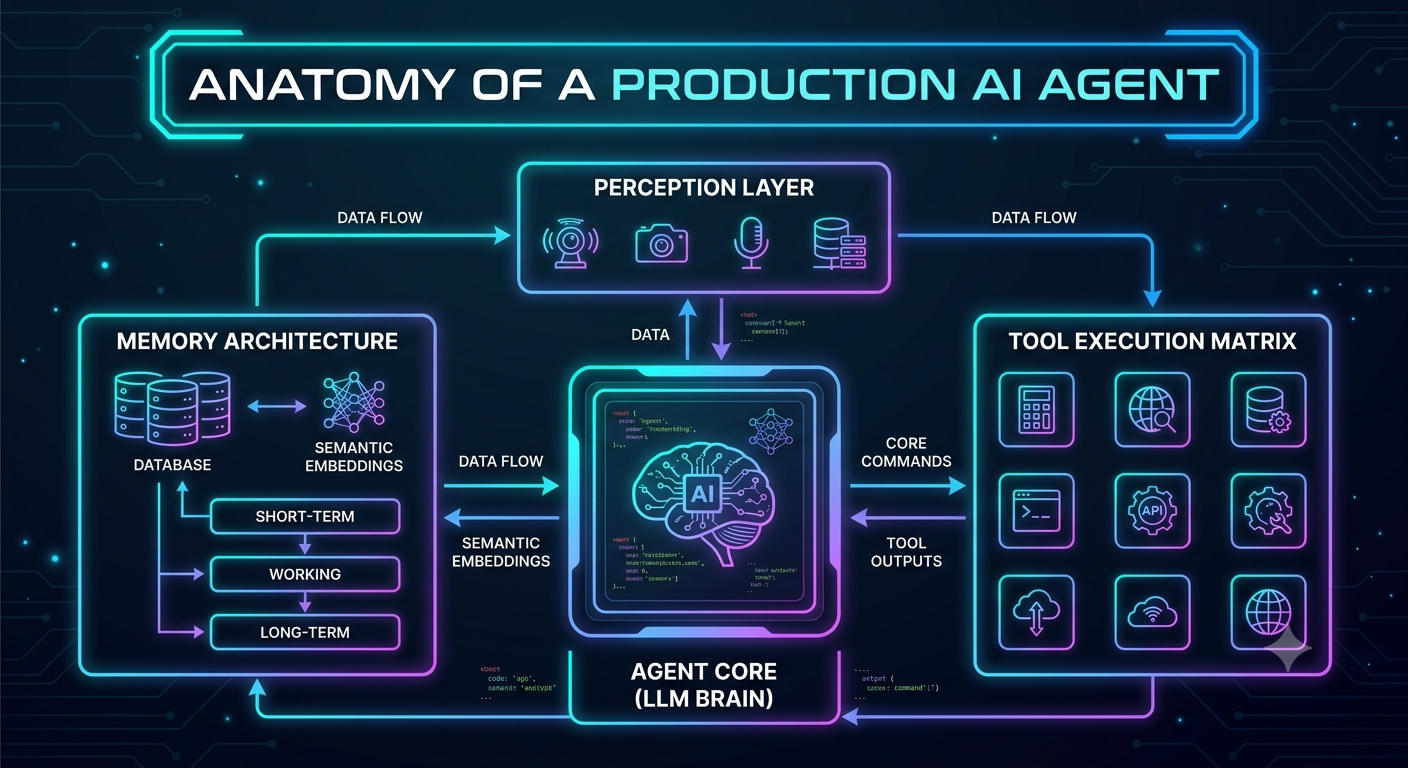
Moving from static single-prompt completions to autonomous agents requires orchestrating feedback loops. Every production-grade AI agent relies on 4 Fundamental Building Blocks:
+-----------------------------------------------------------------------------+
| 1. PERCEPTION |
| (User Input, Environment Sensors, Multimodal Parsers) |
+------------------------------+----------------------------------------------+
|
v
+----------------------------------------------------------------------------+
| 2. BRAIN (LLM) |
| (Task Decomposition, Planning, Decision Reasoning) |
+--------------+-------------------------------+----------------------------+
| ^
v |
+------------------------------+---------------+---------------------------+
| 3. MEMORY | 4. TOOLS |
| (Short-term: Conversation) | (APIs, Code Interpreters, |
| (Long-term: Vector Store) | Database Connectors) |
+------------------------------+--------------------------------------------+
1. Perception (The Ingestion Layer)
Function: Translates raw inputs—text, structured JSON, code, or images—into normalized context the LLM can evaluate.
Best Practice: Always sanitize inputs and explicitly separate system instructions from untrusted user content to prevent prompt injection attacks.
2. The Brain (Planning & Decision Engine)
Function: Breaks down a high-level goal into smaller, sequential sub-tasks.
Best Practice: Implement structured planning techniques like ReAct (Reasoning + Acting) or Plan-and-Solve. Enforce a maximum step limit (e.g., max 10 execution loops) to prevent infinite loops when an agent gets stuck.
3. Memory System (Context Persistence)
Short-Term Memory: Retains immediate chat history within the active context window.
Long-Term Memory: Uses semantic search over vector databases to retrieve past execution logs, user preferences, or domain knowledge when relevant.
Best Practice: Periodically summarize short-term context to conserve token limits and keep inference latency low.
4. Tool Execution (Action Layer)
Function: Gives the agent "hands" to interact with external systems via API calls, SQL queries, or custom code execution.
Best Practice: Never give an agent write access to production databases or external APIs without human-in-the-loop (HITL) approval gates for destructive actions.
Key Takeaways
Limit autonomous loops: Guard against budget burn and infinite recursion by placing strict step limits on reasoning loops.
Decouple planning from execution: Let the LLM plan actions in structured formats (like JSON), but let deterministic code validate and execute those actions.
Implement Human-in-the-Loop (HITL): Require manual verification for critical operations (e.g., payments, data deletions, external emails).
CTA
Building autonomous agents, RAG systems, or AI infrastructure?
Join the AI Builders & Enthusiasts community today to access step-by-step system designs, code templates, and technical discussions with fellow AI developers!
Moving from static single-prompt completions to autonomous agents requires orchestrating feedback loops. Every production-grade AI agent relies on 4 Fundamental Building Blocks:
+-----------------------------------------------------------------------------+
| 1. PERCEPTION |
| (User Input, Environment Sensors, Multimodal Parsers) |
+------------------------------+----------------------------------------------+
|
v
+----------------------------------------------------------------------------+
| 2. BRAIN (LLM) |
| (Task Decomposition, Planning, Decision Reasoning) |
+--------------+-------------------------------+----------------------------+
| ^
v |
+------------------------------+---------------+---------------------------+
| 3. MEMORY | 4. TOOLS |
| (Short-term: Conversation) | (APIs, Code Interpreters, |
| (Long-term: Vector Store) | Database Connectors) |
+------------------------------+--------------------------------------------+
1. Perception (The Ingestion Layer)
Function: Translates raw inputs—text, structured JSON, code, or images—into normalized context the LLM can evaluate.
Best Practice: Always sanitize inputs and explicitly separate system instructions from untrusted user content to prevent prompt injection attacks.
2. The Brain (Planning & Decision Engine)
Function: Breaks down a high-level goal into smaller, sequential sub-tasks.
Best Practice: Implement structured planning techniques like ReAct (Reasoning + Acting) or Plan-and-Solve. Enforce a maximum step limit (e.g., max 10 execution loops) to prevent infinite loops when an agent gets stuck.
3. Memory System (Context Persistence)
Short-Term Memory: Retains immediate chat history within the active context window.
Long-Term Memory: Uses semantic search over vector databases to retrieve past execution logs, user preferences, or domain knowledge when relevant.
Best Practice: Periodically summarize short-term context to conserve token limits and keep inference latency low.
4. Tool Execution (Action Layer)
Function: Gives the agent "hands" to interact with external systems via API calls, SQL queries, or custom code execution.
Best Practice: Never give an agent write access to production databases or external APIs without human-in-the-loop (HITL) approval gates for destructive actions.
Key Takeaways
Limit autonomous loops: Guard against budget burn and infinite recursion by placing strict step limits on reasoning loops.
Decouple planning from execution: Let the LLM plan actions in structured formats (like JSON), but let deterministic code validate and execute those actions.
Implement Human-in-the-Loop (HITL): Require manual verification for critical operations (e.g., payments, data deletions, external emails).
CTA
Building autonomous agents, RAG systems, or AI infrastructure?
Join the AI Builders & Enthusiasts community today to access step-by-step system designs, code templates, and technical discussions with fellow AI developers!
The AI Agent Architecture Blueprint: 4 Components for Autonomous Workflows
Moving from static single-prompt completions to autonomous agents requires orchestrating feedback loops. Every production-grade AI agent relies on 4 Fundamental Building Blocks:
+-----------------------------------------------------------------------------+
| 1. PERCEPTION |
| (User Input, Environment Sensors, Multimodal Parsers) |
+------------------------------+----------------------------------------------+
|
v
+----------------------------------------------------------------------------+
| 2. BRAIN (LLM) |
| (Task Decomposition, Planning, Decision Reasoning) |
+--------------+-------------------------------+----------------------------+
| ^
v |
+------------------------------+---------------+---------------------------+
| 3. MEMORY | 4. TOOLS |
| (Short-term: Conversation) | (APIs, Code Interpreters, |
| (Long-term: Vector Store) | Database Connectors) |
+------------------------------+--------------------------------------------+
1. Perception (The Ingestion Layer)
Function: Translates raw inputs—text, structured JSON, code, or images—into normalized context the LLM can evaluate.
Best Practice: Always sanitize inputs and explicitly separate system instructions from untrusted user content to prevent prompt injection attacks.
2. The Brain (Planning & Decision Engine)
Function: Breaks down a high-level goal into smaller, sequential sub-tasks.
Best Practice: Implement structured planning techniques like ReAct (Reasoning + Acting) or Plan-and-Solve. Enforce a maximum step limit (e.g., max 10 execution loops) to prevent infinite loops when an agent gets stuck.
3. Memory System (Context Persistence)
Short-Term Memory: Retains immediate chat history within the active context window.
Long-Term Memory: Uses semantic search over vector databases to retrieve past execution logs, user preferences, or domain knowledge when relevant.
Best Practice: Periodically summarize short-term context to conserve token limits and keep inference latency low.
4. Tool Execution (Action Layer)
Function: Gives the agent "hands" to interact with external systems via API calls, SQL queries, or custom code execution.
Best Practice: Never give an agent write access to production databases or external APIs without human-in-the-loop (HITL) approval gates for destructive actions.
Key Takeaways
Limit autonomous loops: Guard against budget burn and infinite recursion by placing strict step limits on reasoning loops.
Decouple planning from execution: Let the LLM plan actions in structured formats (like JSON), but let deterministic code validate and execute those actions.
Implement Human-in-the-Loop (HITL): Require manual verification for critical operations (e.g., payments, data deletions, external emails).
CTA
Building autonomous agents, RAG systems, or AI infrastructure?
Join the AI Builders & Enthusiasts community today to access step-by-step system designs, code templates, and technical discussions with fellow AI developers!

 English
 Arabic
 French
 Spanish
 Deutsch
 Turkish
 Dutch
Dutch
 Italiano
 Russian
 Romaian
 Portuguese (Brazil)
 Greek
Greek