


Stop Scaling Monoliths Without Guardrails: The 3-Step High-Availability Architecture Framework for India's Next-Gen Tech Ecosystem
We have all been there: deploying a quick service release, watching it handle routine traffic, and assuming the underlying architecture will naturally handle exponential user growth. While rapid deployment is essential, treating core infrastructure resilience as an afterthought leads to cascading outages and frustrated users.
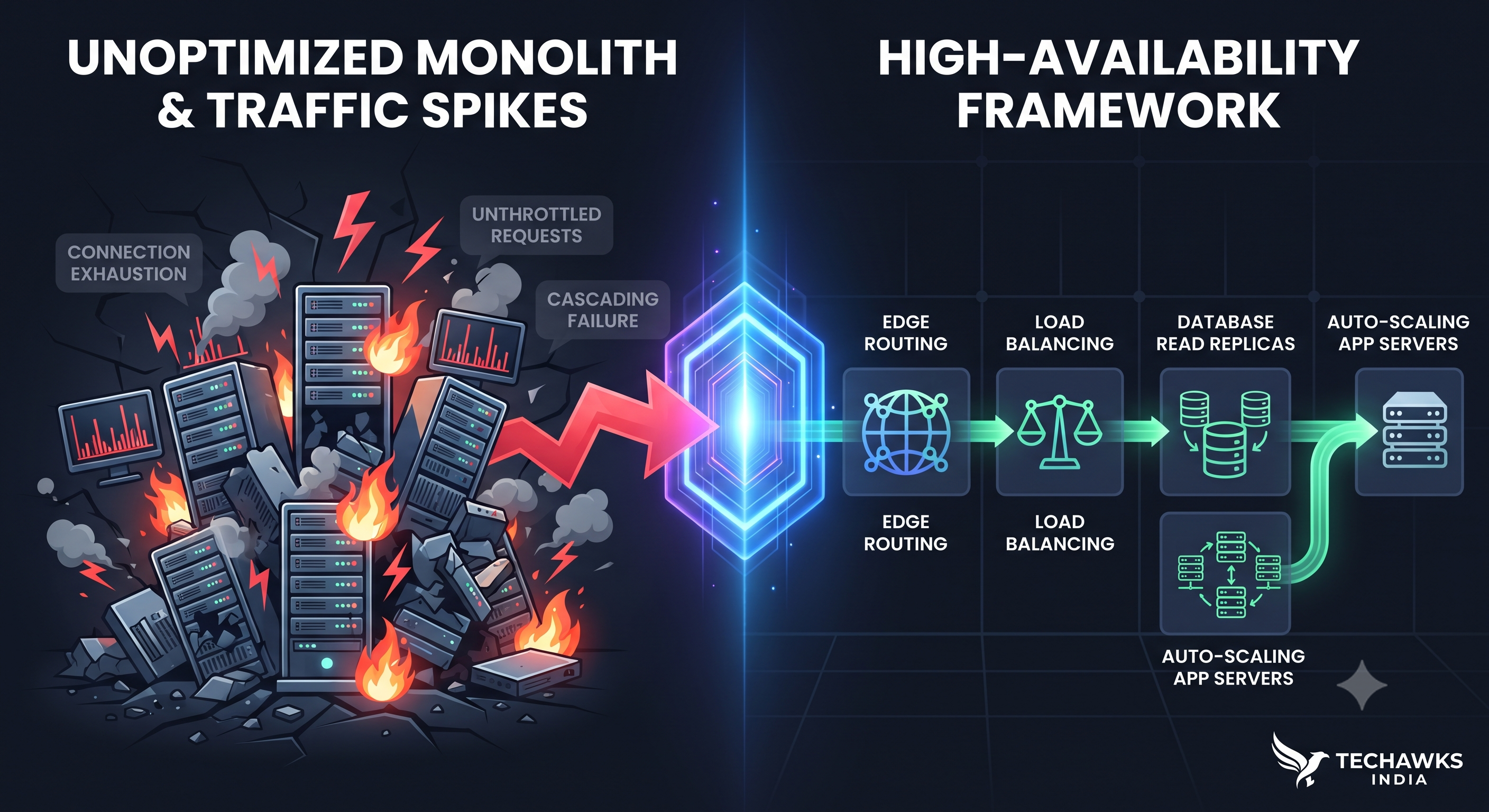
To transform naive architectures into robust, high-availability operations suited for India's high-scale digital landscape, put every system through this rigorous 3-step challenge framework:
Step 1: The Database Connection & Pooling Audit
Database connection exhaustion is the #1 silent killer during high-traffic events. Before pushing any service live, audit your connection pooling limits and query concurrency boundaries. Ask yourself: How does this service behave when connection requests spike by 10x? Implement aggressive connection pooling, query caching, and read replicas to offload heavy read traffic from your primary database.
Step 2: The Rate Limiting & Graceful Degradation Strategy
Unbounded traffic hitting your backend endpoints without protection will inevitably crash your servers. Never let unthrottled requests overwhelm your core business logic. Implement distributed rate limiting at the edge and design graceful degradation paths—such as serving static fallback pages or cached data—when downstream dependencies experience latency.
Step 3: The Regional Latency & CDN Optimization Pass
Serving static assets and dynamic content from a single centralized server creates unnecessary latency for users across diverse geographic zones. Strip out inefficient routing, leverage edge content delivery networks (CDNs), and optimize asset compression to ensure lightning-fast load times regardless of network conditions.
The Challenge for Today:
Open your system's architecture diagram or most recent deployment config. Audit your database maximum connection limits and edge rate-limiting rules. If you find a single unthrottled endpoint or missing connection pooler, refactor it immediately before your next traffic spike tests it for you.
Key Takeaways
Protect Your Database: Never run unpooled database connections; implement strict pooling limits and read replicas to survive traffic surges.
Enforce Rate Limiting: Shield your core services from unthrottled traffic by implementing distributed rate limits and graceful degradation paths.
Minimize Latency: Leverage CDNs and edge caching to optimize delivery speeds for users across diverse geographic regions.
CTA (Join Techawks India)
Want to elevate your system architecture and engineering practices alongside thousands of developers across the subcontinent? Join Techawks India today to share scaling patterns, tackle weekly engineering challenges, and build resilient software systems together.
We have all been there: deploying a quick service release, watching it handle routine traffic, and assuming the underlying architecture will naturally handle exponential user growth. While rapid deployment is essential, treating core infrastructure resilience as an afterthought leads to cascading outages and frustrated users.
To transform naive architectures into robust, high-availability operations suited for India's high-scale digital landscape, put every system through this rigorous 3-step challenge framework:
Step 1: The Database Connection & Pooling Audit
Database connection exhaustion is the #1 silent killer during high-traffic events. Before pushing any service live, audit your connection pooling limits and query concurrency boundaries. Ask yourself: How does this service behave when connection requests spike by 10x? Implement aggressive connection pooling, query caching, and read replicas to offload heavy read traffic from your primary database.
Step 2: The Rate Limiting & Graceful Degradation Strategy
Unbounded traffic hitting your backend endpoints without protection will inevitably crash your servers. Never let unthrottled requests overwhelm your core business logic. Implement distributed rate limiting at the edge and design graceful degradation paths—such as serving static fallback pages or cached data—when downstream dependencies experience latency.
Step 3: The Regional Latency & CDN Optimization Pass
Serving static assets and dynamic content from a single centralized server creates unnecessary latency for users across diverse geographic zones. Strip out inefficient routing, leverage edge content delivery networks (CDNs), and optimize asset compression to ensure lightning-fast load times regardless of network conditions.
The Challenge for Today:
Open your system's architecture diagram or most recent deployment config. Audit your database maximum connection limits and edge rate-limiting rules. If you find a single unthrottled endpoint or missing connection pooler, refactor it immediately before your next traffic spike tests it for you.
Key Takeaways
Protect Your Database: Never run unpooled database connections; implement strict pooling limits and read replicas to survive traffic surges.
Enforce Rate Limiting: Shield your core services from unthrottled traffic by implementing distributed rate limits and graceful degradation paths.
Minimize Latency: Leverage CDNs and edge caching to optimize delivery speeds for users across diverse geographic regions.
CTA (Join Techawks India)
Want to elevate your system architecture and engineering practices alongside thousands of developers across the subcontinent? Join Techawks India today to share scaling patterns, tackle weekly engineering challenges, and build resilient software systems together.
Stop Scaling Monoliths Without Guardrails: The 3-Step High-Availability Architecture Framework for India's Next-Gen Tech Ecosystem
We have all been there: deploying a quick service release, watching it handle routine traffic, and assuming the underlying architecture will naturally handle exponential user growth. While rapid deployment is essential, treating core infrastructure resilience as an afterthought leads to cascading outages and frustrated users.
To transform naive architectures into robust, high-availability operations suited for India's high-scale digital landscape, put every system through this rigorous 3-step challenge framework:
Step 1: The Database Connection & Pooling Audit
Database connection exhaustion is the #1 silent killer during high-traffic events. Before pushing any service live, audit your connection pooling limits and query concurrency boundaries. Ask yourself: How does this service behave when connection requests spike by 10x? Implement aggressive connection pooling, query caching, and read replicas to offload heavy read traffic from your primary database.
Step 2: The Rate Limiting & Graceful Degradation Strategy
Unbounded traffic hitting your backend endpoints without protection will inevitably crash your servers. Never let unthrottled requests overwhelm your core business logic. Implement distributed rate limiting at the edge and design graceful degradation paths—such as serving static fallback pages or cached data—when downstream dependencies experience latency.
Step 3: The Regional Latency & CDN Optimization Pass
Serving static assets and dynamic content from a single centralized server creates unnecessary latency for users across diverse geographic zones. Strip out inefficient routing, leverage edge content delivery networks (CDNs), and optimize asset compression to ensure lightning-fast load times regardless of network conditions.
The Challenge for Today:
Open your system's architecture diagram or most recent deployment config. Audit your database maximum connection limits and edge rate-limiting rules. If you find a single unthrottled endpoint or missing connection pooler, refactor it immediately before your next traffic spike tests it for you.
Key Takeaways
Protect Your Database: Never run unpooled database connections; implement strict pooling limits and read replicas to survive traffic surges.
Enforce Rate Limiting: Shield your core services from unthrottled traffic by implementing distributed rate limits and graceful degradation paths.
Minimize Latency: Leverage CDNs and edge caching to optimize delivery speeds for users across diverse geographic regions.
CTA (Join Techawks India)
Want to elevate your system architecture and engineering practices alongside thousands of developers across the subcontinent? Join Techawks India today to share scaling patterns, tackle weekly engineering challenges, and build resilient software systems together.

 English
 Arabic
 French
 Spanish
 Portuguese
 Deutsch
 Turkish
 Dutch
Dutch
 Italiano
 Russian
 Portuguese (Brazil)
 Greek
Greek