


Stop Ignoring Compliance: The 3-Step Data Governance & Privacy Framework for UK Tech Scale-Ups
We have all been there: collecting user data freely during the early growth phase, assuming that sorting out privacy policies and data mapping can wait until later. While moving fast is essential, treating UK GDPR and data governance as a checkbox exercise leaves your organization exposed to severe regulatory penalties and loss of customer trust.
To transform data privacy from a burden into a secure, competitive advantage, put every system through this rigorous 3-step challenge framework:
Step 1: The End-to-End Data Flow Mapping Audit
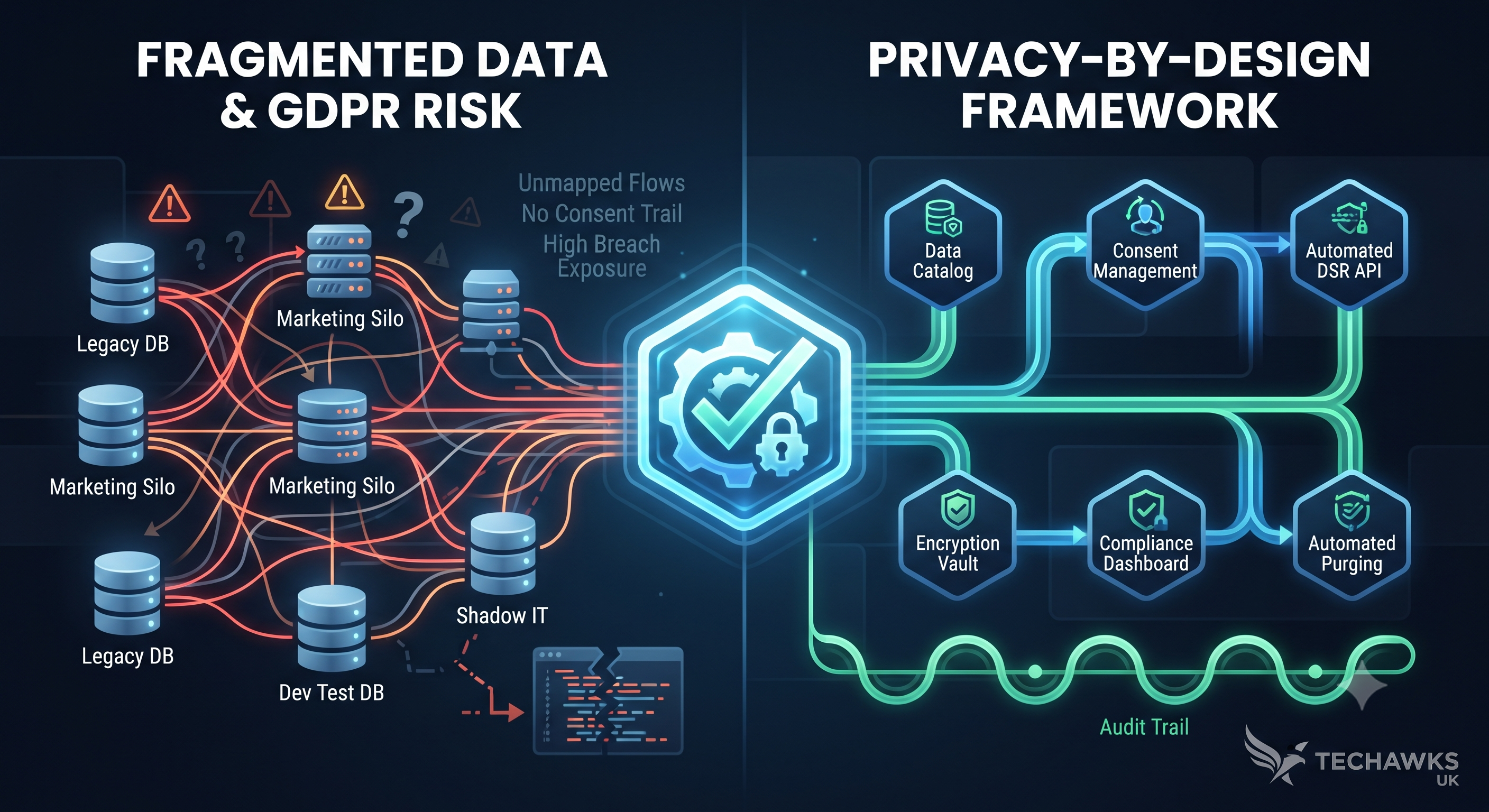
You cannot protect or delete data if you do not know where it lives. Before pushing new features live, map every data pipeline from ingestion to third-party storage. Ask yourself: Do we have a complete record of every personal identifier entering our systems, and exactly where is it processed? Eliminate shadow databases and unauthorized third-party trackers immediately.
Step 2: The Automated Data Subject Rights (DSR) Workflow
Handling Subject Access Requests (SARs) or "right to be forgotten" requests manually via scattered support tickets leads to missed statutory deadlines and compliance failures. Implement automated tools and scripts that can securely query, export, or redact a user's data across all microservices and storage tiers within minutes.
Step 3: The Privacy-by-Design & Minimization Pass
Collecting excessive data "just in case" increases your liability footprint during a breach. Strip out non-essential data collection fields, enforce strict data retention limits with automated purging schedules, and ensure encryption at rest and in transit across all environments.
The Challenge for Today:
Open your application's primary sign-up flow and database schema. Trace how a user's data is stored and whether your system can completely expunge that data across all tables upon request. If you find manual bottlenecks, refactor your data pipeline before a compliance audit tests it for you.
Key Takeaways
Map Your Data: Maintain rigorous end-to-end documentation of all personal data flows to eliminate hidden shadow storage.
Automate Requests: Build streamlined, automated workflows to handle Subject Access Requests well within regulatory deadlines.
Practice Minimization: Collect only necessary data points and enforce strict retention schedules with automated purging.
CTA (Join Techawks UK)
Want to elevate your engineering standards and compliance practices alongside thousands of tech professionals across the United Kingdom? Join Techawks UK today to share governance patterns, tackle weekly engineering challenges, and build secure, trusted software together.
We have all been there: collecting user data freely during the early growth phase, assuming that sorting out privacy policies and data mapping can wait until later. While moving fast is essential, treating UK GDPR and data governance as a checkbox exercise leaves your organization exposed to severe regulatory penalties and loss of customer trust.
To transform data privacy from a burden into a secure, competitive advantage, put every system through this rigorous 3-step challenge framework:
Step 1: The End-to-End Data Flow Mapping Audit
You cannot protect or delete data if you do not know where it lives. Before pushing new features live, map every data pipeline from ingestion to third-party storage. Ask yourself: Do we have a complete record of every personal identifier entering our systems, and exactly where is it processed? Eliminate shadow databases and unauthorized third-party trackers immediately.
Step 2: The Automated Data Subject Rights (DSR) Workflow
Handling Subject Access Requests (SARs) or "right to be forgotten" requests manually via scattered support tickets leads to missed statutory deadlines and compliance failures. Implement automated tools and scripts that can securely query, export, or redact a user's data across all microservices and storage tiers within minutes.
Step 3: The Privacy-by-Design & Minimization Pass
Collecting excessive data "just in case" increases your liability footprint during a breach. Strip out non-essential data collection fields, enforce strict data retention limits with automated purging schedules, and ensure encryption at rest and in transit across all environments.
The Challenge for Today:
Open your application's primary sign-up flow and database schema. Trace how a user's data is stored and whether your system can completely expunge that data across all tables upon request. If you find manual bottlenecks, refactor your data pipeline before a compliance audit tests it for you.
Key Takeaways
Map Your Data: Maintain rigorous end-to-end documentation of all personal data flows to eliminate hidden shadow storage.
Automate Requests: Build streamlined, automated workflows to handle Subject Access Requests well within regulatory deadlines.
Practice Minimization: Collect only necessary data points and enforce strict retention schedules with automated purging.
CTA (Join Techawks UK)
Want to elevate your engineering standards and compliance practices alongside thousands of tech professionals across the United Kingdom? Join Techawks UK today to share governance patterns, tackle weekly engineering challenges, and build secure, trusted software together.
Stop Ignoring Compliance: The 3-Step Data Governance & Privacy Framework for UK Tech Scale-Ups
We have all been there: collecting user data freely during the early growth phase, assuming that sorting out privacy policies and data mapping can wait until later. While moving fast is essential, treating UK GDPR and data governance as a checkbox exercise leaves your organization exposed to severe regulatory penalties and loss of customer trust.
To transform data privacy from a burden into a secure, competitive advantage, put every system through this rigorous 3-step challenge framework:
Step 1: The End-to-End Data Flow Mapping Audit
You cannot protect or delete data if you do not know where it lives. Before pushing new features live, map every data pipeline from ingestion to third-party storage. Ask yourself: Do we have a complete record of every personal identifier entering our systems, and exactly where is it processed? Eliminate shadow databases and unauthorized third-party trackers immediately.
Step 2: The Automated Data Subject Rights (DSR) Workflow
Handling Subject Access Requests (SARs) or "right to be forgotten" requests manually via scattered support tickets leads to missed statutory deadlines and compliance failures. Implement automated tools and scripts that can securely query, export, or redact a user's data across all microservices and storage tiers within minutes.
Step 3: The Privacy-by-Design & Minimization Pass
Collecting excessive data "just in case" increases your liability footprint during a breach. Strip out non-essential data collection fields, enforce strict data retention limits with automated purging schedules, and ensure encryption at rest and in transit across all environments.
The Challenge for Today:
Open your application's primary sign-up flow and database schema. Trace how a user's data is stored and whether your system can completely expunge that data across all tables upon request. If you find manual bottlenecks, refactor your data pipeline before a compliance audit tests it for you.
Key Takeaways
Map Your Data: Maintain rigorous end-to-end documentation of all personal data flows to eliminate hidden shadow storage.
Automate Requests: Build streamlined, automated workflows to handle Subject Access Requests well within regulatory deadlines.
Practice Minimization: Collect only necessary data points and enforce strict retention schedules with automated purging.
CTA (Join Techawks UK)
Want to elevate your engineering standards and compliance practices alongside thousands of tech professionals across the United Kingdom? Join Techawks UK today to share governance patterns, tackle weekly engineering challenges, and build secure, trusted software together.

 English
 Arabic
 French
 Spanish
 Portuguese
 Deutsch
 Dutch
Dutch
 Italiano
 Russian
 Romaian
 Portuguese (Brazil)
 Greek
Greek