


Stop Building Without Localization Guardrails: The 3-Step Multi-Regional Architecture Framework for UAE Tech Scale-Ups
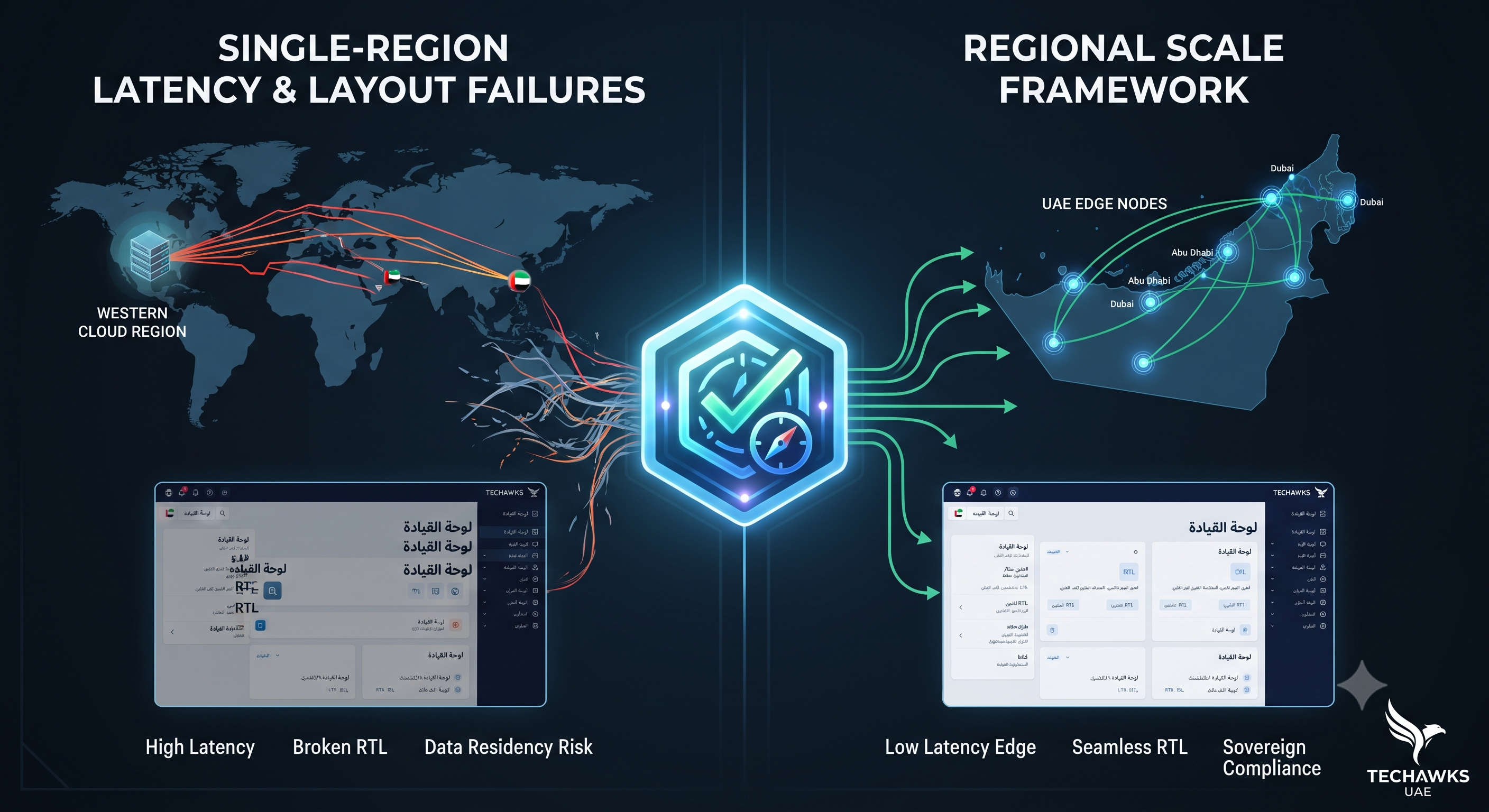
We have all been there: launching an application globally while assuming a single Western cloud region and left-to-right design will suffice everywhere. While rapid deployment is essential, treating localization and regional data governance as checkboxes leads to poor performance, compliance risks, and high user churn.
To transform a standard deployment into a robust, high-performance regional operation suited for the UAE's thriving digital economy, put every system through this rigorous 3-step challenge framework:
Step 1: The Local Edge & Low-Latency Routing Audit
Distant cloud regions introduce severe network latency for users accessing services from the Middle East. Before pushing any service live, audit your CDN and server placement. Ask yourself: Are our static assets and API endpoints cached at regional edge nodes within the UAE? Leverage local data centers and multi-region routing to ensure lightning-fast response times.
Step 2: The Bi-Directional UI & Localization Check
Supporting diverse linguistic communities requires more than simple text translation. Ensure your application architecture fully supports dynamic layout mirroring (LTR and RTL), proper font rendering for Arabic typography, and localized date, currency, and numerical formatting without breaking UI components.
Step 3: The Data Residency & Sovereign Compliance Pass
Many regional sectors and enterprise clients require data to remain strictly within domestic borders. Strip out cross-border logging vulnerabilities, implement local data residency storage policies, and ensure your cloud infrastructure complies with regional regulatory data protection standards.
The Challenge for Today:
Open your application's deployment topology and frontend codebase. Test your UI layout in an RTL configuration and check your primary database hosting region. If your data is stored thousands of miles away or your UI breaks under localized text, refactor your architecture before regional users experience the lag.
Key Takeaways
Optimize for Edge Latency: Deploy services and edge caching nodes close to your regional users to eliminate network lag.
Master Bi-Directional Design: Build robust UI systems that seamlessly handle RTL layouts, localized typography, and regional formatting.
Ensure Data Residency: Comply with local regulatory frameworks by keeping sensitive data stored within domestic cloud regions.
CTA (Join Techawks UAE)
Want to elevate your technical architecture and connect with innovators across the UAE tech ecosystem? Join Techawks UAE today to share regional scaling patterns, tackle weekly engineering challenges, and build world-class products together.
We have all been there: launching an application globally while assuming a single Western cloud region and left-to-right design will suffice everywhere. While rapid deployment is essential, treating localization and regional data governance as checkboxes leads to poor performance, compliance risks, and high user churn.
To transform a standard deployment into a robust, high-performance regional operation suited for the UAE's thriving digital economy, put every system through this rigorous 3-step challenge framework:
Step 1: The Local Edge & Low-Latency Routing Audit
Distant cloud regions introduce severe network latency for users accessing services from the Middle East. Before pushing any service live, audit your CDN and server placement. Ask yourself: Are our static assets and API endpoints cached at regional edge nodes within the UAE? Leverage local data centers and multi-region routing to ensure lightning-fast response times.
Step 2: The Bi-Directional UI & Localization Check
Supporting diverse linguistic communities requires more than simple text translation. Ensure your application architecture fully supports dynamic layout mirroring (LTR and RTL), proper font rendering for Arabic typography, and localized date, currency, and numerical formatting without breaking UI components.
Step 3: The Data Residency & Sovereign Compliance Pass
Many regional sectors and enterprise clients require data to remain strictly within domestic borders. Strip out cross-border logging vulnerabilities, implement local data residency storage policies, and ensure your cloud infrastructure complies with regional regulatory data protection standards.
The Challenge for Today:
Open your application's deployment topology and frontend codebase. Test your UI layout in an RTL configuration and check your primary database hosting region. If your data is stored thousands of miles away or your UI breaks under localized text, refactor your architecture before regional users experience the lag.
Key Takeaways
Optimize for Edge Latency: Deploy services and edge caching nodes close to your regional users to eliminate network lag.
Master Bi-Directional Design: Build robust UI systems that seamlessly handle RTL layouts, localized typography, and regional formatting.
Ensure Data Residency: Comply with local regulatory frameworks by keeping sensitive data stored within domestic cloud regions.
CTA (Join Techawks UAE)
Want to elevate your technical architecture and connect with innovators across the UAE tech ecosystem? Join Techawks UAE today to share regional scaling patterns, tackle weekly engineering challenges, and build world-class products together.
Stop Building Without Localization Guardrails: The 3-Step Multi-Regional Architecture Framework for UAE Tech Scale-Ups
We have all been there: launching an application globally while assuming a single Western cloud region and left-to-right design will suffice everywhere. While rapid deployment is essential, treating localization and regional data governance as checkboxes leads to poor performance, compliance risks, and high user churn.
To transform a standard deployment into a robust, high-performance regional operation suited for the UAE's thriving digital economy, put every system through this rigorous 3-step challenge framework:
Step 1: The Local Edge & Low-Latency Routing Audit
Distant cloud regions introduce severe network latency for users accessing services from the Middle East. Before pushing any service live, audit your CDN and server placement. Ask yourself: Are our static assets and API endpoints cached at regional edge nodes within the UAE? Leverage local data centers and multi-region routing to ensure lightning-fast response times.
Step 2: The Bi-Directional UI & Localization Check
Supporting diverse linguistic communities requires more than simple text translation. Ensure your application architecture fully supports dynamic layout mirroring (LTR and RTL), proper font rendering for Arabic typography, and localized date, currency, and numerical formatting without breaking UI components.
Step 3: The Data Residency & Sovereign Compliance Pass
Many regional sectors and enterprise clients require data to remain strictly within domestic borders. Strip out cross-border logging vulnerabilities, implement local data residency storage policies, and ensure your cloud infrastructure complies with regional regulatory data protection standards.
The Challenge for Today:
Open your application's deployment topology and frontend codebase. Test your UI layout in an RTL configuration and check your primary database hosting region. If your data is stored thousands of miles away or your UI breaks under localized text, refactor your architecture before regional users experience the lag.
Key Takeaways
Optimize for Edge Latency: Deploy services and edge caching nodes close to your regional users to eliminate network lag.
Master Bi-Directional Design: Build robust UI systems that seamlessly handle RTL layouts, localized typography, and regional formatting.
Ensure Data Residency: Comply with local regulatory frameworks by keeping sensitive data stored within domestic cloud regions.
CTA (Join Techawks UAE)
Want to elevate your technical architecture and connect with innovators across the UAE tech ecosystem? Join Techawks UAE today to share regional scaling patterns, tackle weekly engineering challenges, and build world-class products together.

 Arabic
 French
 Spanish
 Portuguese
 Deutsch
 Turkish
 Dutch
Dutch
 Italiano
 Russian
 Romaian
 Portuguese (Brazil)
 Greek
Greek