


Stop Ignoring Data Residency: The 3-Step Compliance Framework for Canadian Tech Scale-Ups
We have all been there: launching a digital product on a standard global cloud configuration, assuming that data storage locations do not matter as long as the service runs fast. While rapid deployment is essential, treating Canadian privacy legislation and cross-border data routing as an afterthought leaves your organization vulnerable to regulatory penalties and lost enterprise trust.
To transform data compliance from a barrier into a secure, competitive advantage for Canada's tech ecosystem, put every system through this rigorous 3-step challenge framework:
Step 1: The Cloud Region & Data Residency Audit
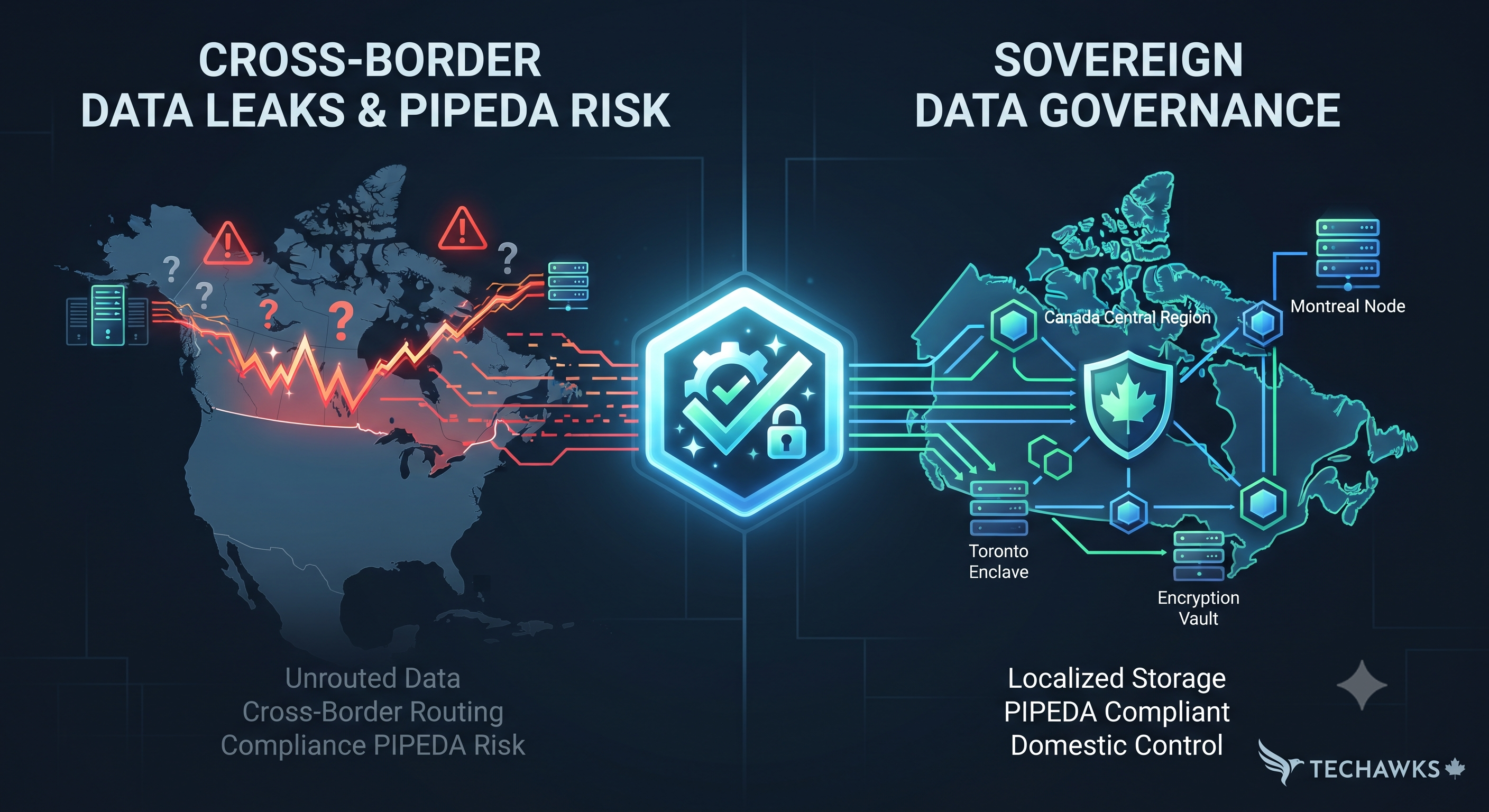
Default cloud configurations often replicate database backups or route traffic across international borders without explicit developer awareness. Before signing your next client, audit your exact data storage and backup locations. Ask yourself: Is all sensitive user data strictly housed within Canadian cloud regions (such as AWS Canada Central or GCP Montreal/Toronto)? Strip out cross-border replication vectors for protected data.
Step 2: The PIPEDA & Provincial Privacy Compliance Check
Complying with the Personal Information Protection and Electronic Documents Act (PIPEDA)—along with stringent provincial equivalents like Quebec's Law 25—requires rigorous consent management and transparent data handling practices. Implement automated data inventory mapping so you can instantly verify how personal information is collected, used, and disclosed within Canadian jurisdictions.
Step 3: The Cross-Border Transfer & Encryption Pass
If data must transit outside Canadian borders for specialized third-party processing, ensure it is protected by robust end-to-end encryption with keys managed exclusively within domestic control. Strip out unencrypted third-party analytics trackers that inadvertently leak personal identifiers to foreign servers.
The Challenge for Today:
Open your cloud provider's database management console and check the physical region of your primary storage buckets and read replicas. If a single byte of sensitive Canadian user data is sitting outside domestic borders, refactor your infrastructure deployment script immediately.
Key Takeaways
Secure Domestic Storage: Never rely on default cloud routing; explicitly pin your primary databases and backups to Canadian cloud regions.
Master Compliance Frameworks: Align your data governance tightly with PIPEDA and provincial privacy laws to win enterprise and public sector trust.
Control Cross-Border Transit: Enforce strict end-to-end encryption and eliminate unvetted third-party trackers that leak user data internationally.
CTA (Join Techawks Canada)
Want to elevate your engineering standards and connect with innovators across the Canadian tech ecosystem? Join Techawks Canada today to share governance patterns, tackle weekly engineering challenges, and build secure, trusted software together.
We have all been there: launching a digital product on a standard global cloud configuration, assuming that data storage locations do not matter as long as the service runs fast. While rapid deployment is essential, treating Canadian privacy legislation and cross-border data routing as an afterthought leaves your organization vulnerable to regulatory penalties and lost enterprise trust.
To transform data compliance from a barrier into a secure, competitive advantage for Canada's tech ecosystem, put every system through this rigorous 3-step challenge framework:
Step 1: The Cloud Region & Data Residency Audit
Default cloud configurations often replicate database backups or route traffic across international borders without explicit developer awareness. Before signing your next client, audit your exact data storage and backup locations. Ask yourself: Is all sensitive user data strictly housed within Canadian cloud regions (such as AWS Canada Central or GCP Montreal/Toronto)? Strip out cross-border replication vectors for protected data.
Step 2: The PIPEDA & Provincial Privacy Compliance Check
Complying with the Personal Information Protection and Electronic Documents Act (PIPEDA)—along with stringent provincial equivalents like Quebec's Law 25—requires rigorous consent management and transparent data handling practices. Implement automated data inventory mapping so you can instantly verify how personal information is collected, used, and disclosed within Canadian jurisdictions.
Step 3: The Cross-Border Transfer & Encryption Pass
If data must transit outside Canadian borders for specialized third-party processing, ensure it is protected by robust end-to-end encryption with keys managed exclusively within domestic control. Strip out unencrypted third-party analytics trackers that inadvertently leak personal identifiers to foreign servers.
The Challenge for Today:
Open your cloud provider's database management console and check the physical region of your primary storage buckets and read replicas. If a single byte of sensitive Canadian user data is sitting outside domestic borders, refactor your infrastructure deployment script immediately.
Key Takeaways
Secure Domestic Storage: Never rely on default cloud routing; explicitly pin your primary databases and backups to Canadian cloud regions.
Master Compliance Frameworks: Align your data governance tightly with PIPEDA and provincial privacy laws to win enterprise and public sector trust.
Control Cross-Border Transit: Enforce strict end-to-end encryption and eliminate unvetted third-party trackers that leak user data internationally.
CTA (Join Techawks Canada)
Want to elevate your engineering standards and connect with innovators across the Canadian tech ecosystem? Join Techawks Canada today to share governance patterns, tackle weekly engineering challenges, and build secure, trusted software together.
Stop Ignoring Data Residency: The 3-Step Compliance Framework for Canadian Tech Scale-Ups
We have all been there: launching a digital product on a standard global cloud configuration, assuming that data storage locations do not matter as long as the service runs fast. While rapid deployment is essential, treating Canadian privacy legislation and cross-border data routing as an afterthought leaves your organization vulnerable to regulatory penalties and lost enterprise trust.
To transform data compliance from a barrier into a secure, competitive advantage for Canada's tech ecosystem, put every system through this rigorous 3-step challenge framework:
Step 1: The Cloud Region & Data Residency Audit
Default cloud configurations often replicate database backups or route traffic across international borders without explicit developer awareness. Before signing your next client, audit your exact data storage and backup locations. Ask yourself: Is all sensitive user data strictly housed within Canadian cloud regions (such as AWS Canada Central or GCP Montreal/Toronto)? Strip out cross-border replication vectors for protected data.
Step 2: The PIPEDA & Provincial Privacy Compliance Check
Complying with the Personal Information Protection and Electronic Documents Act (PIPEDA)—along with stringent provincial equivalents like Quebec's Law 25—requires rigorous consent management and transparent data handling practices. Implement automated data inventory mapping so you can instantly verify how personal information is collected, used, and disclosed within Canadian jurisdictions.
Step 3: The Cross-Border Transfer & Encryption Pass
If data must transit outside Canadian borders for specialized third-party processing, ensure it is protected by robust end-to-end encryption with keys managed exclusively within domestic control. Strip out unencrypted third-party analytics trackers that inadvertently leak personal identifiers to foreign servers.
The Challenge for Today:
Open your cloud provider's database management console and check the physical region of your primary storage buckets and read replicas. If a single byte of sensitive Canadian user data is sitting outside domestic borders, refactor your infrastructure deployment script immediately.
Key Takeaways
Secure Domestic Storage: Never rely on default cloud routing; explicitly pin your primary databases and backups to Canadian cloud regions.
Master Compliance Frameworks: Align your data governance tightly with PIPEDA and provincial privacy laws to win enterprise and public sector trust.
Control Cross-Border Transit: Enforce strict end-to-end encryption and eliminate unvetted third-party trackers that leak user data internationally.
CTA (Join Techawks Canada)
Want to elevate your engineering standards and connect with innovators across the Canadian tech ecosystem? Join Techawks Canada today to share governance patterns, tackle weekly engineering challenges, and build secure, trusted software together.

 English
 Arabic
 French
 Spanish
 Portuguese
 Turkish
 Dutch
Dutch
 Italiano
 Russian
 Romaian
 Portuguese (Brazil)
 Greek
Greek